Saint Bathild (also spelled Balthild or Bathilda) was a young Saxon woman sold as a slave in Gaul who became queen of the Franks through her marriage to King Clovis II, then regent of the kingdom during her son's childhood. She fought the trade in captives, supported many monasteries and founded the abbeys of Corbie and Chelles, where she ended her life among the nuns. She died on January 30, 680, and her feast day is January 30.
Who was Saint Bathild?
Bathild was born around 630. Her main biography, a Latin Life written shortly after her death, says that she came "from across the sea" and was "of the race of the Saxons." She most likely came from the parts of Britain settled by the Saxons.
She arrived in Gaul as a slave, sold "at a cheap price." Her biographer saw in this the hand of God, who lifts up the lowly. A later version of her story gives her a noble origin, but without any details.
Bathild was bought by Erchinoald, mayor of the palace of Neustria, who took her into his household. Erchinoald presented her to the young king Clovis II, son of King Dagobert, who married her shortly after 648. A chronicle of the time calls her a "wise and refined queen."
Queen and regent of the Franks
Clovis II and Bathild had several children, including three future kings: Clotaire III, Childeric II and Theuderic III. When Clovis II died in 657, his sons were still small children. Bathild fought to keep the throne for the eldest, Clotaire III, and became regent of the kingdom of Neustria and Burgundy.
She governed surrounded by bishops, such as Saint Ouen of Rouen and Saint Eligius of Noyon, and in 662 she succeeded in having her son Childeric II recognized as king of Austrasia.
A debated reputation
Her rule did not escape the harshness of the age. Anglo-Saxon sources, the Life of Saint Wilfrid and Saint Bede the Venerable, accuse her of having several bishops put to death, among them Aunemund, bishop of Lyon. Modern historians consider these accusations hard to prove and tend to attribute such violence to the mayor of the palace Ebroin, known for his brutality. Bathild remains a debated figure, and it is more honest to say so than to hide it.
A former slave against the slave trade
Having been a slave herself, Bathild acted on behalf of captives. At the request of the pope, she forbade the sale of Christian captives within the kingdom. With her own money she bought the freedom of many captives, whom she set free or placed in monasteries. The Council of Chalon-sur-Saône gave these measures the force of Church law.
She also freed heads of families imprisoned for tax debts and fought against a head tax that reportedly drove some families to let their newborn children die.
Reformer and founder of abbeys
Bathild also fought simony, the buying and selling of Church offices, in the spirit of the reform of Saint Gregory the Great. She showered gifts on the great abbeys of the kingdom, such as Saint-Denis, Saint-Martin of Tours, Jumièges, Saint-Wandrille, Luxeuil and Jouarre. She herself founded the abbey of Corbie, in Picardy, and the abbey of Chelles, near Paris.
The nun of Chelles
In 664 her son Clotaire III came of age, and the great nobles of the kingdom reclaimed their independence. Violence grew around the queen: around 665 the bishop of Paris, one of her advisers, was murdered. Refusing open conflict, Bathild withdrew to the abbey of Chelles, which she had placed under the direction of Abbess Bertilla. There she lived humbly among the nuns, without any political role, perhaps without ever taking vows.
She died on January 30, 680, at about fifty years of age. Her funeral was nothing more than a simple office sung by the nuns. Her cult spread quickly and her tomb became a place of veneration. On March 17, 833, her remains were moved to a new chapel. The Alfred-Bonno museum in Chelles still keeps garments that belonged to her, including an embroidered tunic.
Why is Saint Bathild invoked for victims of trafficking?
Bathild knew both extremes of the human condition: slavery and the crown. Once she held power, she remembered those who were being sold as she had been, and she put her authority at the service of captives, the poor and the Church. In the end she gave up power for prayer.
For this reason she is prayed to today for victims of human trafficking and modern slavery, for people who hold positions of responsibility, and for those who must step down from power. Her story echoes that of Saint Josephine Bakhita, the Sudanese former slave who has become the Church's great intercessor for trafficking victims.
Symbols and how to recognize Saint Bathild in art
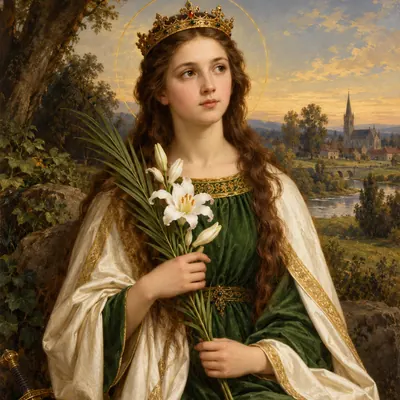
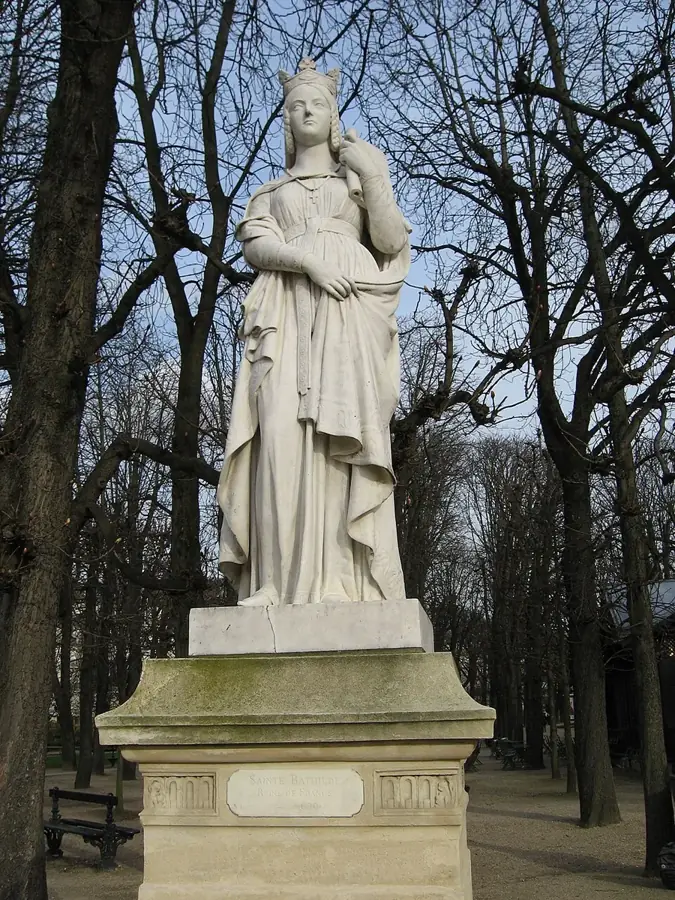
- The crown: she is usually shown as a crowned queen, as in the Chronicles of Saint-Denis or the marble statue in the Luxembourg Garden in Paris.
- The abbess's habit and the book: other images show her in monastic dress, holding a book, recalling her last years at Chelles.
- The ladder: the Golden Legend reports that at her death she saw a ladder set up before the altar of the Virgin Mary and rising to heaven. It is only a legend, but the ladder appears today on the coat of arms of the town of Chelles.
- The young slave: some paintings show the scene of her sale, such as Saint Bathild Sold to Erchinoald by Guy-Louis Vernansal (1700).
Where to pray to Saint Bathild
- Chelles (east of Paris): the church of Saint-André and the Alfred-Bonno museum, which keep her memory and objects that belonged to her.
- Corbie (Picardy): the abbey church of Saint-Pierre, which she founded, with a 14th-century statue of the queen.
- Vanves (near Paris): the priory of the Benedictine Sisters of Saint Bathild.
- Paris: her statue in the chapel of the queens of France in the Basilica of the Sacred Heart (Sacré-Cœur), and another in the Luxembourg Garden.
To pray with her, read the prayer to Saint Bathild or follow the novena to Saint Bathild.
Discover also
- Saint Clotilde, another queen of the Franks, whose oratory at Chelles Bathild enlarged.
- Saint Eligius, bishop of Noyon and one of her advisers.
- Saint Ouen of Rouen, another adviser of the regent.
- Saint Leger of Autun, whom she made bishop of Autun.
- Saint Josephine Bakhita, another saint who had been a slave.