Saint Basil the Elder was a Christian of Asia Minor in the 4th century, a renowned rhetorician of Pontus, son of Saint Macrina the Elder and husband of Saint Emmelia. He is known above all as the father of an exceptional family: among his children were Saint Basil the Great, Saint Gregory of Nyssa, Saint Peter of Sebaste and Saint Macrina the Younger. He died around the middle of the 4th century, and is celebrated on May 30 with his wife.
Who was Saint Basil the Elder?
Basil the Elder left no writings, and his life was never the subject of a separate account. What we know about him comes from a few passages by his children and by their friend Saint Gregory of Nazianzus, who mention the family in their sermons and letters. The information is therefore scanty, and some details, such as the dates of his birth and death, remain uncertain. But these testimonies are enough to sketch the portrait of a Christian layman esteemed for his virtue, a cultivated man and a father who knew how to hand on the faith he had received from his own mother. The Church honors him with his wife Emmelia as a model of a Christian couple and family.

The son of a confessor of the faith
Basil grew up in a Christian family of Pontus. His mother, Macrina the Elder, had been formed in the faith through the tradition of Saint Gregory the Wonderworker, the great bishop of Neocaesarea. At the beginning of the 4th century, under persecution, the family had to flee and hide for several years in the forests of Pontus, at the cost of great hardship. Gregory of Nazianzus, in the funeral oration he devoted to Basil the Great, recalls this trial as a glory of the family. The young Basil thus knew, as a child or young man, what faithfulness to Christ can cost.
A rhetorician esteemed for his virtue
Once peace had returned to the Church, Basil became a teacher of rhetoric and an advocate known throughout Pontus. The testimonies insist less on his successes than on his uprightness: he was regarded as a good man, and his learning was at the service of his faith. He married Emmelia, a young woman from a wealthy and deeply Christian family. The couple lived in some comfort, between the city and the family estate of Annesi, on the banks of the river Iris.
The father of a family of saints
Basil and Emmelia had nine or ten children, depending on the sources. Five of them are venerated as saints: Macrina the Younger, the eldest, who founded a community of virgins; Basil, bishop of Caesarea and Doctor of the Church; Naucratius, who lived as a hermit; Gregory, bishop of Nyssa and a great theologian; and Peter, the youngest, bishop of Sebaste. The father himself took charge of part of his sons' education, in particular Basil's, whom he taught the first elements of letters. But it was above all the climate of faith in the home, kept alive by him, by Emmelia and by grandmother Macrina, that formed these children.
Basil the Elder died around the middle of the 4th century, while his youngest children were still small. After his death, Emmelia and her daughter Macrina chose a life of prayer and poverty, and the estate of Annesi became a consecrated community.
His cult
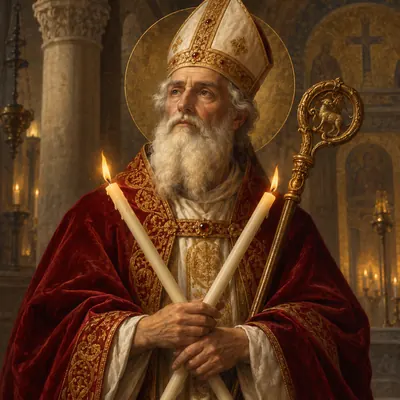
Basil the Elder is honored as a saint together with his wife Emmelia on May 30, in the Catholic Church as in the Orthodox Churches. There is no known shrine of his own: his memory is inseparable from that of his family and of the places in Pontus and Cappadocia where his children lived. In art he rarely appears alone; he is rather found in depictions of the family of Saint Basil.

What can we learn from Saint Basil the Elder?
Basil the Elder founded no monastery and wrote no treatise. His holiness is that of a layman, a husband and a father, who lived his faith in his work and in his home. He shows that the family is the first place where faith is handed on, and that a father can prepare, without knowing it, the holiness of his children. You can pray to him for fathers, for couples, for teachers and for all who have the task of educating.
To pray with him, see the prayer to Saint Basil the Elder and the novena to Saint Basil the Elder.
Where to pray to Saint Basil the Elder
- Niksar (Turkey): ancient Neocaesarea of Pontus, where he worked as a rhetorician.
- Kayseri (Turkey): ancient Caesarea of Cappadocia, the episcopal city of his son Basil the Great.
- In any church, especially when praying for families, since no shrine is specially dedicated to him.
Discover also
- Saint Macrina the Elder, his mother, a confessor of the faith.
- Saint Basil the Great, his son, bishop and Doctor of the Church.
- Saint Macrina the Younger, his eldest daughter.
- Saint Peter of Sebaste, the youngest of his children.