Saint Athanasius of Alexandria, called "the Great", was born in Egypt around 298 and died in Alexandria on May 2, 373. Bishop of Alexandria for forty-five years, he was the chief defender of the faith of the Council of Nicaea against Arianism, to the point of being driven from his see five times. A Father and Doctor of the Church and the author of the Life of Saint Antony, he is celebrated on May 2.
Who was Saint Athanasius?
Athanasius lived through the passage from a persecuted Church to a Church protected by the emperors. This change did not bring peace: in the 4th century, the teaching of the priest Arius, who made the Son of God a creature, deeply divided Christians and found support at the imperial court. Athanasius devoted his whole life to defending the faith proclaimed at Nicaea in 325: the Son is true God, of the same substance as the Father. He was nicknamed "Athanasius against the world", because at times he seemed almost alone in holding firm. His energetic, sometimes rough temperament earned him enemies, but also the unfailing loyalty of the people of Alexandria and the monks of Egypt. The Catholic Church counts him among its Fathers and Doctors; the Eastern Churches venerate him as one of their greatest teachers.

Secretary to Bishop Alexander
Athanasius received a solid Greek education in Alexandria, literary and philosophical. He entered the clergy of the city young, serving as a lector, then became a deacon and the trusted assistant of Bishop Alexander. This was the moment the Arian crisis broke out: Arius, a priest of Alexandria, taught that the Son is not eternal like the Father. A synod condemned him around 321, and Athanasius probably wrote the letter setting out its reasons to the other bishops. In 325, he accompanied Alexander to the Council of Nicaea, which proclaimed that the Son is "consubstantial with the Father". Before dying in 328, Alexander designated him as his successor.
Five exiles for the faith of Nicaea
As soon as he was elected, Athanasius toured his immense diocese as far as Upper Egypt; he ordained as a priest Abbot Pachomius, the father of communal monastic life. But the supporters of Arius regained favor at court, allied with the schismatic party of Meletius. They accused Athanasius of violence and even of having had a bishop, Arsenius, murdered; Arsenius was found alive. In 335, the Synod of Tyre condemned him all the same, and Constantine exiled him to Trier, on the Moselle, where Bishop Maximinus welcomed him.
Back in 337, he was driven out again in 339 and took refuge in Rome. Pope Julius I received him into his communion and a Roman synod declared him innocent. The Council of Serdica, in 343, confirmed this decision. He returned in triumph to Alexandria in 346 and spent ten fruitful years there. In 356, under Emperor Constantius II, soldiers burst into the church where he was celebrating a vigil; he escaped and hid for six years among the monks of the desert, who protected him. It was then that he wrote several of his great works. Emperor Julian, an enemy of Christians, exiled him in turn in 362; Valens drove him out one last time in 365. In all, Athanasius spent about seventeen years far from his Church.
Friend of the monks and author of the Life of Antony
Athanasius understood very early the importance of the monks who peopled the deserts of Egypt. He supported them and bound them to the Church. After the death of Saint Antony in 356, he wrote the Life of Antony, which made the father of monks known throughout the Christian world and became a model of monastic life. This book left its mark on generations: Saint Augustine tells how the story of this life played a part in his own conversion. Athanasius is also the author of major theological treatises, such as On the Incarnation of the Word, and of letters in which he was the first to affirm clearly the full divinity of the Holy Spirit. He summed up his thought in a famous sentence: the Word of God became man so that we might become God.
The last years and the cult
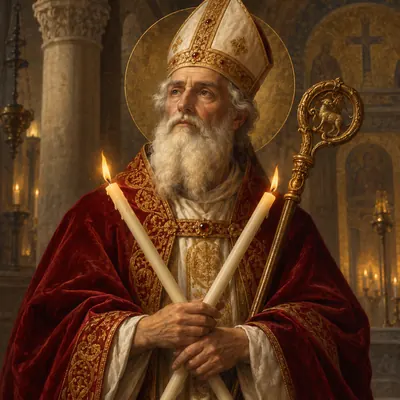
Back for good in 366, Athanasius devoted his last years to the peace of the Church. He supported Saint Basil of Caesarea through his letters and opposed the errors of Apollinaris of Laodicea. In 368, he celebrated forty years as bishop. He died on May 2, 373, after designating his successor, Peter. His relics have been venerated in Venice, in the church of San Zaccaria; in 1973, part of them was given to the Coptic Church and rests in Cairo, in St. Mark's Cathedral. The Catholic Church celebrates him on May 2, the Byzantine Churches on January 18. He is depicted in the vestments of an Eastern bishop, often with the Book of the Gospels.
What can we learn from Saint Athanasius?
Athanasius reminds us that faith in Christ, true God and true man, is not a detail of theology: it is at the heart of salvation. If Christ were not God, he said, man would not be saved. He held firm when almost everyone was giving way, without ever abandoning his Church or his faithful. We can pray to him to keep the faith in times of confusion, for those who are exiled or unjustly accused, and for monks and nuns.
Where to pray to Saint Athanasius
- Church of San Zaccaria (Venice): his relics rest there in a marble altar, beside those of Saint Zechariah.
- St. Mark's Cathedral (Cairo): the Coptic cathedral that received part of his relics in 1973.
- Trier (Germany): the city of his first exile, where he was welcomed by Bishop Maximinus.
Discover also
- Saint Alexander of Alexandria, his teacher and predecessor, the first opponent of Arius.
- Saint Antony the Great, the father of monks, whose life he wrote.
- Saint Julius I, the pope who welcomed him in Rome.
- Saint Serapion of Thmuis, his friend, to whom he addressed his letters on the Holy Spirit.