Saint Aprunculus (Aproncule in French) was a Gallic bishop of the late 5th century. First bishop of Langres, he had to flee the Burgundian kingdom, where he was suspected of favoring the Franks, and took refuge in Auvergne. There he became bishop of Clermont, succeeding the famous Sidonius Apollinaris. He died around 491 and was buried at Clermont. His feast day is May 14.
Who was Saint Aprunculus?
Aprunculus lived at a time of great upheaval: the Western Roman Empire had disappeared in 476, and Gaul was divided between several kingdoms, Burgundian, Visigothic and Frankish. In this unstable world, bishops were often the last representatives of Roman order and the protectors of the cities. We know Aprunculus mainly through Saint Gregory of Tours, who tells his story in his History of the Franks, and through Sidonius Apollinaris, who mentions his family. These witnesses are brief, but they give the picture of a faithful bishop, forced into exile, then welcomed by another Church.
Bishop of Langres in the Burgundian kingdom
Aprunculus came from the Gallo-Roman aristocracy, like many bishops of his time. Sidonius Apollinaris, who knew him, specifies that his father came from Autun and his mother from Auvergne. He became bishop of Langres, a city then part of the kingdom of the Burgundians. They were Christians, but many followed Arianism, a doctrine that denied the full divinity of Christ. Catholic bishops in their territories were therefore in a delicate position, especially as the power of the Franks was growing to the north.
Exile in Auvergne
According to Gregory of Tours, the Burgundians came to suspect Aprunculus of wanting the Franks to rule and decided to have him killed. Warned of the danger, the bishop fled and reached Auvergne, then under Visigothic rule. Tradition sometimes connects this with King Gundobad and the Frankish king Clovis, but the political details remain uncertain. What is certain is that he had to leave everything to save his life, and that he was welcomed by the Church of Clermont.
Successor of Sidonius Apollinaris at Clermont
At Clermont, the bishop was then Sidonius Apollinaris, a great writer and statesman who had become a pastor. Gregory of Tours reports that before dying, Sidonius announced to his people that Aprunculus would be his successor. After his death, Aprunculus did indeed become bishop of Clermont. He governed this Church for a few years, until his death, which is generally placed in 491; some sources suggest a slightly earlier date. He was buried in the church of Saint-Étienne in Clermont, which has become the present church of Saint-Eutrope.
Devotion and art
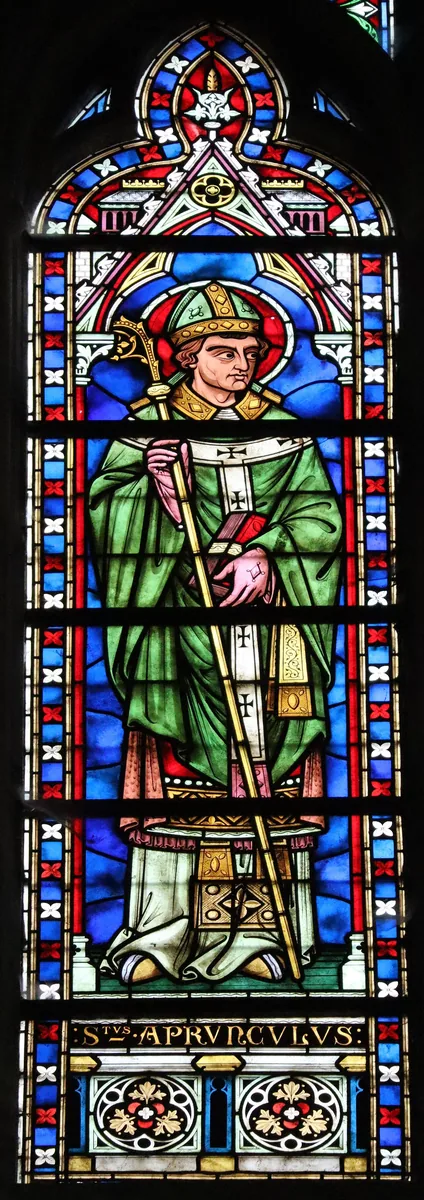
Saint Aprunculus is honored as a saint by the Catholic Church and the Orthodox Church, and his feast is celebrated on May 14. His cult has remained mainly local, at Clermont and Langres. A stained glass window in the cathedral of Saint-Mammès in Langres shows him among the bishops of the city, with mitre and crozier. No known relic is the object of particular veneration today.

What can we learn from Saint Aprunculus?
Saint Aprunculus knew the trial of exile: driven from his city by threats, he found refuge in another Church that welcomed him and gave him a new mission. His life shows that God can bring about a new service in the very midst of uprooting. You can pray to him for refugees and exiles, for bishops living in difficult political situations, and for the dioceses of Langres and Clermont.
To pray with him, see the prayer to Saint Aprunculus and the novena to Saint Aprunculus.
Where to pray to Saint Aprunculus
- Clermont-Ferrand (Puy-de-Dôme): the church of Saint-Eutrope, heir to the church of Saint-Étienne where he was buried.
- Langres (Haute-Marne): the cathedral of Saint-Mammès, where a stained glass window shows him.
Discover also
- Saint Sidonius Apollinaris, bishop of Clermont, who announced him as his successor.
- Saint Gregory of Tours, the historian who passed on his story.
- Saint Austremonius, first bishop of Clermont.