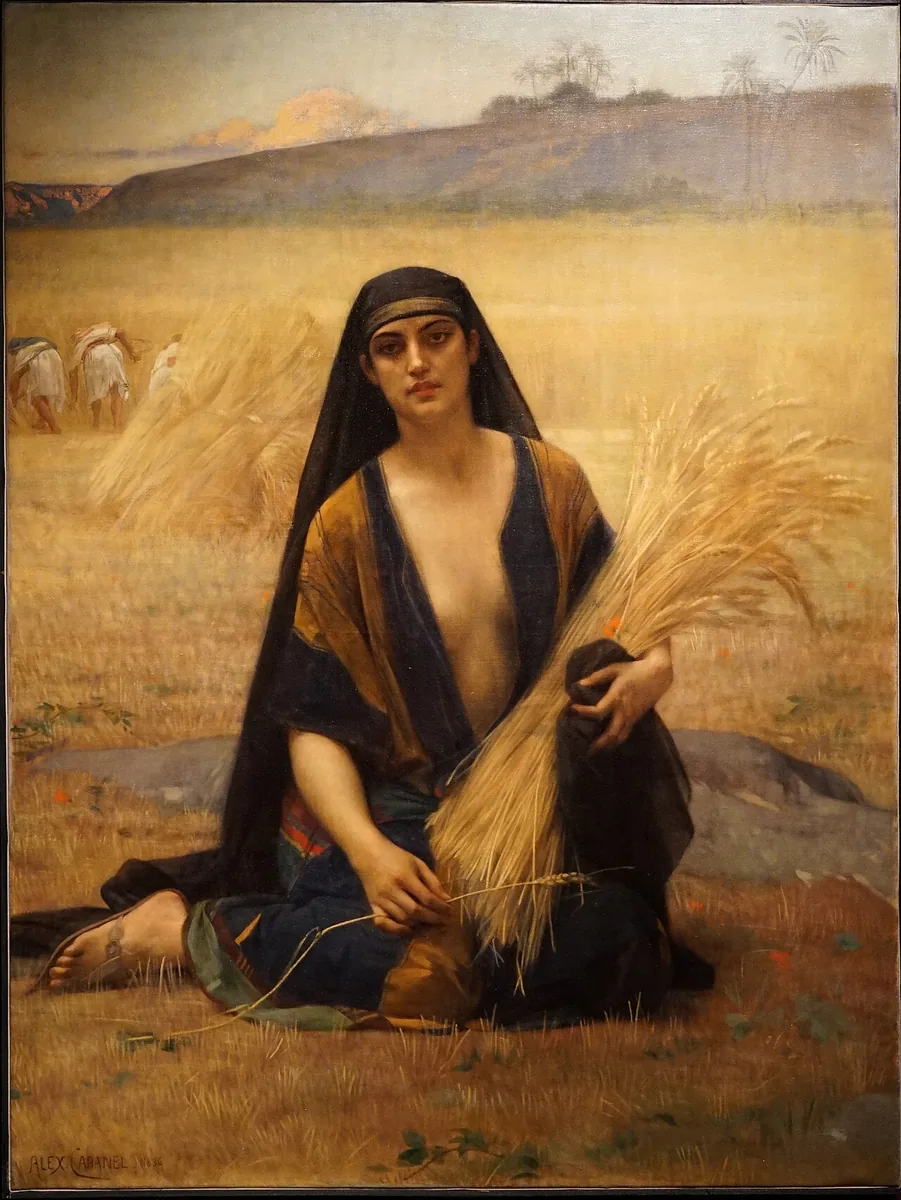
Ruth is the heroine of one of the most beautiful books of the Bible, a short story of four chapters. A young woman of Moab, a foreign people, she is widowed and chooses not to abandon her mother-in-law Naomi, also a widow and childless: "Wherever you go I will go; your people shall be my people, and your God my God." In Bethlehem she gleans in the fields of Boaz, who marries her. She becomes the great-grandmother of King David, and Saint Matthew names her among the ancestors of Jesus.
Who was Ruth?
The book of Ruth is set "in the days when the judges ruled," around the eleventh century BC, but it was probably written much later. A family from Bethlehem, Elimelech, his wife Naomi and their two sons, settles in the land of Moab, east of the Dead Sea, to escape a famine. The two sons marry Moabite women, Orpah and Ruth. Then Elimelech and his two sons die. The three women find themselves widowed and without protection.
"Wherever you go I will go"
Naomi decides to return to Bethlehem and urges her daughters-in-law to go back to their mothers and start their lives again. Orpah kisses her mother-in-law and leaves. Ruth, however, clings to Naomi: "Do not press me to go back and abandon you! Wherever you go I will go, wherever you lodge I will lodge. Your people shall be my people and your God my God. Where you die I will die" (Ruth 1:16-17). These words of a foreign woman have become one of the most beautiful declarations of faithfulness in the Bible, often read at weddings.
In the field of Boaz
The two women arrive in Bethlehem at the beginning of the barley harvest. To feed Naomi, Ruth goes gleaning, that is, gathering the ears left behind by the harvesters, as the law allowed the poor and foreigners to do. She comes to the field of Boaz, a wealthy relative of Elimelech. Boaz has heard of her kindness to her mother-in-law: he protects her, has her eat with his servants and asks that ears be dropped on purpose for her. "May the Lord reward what you have done," he tells her.
Marriage and descendants
On Naomi's advice, Ruth goes to Boaz at night on the threshing floor and asks him to act as her "redeemer," the kinsman bound to raise up the name of a dead relative. Boaz agrees, settles the matter before the elders at the city gate and marries Ruth. They have a son, Obed. The women of Bethlehem tell Naomi: "Your daughter-in-law who loves you is worth more to you than seven sons." Obed would be the father of Jesse, the father of David.
Why do Christians honor Ruth?
Ruth is the figure of faithfulness, the Hebrew word "hesed," the love that stays when nothing obliges it to. She also shows that God welcomes the foreigner: a Moabite, from a people long rejected, becomes the ancestor of King David and of the Messiah. Saint Matthew names her in the genealogy of Jesus, among only five women (Matthew 1:5). People pray with Ruth for faithfulness in families, for widows, for relationships between mothers-in-law and daughters-in-law, and for foreigners and migrants.
To pray with her, read the prayer with Ruth the Moabite, or follow the novena with Ruth.
Discover also
- King David, her great-grandson.
- Queen Esther, another great woman of the Old Testament.
- The Blessed Virgin Mary, named with Ruth in the genealogy of Jesus.
- Abraham, who also left his country to follow God.