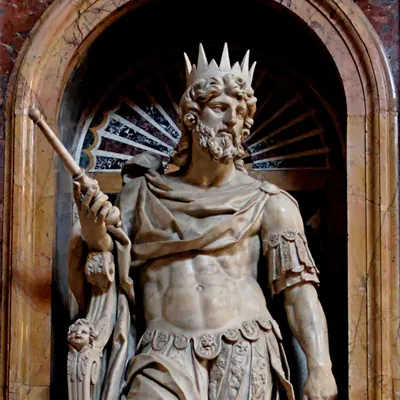
Solomon, son of King David and Bathsheba, reigned over Israel in the tenth century BC. At the start of his reign he asked God neither for riches nor for a long life, but for "a listening heart" to govern his people well. His wisdom became legendary, from the famous judgment between two mothers to the visit of the Queen of Sheba. In Jerusalem he built the first Temple, God's house in the midst of his people. But the end of his reign was darkened by idolatry. Tradition attributes several books of the Bible to him, including Proverbs, the Song of Songs and Wisdom.
Who was King Solomon?
Solomon was born in Jerusalem around 990 BC. He was the son of David and Bathsheba, the wife of Uriah whom David had taken after having her husband killed; the prophet Nathan gave him the name Jedidiah, "beloved of the Lord." When David died, around 970, Solomon succeeded him and reigned for about forty years. His name comes from "shalom," peace: his reign was a time of peace and prosperity, the most brilliant in the history of Israel.
"Give your servant a listening heart"
At Gibeon, God appeared to Solomon in a dream: "Ask something of me and I will give it to you." The young king answered: "I am a mere youth, not knowing at all how to act. Give your servant a listening heart to judge your people and to distinguish between good and evil" (1 Kings 3:9). God was pleased with this request: because he had asked neither for a long life, nor for riches, nor for the death of his enemies, he would receive wisdom, and everything else besides.
The judgment of Solomon
Two women come before the king. They live in the same house and have each given birth to a child; one child has died, and each woman claims the living one is hers. Solomon calls for a sword: "Cut the living child in two, and give half to one woman and half to the other." One agrees; the other cries out: "Give her the living baby, but spare its life!" The king recognizes the true mother by her love and gives her back her son (1 Kings 3:16-28). Ever since, people speak of "a judgment of Solomon."
The Temple of Jerusalem
David had wanted to build a house for God; it was Solomon who built it, in seven years, on Mount Moriah, with cedar from Lebanon and the help of King Hiram of Tyre. The ark of the covenant was placed in it, and the cloud of God's glory filled the Temple. Solomon then prayed for the whole people, and even for the foreigner who would come to pray there: "The heavens and the highest heavens cannot contain you, much less this house which I have built!" (1 Kings 8:27). The Queen of Sheba came from afar to test his wisdom and left full of wonder.
The fall of a wise man
The Bible does not hide the shadows of this reign. Solomon amassed riches, imposed heavy forced labor on the people and married many foreign wives. In his old age he let himself be led into building shrines to their gods: "his heart was not entirely with the Lord" (1 Kings 11:4). At his death, around 931, the kingdom split in two. The wisest of kings thus shows that wisdom received must be guarded each day by faithfulness.
Why do Christians remember King Solomon?
Solomon is first of all the man of one prayer: asking for wisdom rather than success. The Church does not celebrate him in the Roman calendar, but the Eastern Churches honor him with the ancestors of Christ on the Sunday of the Holy Forefathers, before Christmas. Jesus mentions him twice: "Not even Solomon in all his splendor was clothed like one of the lilies of the field," and "there is something greater than Solomon here." People pray with him to ask for wisdom before a decision, an exam or a new responsibility, or for those who govern and judge.
To pray with him, read the prayer for wisdom with King Solomon, or follow the novena with King Solomon.
Discover also
- King David, his father, who prepared the building of the Temple.
- Job, another great figure of the wisdom books.
- The prophet Isaiah, who had his vision of God in Solomon's Temple.
- Saint Thomas Aquinas, Doctor of the Church who asked for wisdom every day.