Saint Walstan (or Walston) was an English farm laborer of the early 11th century, venerated in Norfolk as the patron of farmers, farm workers and farm animals. Born at Bawburgh, or at Blythburgh according to another tradition, he died in 1016 while mowing a meadow at Taverham and was buried at Bawburgh, near Norwich. His feast day is May 30.
Who was Saint Walstan?
Walstan is a popular saint of East Anglia, whose cult grew up in the countryside around Norwich. He was neither a monk, nor a priest, nor a martyr: he was a layman who chose to live the Gospel through humble, hard work in the service of others. His life is known to us through medieval accounts, including an anonymous Life kept in the library of Lambeth Palace, and through later hagiographers such as Alban Butler. These texts, written long after his death, mix memories with the marvelous; the sources even disagree about his birthplace.

Choosing a humble life
According to Butler, Walstan was the son of well-off parents, whom tradition names Benedict and Blitha. Around the age of twelve, he left his family to become a farmhand at Taverham, a few miles away. He chose the hardest work, in a spirit of penance and humility. He fasted and spent long periods in prayer; the accounts also show him generous to the poor. He made a vow of celibacy, but remained a layman in the middle of the fields. The stories stress his kindness toward the animals in his care.
A death in the hayfield
The account tells that Walstan, sensing his end approaching, was visited by an angel while he was mowing hay. He died on the spot, on May 30, 1016. He had asked that his body be laid on a cart drawn by two oxen, and that they be allowed to go wherever they wished. The oxen led the procession to Bawburgh, where he was buried. Tradition adds that springs gushed forth at the places where the team stopped. Saint Walstan's Well, at Bawburgh, can still be seen today.
Devotion and art
The cult of Walstan arose spontaneously, carried by the devotion of country people. A chapel was added to the church of Saint Mary at Bawburgh, which took the name of Saint Mary and Saint Walstan. Throughout the Middle Ages, his shrine was a place of pilgrimage for farmers and farm workers, who came to entrust their animals and crops to him. The English Reformation put an end to this pilgrimage, but the memory of the saint did not disappear.
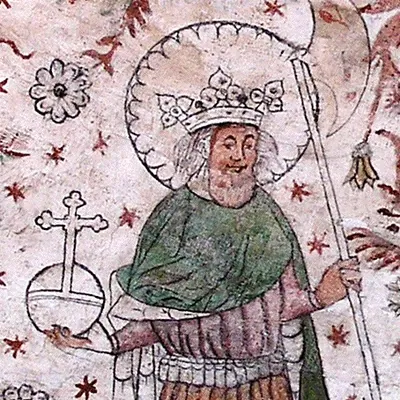
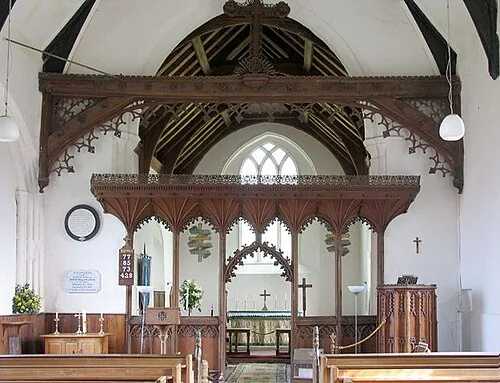
He is often shown crowned and holding a scepter, signs of the noble birth that legend gives him, but above all with a scythe in his hand and cattle beside him. Several painted rood screens in Norfolk and Suffolk show him this way. In modern times his cult has spread to Kent, Buckinghamshire and even Kenya. Every year at Bawburgh, a celebration in his honor takes place on the Sunday nearest to May 30.

What can we learn from Saint Walstan?
Walstan shows that one can become a saint in the most ordinary work. He founded neither a monastery nor any great work: he mowed, cared for animals, shared his bread and prayed. His life echoes that of Saint Isidore the Farmer, another layman made holy in the fields. You can pray to him for farmers, livestock breeders and farm workers, for those whose work is hard and little recognized, and for the care of creation.
Where to pray to Saint Walstan
- Bawburgh (Norfolk, England): the church of Saint Mary and Saint Walstan, now Anglican, and the well that bears his name.
- Taverham (Norfolk): the village where he worked and died.
- Rongai (Kenya): the church dedicated to him since 1988.
Discover also
- Saint Isidore the Farmer, a farm worker of Madrid and patron of farmers.
- Saint Edmund the Martyr, king of East Anglia, another great saint of this region.
- Saint Fiacre, hermit gardener and patron of market gardeners.