Saint Vulbas, also called Villebaud or Willebad (in Latin Vulbandus or Vibaldus), was a Burgundian nobleman of the 7th century. An officer of King Dagobert I, then patrician in Burgundy, he was murdered in 642 on the orders of the mayor of the palace Flaochad. He was venerated as a martyr, not for refusing to deny his faith, but for justice. His sarcophagus is kept in the church of the village in the Ain that bears his name, Saint-Vulbas. His feast day is May 10.
Who was Saint Vulbas?
Vulbas belongs to the world of the great lay nobles of the Merovingian age, men who served the Frankish kings in war and in government, some of whom were honored as saints after their death. The sources that speak of him are few. Chronicles of the Merovingian period mention a patrician named Willebad, caught up in the power struggles of Burgundy; the local tradition of the Bugey, collected in the 19th century by Father Jean-Irénée Depéry in his Hagiological History of Belley, kept the memory of his holiness and of his tomb. What can be said about his life is therefore brief, and part of it belongs to tradition rather than to certain history.

A nobleman in the service of the Frankish kings
According to the tradition collected by Depéry, Vulbas was born into a noble family of the kingdom of Burgundy, one of the great parts of the Frankish world in the 7th century. He first made a career in the army of King Dagobert I. He is credited with commanding the royal expedition against the Gascons, a people of the southwest who resisted Frankish rule. Returning victorious, he received the title of patrician, which made him one of the leading figures of Burgundy, with military and judicial duties.
Tradition presents him as a man of integrity, respected by the nobles of his region and attentive to the weak. It reports no miracles during his lifetime. His holiness, as it was understood after him, lies in the way he exercised power and in the unjust death he suffered.
A death for justice
When Dagobert died in 639, the nobles of Burgundy wished to be governed directly from Neustria, without a mayor of the palace of their own. Queen Nanthild, Dagobert's widow and regent for her son Clovis II, nevertheless appointed Flaochad mayor of the palace of Burgundy in 642. According to the traditional account, Flaochad saw Vulbas as a rival: the patrician's standing among the Burgundian nobles overshadowed him. He had him murdered that same year.
Tradition reports that Flaochad died in turn a few days later, in great suffering, and people of the time saw in it a judgment of God. Vulbas was then regarded as a martyr, not because he died confessing the faith before persecutors, but because he fell victim to the injustice and jealousy of the powerful. This form of holiness is found in other figures of the period, such as Saint Leger, bishop of Autun, a victim a few decades later of the mayor of the palace Ebroin.
The tomb at Saint-Vulbas
The monks of the monastery of Condat, today the abbey of Saint-Claude in the Jura, are said to have honored their benefactor by moving his body to a church in the Bugey, on the banks of the Rhône. The village took the saint's name: Saint-Vulbas, also found as Saint Villebaud or Saint Bourbas. The church, mentioned as early as the 9th century, still houses a white marble sarcophagus from the Merovingian period, known as the sarcophagus of Saint Vulbas, listed as a historic object since 1920. The villagers are still called Villibadois today.
Cult and memory
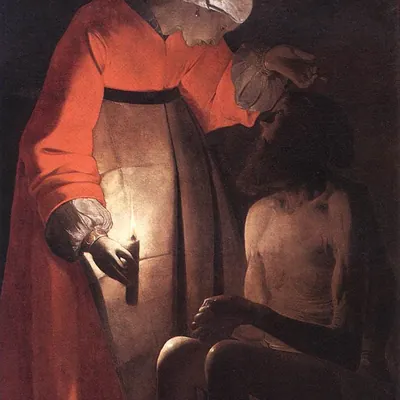
Saint Vulbas is celebrated on May 10. His memory has been kept above all in the Bugey, where the Church of Belley preserved the remembrance of its saints. His cult has remained local and discreet. He has no fixed iconography: when he is depicted, it is as a nobleman or a man at arms, in the manner of the lay saints of the early Middle Ages. Yet his tomb, his name given to a village and the memory kept in the Bugey are enough to show that a man of power could be recognized as a just man.
What can we learn from Saint Vulbas?
Saint Vulbas reminds us that one can serve God in public responsibilities. A soldier, then a high dignitary, he kept, according to tradition, the esteem of those he governed, and he paid with his life for refusing to be a tool of court rivalries. We can pray to him for those who hold authority, for victims of jealousy or unjust violence, and for all who try to remain upright in a world of power.
Where to pray to Saint Vulbas
- Saint-Vulbas (Ain): the village church, where his Merovingian sarcophagus is kept.
- Saint-Claude (Jura): the former abbey of Condat, whose monks had his body moved, according to tradition.
Discover also
- Saint Leger, bishop of Autun, also a victim of a mayor of the palace.
- Saint Eligius, counselor of King Dagobert I, his contemporary.
- Saint Romanus of Condat, founder of the Jura monastery that honored his memory.