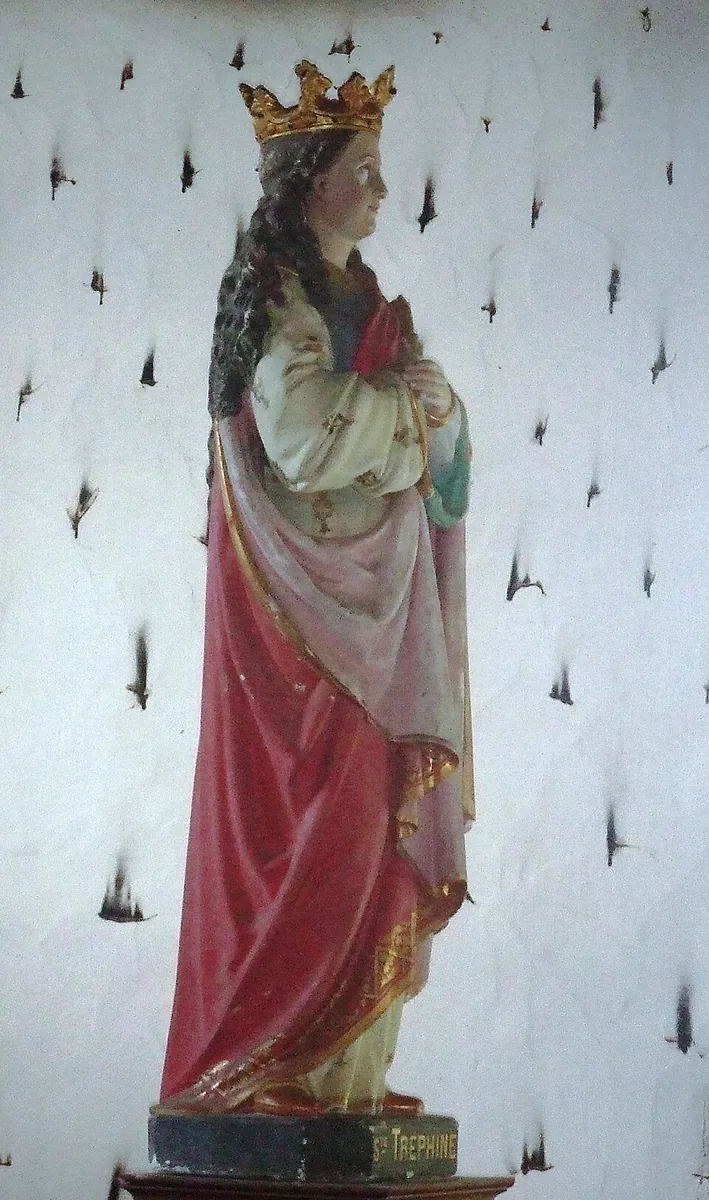
Saint Tryphine (Tréphine or Triphine in French) is a Breton saint of the 6th century, on the border between history and legend. The daughter of King Waroch of the Vannes region, married around 550 to the fearsome Count Conomor, she is said to have been put to death by him while she was expecting a child, the future Saint Tremeur. Breton tradition venerates her as a martyr and protector of sick children. Her feast day is July 21.
Who was Saint Tryphine?
Tryphine is first mentioned in the 11th century, in the Life of Saint Gildas written by Vitalis, a monk of the abbey of Saint-Gildas de Rhuys. Her story was later developed by Breton hagiographers, such as Albert Le Grand in the 17th century, and by popular tradition. Historians think it keeps the memory of a real woman, the wife of Conomor, a well-attested Breton chieftain of the 6th century. But the details of her life, and above all the miracles surrounding it, belong to legend. Her story should therefore be read as an account of faith, handed down by generations of Bretons, rather than as a biography.

A marriage for peace
According to the account, around 550, Waroch, ruler of the Vannes region, was threatened by Conomor, Count of Poher and master of a large part of northern Brittany. Conomor sought to extend his lands through a series of marriages. To avoid war, Saint Gildas advised Waroch to give Conomor the hand of his daughter Tryphine. The young woman accepted this marriage for the good of her people.
But Conomor had received a prophecy: he would be killed by his own son. To protect himself, the legend says, he put his wives to death as soon as they were expecting a child. Tryphine, his fourth wife, in turn became pregnant.
Flight and martyrdom
Tryphine fled. Popular tradition says she was helped by the souls of the previous wives. In the forest, she gave birth to a son, Tremeur, and hid him. Conomor caught up with her and cut off her head. This is why she is counted among the so-called "cephalophore" saints, beheaded martyrs whose legends tell of wonders linked to their heads.
Her parents recovered her body and went to see Saint Gildas, in his hermitage at Bieuzy, to remind him that he was the one who had advised this marriage. The legend says that Gildas went to Vannes, placed Tryphine's head back on her shoulders and restored her to life. She then founded a convent in Vannes, where she ended her days in prayer. Her son Tremeur, according to other accounts, was later killed by Conomor and is also honored as a martyr.
Devotion and art
Saint Tryphine is celebrated on July 21; some sources also give July 14. Her son Saint Tremeur is celebrated on November 8. In Brittany, she is invoked for sick children and for children born after term. A village in the Côtes-d'Armor bears her name, Sainte-Tréphine. Chapels are dedicated to her, notably in Pontivy, at Trébalay in Bannalec and at Saint-Aignan (Morbihan), where a pardon is held in her honor.
Her story has deeply marked the Breton imagination. A mystery play in Breton, Saint Tryphine and King Arthur, was collected by François-Marie Luzel. The story has also been compared with the tale of Bluebeard, and it inspired Anatole Le Braz and the painter Paul Sérusier.

What can we learn from Saint Tryphine?
Beyond the legend, Tryphine is the figure of a mother who protects her child's life at the cost of her own. She accepted a marriage for the sake of peace, she suffered the violence of a husband, and she did everything to save her son. Breton tradition saw in her a protector of sick children and anxious mothers. You can pray to her for women who suffer domestic violence, for mothers expecting a child in fear, and for sick children.
To pray with her, see the prayer to Saint Tryphine and the novena to Saint Tryphine.
Where to pray to Saint Tryphine
- Sainte-Tréphine (Côtes-d'Armor): the village that bears her name.
- Pontivy (Morbihan): the chapel of Sainte-Tréphine.
- Saint-Aignan (Morbihan): her chapel and her pardon.
- Bannalec (Finistère): the chapel of Trébalay, of which she is the patron.
Discover also
- Saint Tremeur, her son, a martyr according to tradition.
- Saint Gildas the Wise, who advised her marriage and, according to legend, restored her to life.
- Saint Non, another sorely tried mother of early Brittany.