Saint Trudpert was a missionary hermit of the 7th century, honored as a martyr in the Breisgau, in what is now southwestern Germany. Coming from Ireland according to the most widespread tradition, he settled in a valley of the Black Forest, south of Freiburg, where he was killed around 607 or around 644, depending on the sources. The Benedictine abbey of St. Trudpert, at Münstertal, keeps his memory alive. His feast day is April 26.
Who was Saint Trudpert?
Trudpert belongs to the generation of monks and hermits who, in the 6th and 7th centuries, brought the Gospel to the Alemanni, between the Rhine and Lake Constance. His name is Germanic, and historians disagree about his origins: many say he was Irish, others think he was a native of the region. What we know of his life rests on a Life written in the 9th century, at the time of the translation of his relics, then revised in the 10th and 13th centuries. This late account mixes real memories with legendary elements: it should be read as a witness to the veneration that surrounded him rather than as a precise biography.

A hermit in the Black Forest
According to the account, Trudpert did not want to set out on his own initiative: he first went to Rome to receive his mission from the pope. This detail, common in the Lives of missionaries, stresses his attachment to the universal Church. Arriving among the Alemanni, in the Breisgau, he met a nobleman named Otbert, who gave him a piece of wooded land in a valley at the foot of the mountains, south of Freiburg.
There Trudpert lived the life of the first hermits: he cleared the forest, built a cell and a small chapel, and divided his days between prayer, manual work and asceticism. Otbert had given him a few servants to help with the hardest work. Around him, Christianity was slowly gaining ground in a region still marked by the old cults.
A violent death
The Life tells that one day, while Trudpert was resting under a fir tree, one of these servants, unhappy with the heavy tasks he was given, struck him dead with an axe. Otbert buried him with respect on the very spot. Strictly speaking, Trudpert was not put to death for refusing to deny his faith; but tradition honored him as a martyr, because he gave his life in the service of the Gospel in a mission land. The sources do not agree on the date: some give 607, others 644.
Devotion and art
In the following century, a monastery rose on the place of his death. It became the Benedictine abbey of St. Trudpert, one of the oldest in the Black Forest. In 815, his relics were solemnly translated, and his first Life was written at that time. They rest in the abbey church; a portion was entrusted to the abbey of Ettenheimmünster, in Baden. The valley itself, Münstertal, takes its name from the monastery.
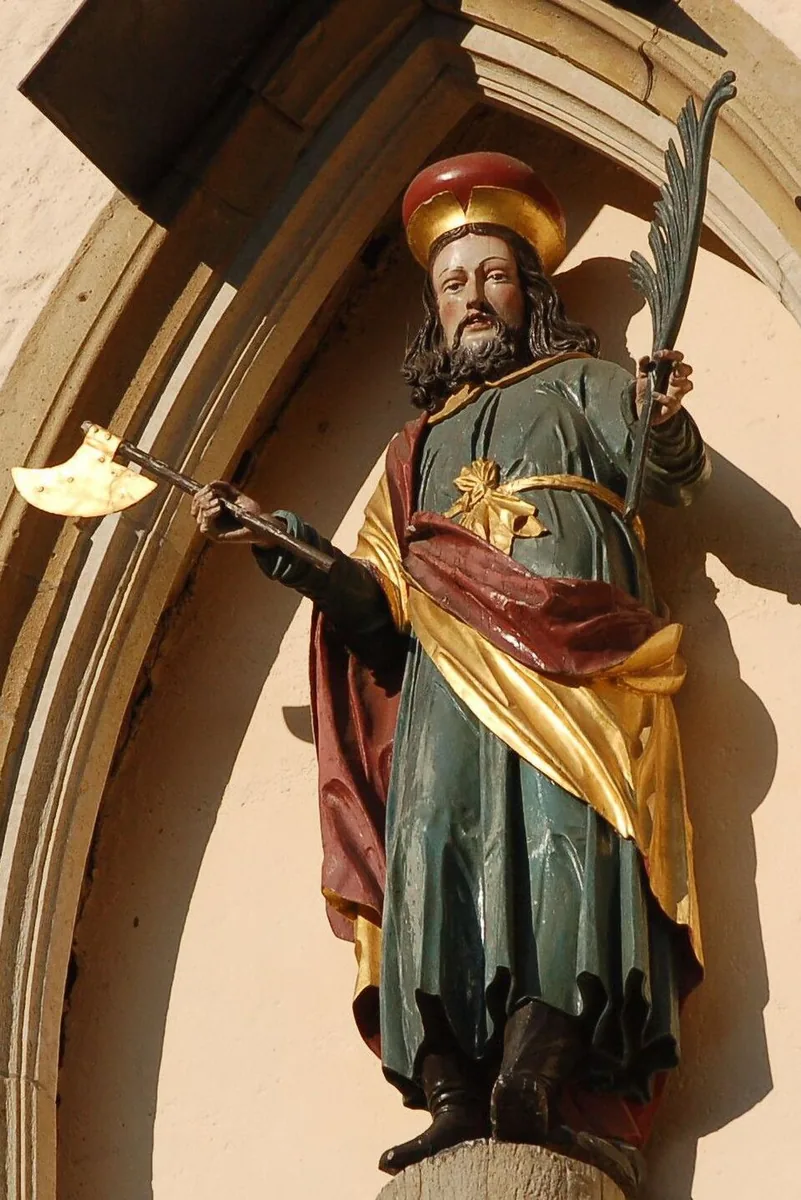
Saint Trudpert is celebrated on April 26. He is most often shown with the martyr's palm and an axe, the weapon of his murderer. He is venerated as one of the first apostles of the Breisgau, and his cult remains alive in the region of Freiburg.
What can we learn from Saint Trudpert?
Trudpert is a witness to the patience of beginnings. He did not found a great institution in his lifetime: he cleared a patch of forest, built a chapel and prayed. On that humble furrow others built after him an abbey that lasted more than a thousand years. His death, caused by the ingratitude of a man he provided for, also reminds us that serving others is not always repaid. You can pray to him for missionaries, for those who work the land and the forest, and for those who begin a work without seeing its fruit.
To pray with him, see the prayer to Saint Trudpert and the novena to Saint Trudpert.
Where to pray to Saint Trudpert
- St. Trudpert Abbey, at Münstertal (Baden-Württemberg, Germany): built on the place of his death, it keeps his relics.
- Ettenheimmünster (Baden-Württemberg): the former abbey that received part of his relics.
- The churches of the Freiburg region that keep his memory.
Discover also
- Saint Fridolin of Säckingen, another missionary from Ireland according to tradition, apostle of the Upper Rhine.
- Saint Columbanus, the great Irish monk whose disciples evangelized the Alemanni.
- Saint Gall, disciple of Saint Columbanus and hermit among the Alemanni.
- Saint Pirmin, founder of abbeys in Baden in the 8th century.