Saint Tewdrig (in Latin Theodoricus, sometimes called Theodoric or Tewdric) was a king of Gwent, in southeast Wales, who lived between the 5th and 6th centuries. According to tradition, he gave up the throne to live as a hermit near Tintern, then took up arms again to defend his people against the pagan Saxons. Mortally wounded, he died at Mathern, near Chepstow, where he was buried. He is celebrated on April 1, and sometimes on January 3.
Who was Saint Tewdrig?
Tewdrig belongs to that very ancient world of Christian Wales, between the end of the Roman Empire and the arrival of the Anglo-Saxons. His story is known mainly from the Book of Llandaff, a collection compiled in the 12th century, and from Welsh royal genealogies. The dates of his reign are very uncertain: historians place him in the 5th, the 6th, or even the early 7th century. His account therefore mixes history and tradition. He has been honored as a saint and martyr since the Middle Ages, because he died defending a Christian people against pagan invaders.

A king who chose prayer
According to Welsh traditions, Tewdrig was a warrior king who strengthened the kingdom of Gwent and fought the peoples from Ireland who had settled in the west of the country. But at the height of his power he made a surprising choice: he left the crown to his son Meurig and withdrew into solitude, on the rocks overlooking the Wye, near present-day Tintern. The man who had commanded armies wanted to live alone with God, in prayer and penance.
A king giving up power to become a hermit is not rare in the history of the saints of the British Isles. It expresses a deep conviction: earthly kingship passes away, God alone remains.
The last battle
The Book of Llandaff tells what follows. The Saxons, still pagan, threaten Meurig's kingdom. The old king is told that he will win the victory but be mortally wounded in it. Even so, he leaves his hermitage and takes up arms to protect his people. At the ford of the Wye, near Tintern, the Saxons are put to flight. Tewdrig himself is struck a fatal blow to the head.
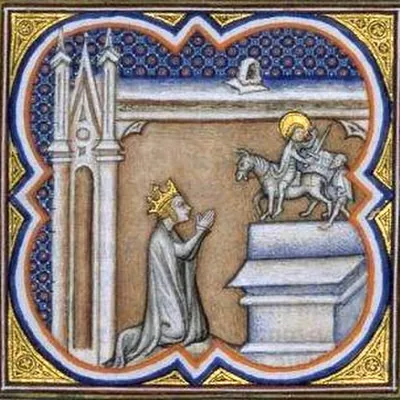
He had asked to be buried on the island of Flat Holm, in the Bristol Channel. But according to tradition, the cart carrying him, drawn by two stags, stopped at Mathern, on the edge of an arm of the Severn estuary. A spring gushed forth where his wounds were washed. He died there, and his son had a church built over his tomb. The old name of the place, Merthyr Tewdrig, is often understood as "the martyr Tewdrig."

Veneration and memory
Tewdrig has been venerated as a saint and martyr since the Middle Ages, in the Church of Llandaff, without any canonization process: his is an immemorial cult, older than the separation of the Eastern and Western Churches. His cult has remained local, but his memory has stayed alive in Christian Wales, and he is also honored by the Orthodox. His feast is most often celebrated on April 1; some calendars commemorate him on January 3.
In the early 17th century, the Anglican bishop of Llandaff, Francis Godwin, reported that while restoring the church of Mathern he had discovered near the altar a stone coffin containing a skeleton with a fractured skull, which he identified as Tewdrig's. A plaque, put up at his request, still recalls this discovery. Near the church, St Tewdric's Well is mentioned as early as the early Middle Ages.
What should we remember about Saint Tewdrig?
Tewdrig knew how to give up power to seek God, and he also knew how to leave his retreat when his people needed him. He reminds us that prayer does not take us away from our responsibilities: it frees us to serve. We can pray to him for those who exercise authority, for those who defend others at the risk of their lives, and for those who must know when to hand over the reins.
To pray with him, see the prayer to Saint Tewdrig and the novena to Saint Tewdrig.
Where to pray to Saint Tewdrig
- Mathern (Monmouthshire, Wales): St Tewdric's Church, where tradition places his tomb, and the well that bears his name.
- Tintern (Monmouthshire): the Wye valley, where he lived as a hermit and fought his last battle.
- Llandaff (Cardiff): the cathedral, whose Book of Llandaff has kept his story.
Discover also
- Saint David, patron saint of Wales.
- Saint Dubricius, bishop at the origins of the diocese of Llandaff.
- Saint Edmund the Martyr, another king who died facing pagan invaders.
- Saint Olaf, king of Norway who fell in battle and is venerated as a martyr.