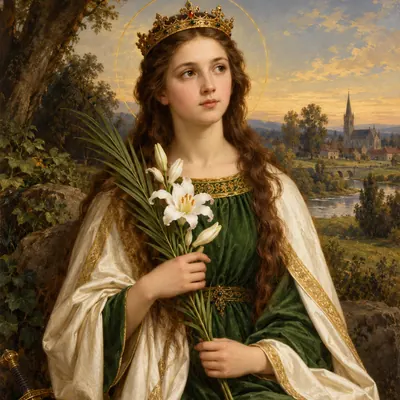
Saint Sæthryth, sometimes called Saethryth or Sethrida, was an Anglo-Saxon princess of the 7th century, stepdaughter of Anna, king of the East Angles. She went to Gaul, became a nun at the abbey of Faremoutiers, in Brie, and later its second abbess after Saint Fara. She died around 660. Her feast day is January 10 (some calendars give January 7).
Who was Saint Sæthryth?
Sæthryth is known to us through a few lines by Saint Bede the Venerable, the great historian of Christian England, who wrote his Ecclesiastical History of the English People in the early 8th century. He presents her as the stepdaughter of King Anna, that is, the daughter the queen had from a first marriage. A later chronicle, the Book of Ely, wrongly made her a daughter of Anna and his wife Hereswith, who was in fact the king's sister-in-law. These few facts, sober but reliable, are enough to sketch a life given to God far from her native land.
An English princess in Gaul
In the middle of the 7th century, England still had very few monasteries. Bede explains that many English people who wished to embrace religious life then went to the monasteries of the kingdom of the Franks. Many women of the royal family of East Anglia made this choice. Sæthryth left for Faremoutiers, where she was joined by her half-sister Æthelburh, daughter of King Anna.
Faremoutiers had been founded around 620 by Saint Fara, a young woman of the Frankish nobility, in the great monastic movement inspired by Saint Columbanus. For a princess from across the Channel, entering this monastery meant giving up her rank, her language and her land, to live in obedience, common prayer and poverty.
Abbess of Faremoutiers
The community trusted her so much that on the death of Saint Fara, in 655 or 657, it was Sæthryth who was chosen to succeed her. She thus became the second abbess of Faremoutiers. The sources say nothing precise about her government, which was brief, since she died around 660. But the simple fact that a foreigner was placed at the head of a great Frankish abbey, following its founder, says much about the esteem she enjoyed. After her, her half-sister Æthelburh took charge of the monastery.
Devotion
Sæthryth was venerated as a saint after her death, at Faremoutiers as well as in the memory of the Church in England, which honored the whole family of King Anna. Her feast is kept on January 10; some calendars place it on January 7. No early iconography of her own is known: she is most often recalled alongside Saint Fara and her half-sister Æthelburh, among the abbesses of Faremoutiers.
What can we learn from Saint Sæthryth?
We know little about Sæthryth, but that little speaks volumes. She left a royal court for a foreign monastery, she was recognized by her sisters, and she received the heavy task of succeeding a founder. Her life reminds us that holiness often unfolds in discretion, and that the Church was built by men and women ready to leave their homeland. You can pray to her for consecrated people, for those who live far from home and for those who must carry on the work of a founder.
To pray with her, see the prayer to Saint Sæthryth and the novena to Saint Sæthryth.
Where to pray to Saint Sæthryth
- Faremoutiers Abbey (Seine-et-Marne, France): the monastery of which she was abbess, now home to a community of Benedictine nuns.
- In any church or chapel, on January 10, in union with the nuns of Faremoutiers.
Discover also
- Saint Æthelburh of Faremoutiers, her half-sister, who succeeded her as abbess.
- Saint Etheldreda of Ely, daughter of King Anna, founder of the abbey of Ely.
- Saint Columbanus, whose monastic movement gave birth to Faremoutiers.
- Saint Bede the Venerable, the historian who handed down her name.