Saint Primael, or Primel, was a Breton hermit of the early Middle Ages, a native of Wales according to tradition. He lived in a forest of Cornouaille in the time of Saint Corentin, first Bishop of Quimper, in the 5th or 6th century. He is invoked above all in Finistère, where the municipality of Primelin bears his name. His feast day is May 15.
Who was Saint Primael?
Primael is one of the many Breton saints who came from Britain in the first centuries of Armorican Brittany, of whom we mostly know the name, a few local traditions and places of worship. No ancient Life of him has come down to us. The best-known account was recorded in the 17th century by the Dominican Albert Le Grand, of Morlaix, in his Lives of the Saints of Armorican Brittany, published in 1636, in connection with Saint Corentin. This late text gathers oral traditions and should be read as such.
The sources do not agree on the exact period: he is placed in the 5th or 6th century, depending on the date chosen for Saint Corentin himself. Still, his cult is well established in Cornouaille and in northern Finistère, with churches, chapels and places that bear his name.
The lame hermit and Saint Corentin
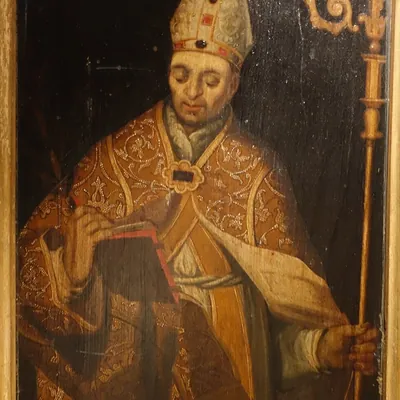
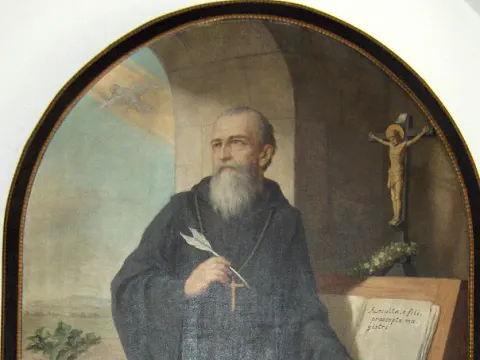
According to Albert Le Grand's account, Primael was a solitary priest who led a very holy life in a forest of Cornouaille. Corentin, himself a hermit before becoming bishop, went to see him to receive his advice. Primael welcomed him gladly, and the two men spent the day speaking of God, then the night in prayer.
In the morning, Corentin wished to say Mass in his host's oratory. Primael prepared everything that was needed, then went to fetch water from a distant spring. Corentin waited for him a long time. Coming out, he saw him returning with small steps, out of breath, for the spring was far and the old hermit was lame. Moved with pity, Corentin prayed God to provide water closer to the hermitage. After Mass, he planted his staff in the ground, and a spring gushed up at that spot. The two saints gave thanks, and Corentin, after a few days, returned to his own hermitage at Plomodiern.
This story, whose historical truth cannot be checked, expresses well the spiritual friendship between these first Breton monks, and Corentin's brotherly care for an elderly, infirm companion.
Devotion and art
Saint Primael is celebrated on May 15 in the calendar of Breton saints. The parish church of Primelin, in Cap Sizun, is dedicated to him and the municipality takes its name from him; his pardon (a traditional Breton religious festival) is held there on the first Sunday of August. A statue in the choir shows him with a cane, in memory of his infirmity. The parish church of Saint-Évarzec, near Quimper, is also under his patronage. At Saint-Thois, a chapel of Saint Primael, built on an ancient oratory, has now disappeared; a spring lay beneath its sacristy.
Tradition also says that Primael founded Plougasnou, in the Trégor area of Finistère, with Saint Meriadoc; a coastal village there bears his name, Primel. In Quimper, a lane called impasse Saint-Primel recalls that one of the city's seven chaplaincies was dedicated to him.

What can we learn from Saint Primael?
Saint Primael is presented to us as an old, lame hermit who welcomes his visitor, prays with him and goes himself to fetch water despite his difficulty. He reminds us of the value of hospitality, spiritual friendship and perseverance in weakness. You can pray to him for people with disabilities or who walk with difficulty, for the elderly, and for all who seek God in silence.
To pray with him, see the prayer to Saint Primael and the novena to Saint Primael.
Where to pray to Saint Primael
- Church of Saint-Primel in Primelin (Finistère): the parish church that bears his name, where his pardon is held on the first Sunday of August.
- Church of Saint-Primel in Saint-Évarzec (Finistère): another parish church dedicated to him.
- Primel, at Plougasnou (Finistère): the coastal village that keeps his name.
Discover also
- Saint Corentin, first Bishop of Quimper, who visited him according to tradition.
- Saint Meriadoc, linked by tradition to the founding of Plougasnou.
- Saint Tujan, another saint honored at Primelin, in Cap Sizun.