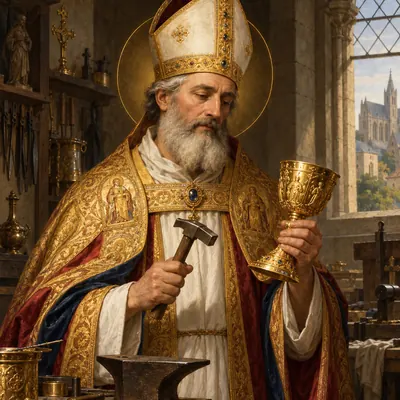
Saint Praejectus, known in French as Saint Priest, Saint Prix, Saint Projet or Saint Préjet depending on the region, was a bishop of Clermont in the 7th century. Born around 625 at Vézézoux, in Auvergne, he was a pastor devoted to the poor and a founder of hospitals and monasteries, before he was murdered at Volvic on January 25, 676. Honored as a martyr, his feast day is January 25.
Who was Saint Praejectus?
Praejectus belongs to Merovingian Auvergne, an age when bishops were at once pastors, builders and public figures caught up in the affairs of the Frankish kings. We know him mainly through the Passion of Saint Praejectus (Passio Praejecti), a Latin account that historians consider very close to the events. This is rare for a saint of that period: behind the edifying features, we discover a real bishop, involved in the conflicts of his time, who paid for it with his life.
His name took very different forms as it spread across France: Saint Priest in Clermont, Limousin and the Lyonnais, Saint Prix in the Île-de-France and Picardy, Saint Projet in Cantal, Angoumois, Quercy and Bordeaux, Saint Préjet in Haute-Loire and Allier. All the places that bear his name show how far his cult spread.

A young cleric at the service of the poor
Born into a family of Roman culture, Praejectus received a solid education at Issoire, at the monastery founded in memory of Saint Austremonius, the first bishop of Auvergne. He was a diligent student who loved letters and liturgical chant. The archdeacon Genesius, the future bishop of Clermont, took him under his guidance and, once bishop, entrusted him very young with the parish of Issoire, while he was still only a deacon.
The young pastor combined the study of theology with the care of the faithful. According to the tradition of Issoire, he had a church built outside the walls, and he founded a church and a hospital. All the accounts stress his devotion to the poor and the weak. He was also interested in the history of his Church: he is said to have written the Lives of the first martyrs of Auvergne, but these texts are now lost.
Abbot, then bishop of Clermont
After the death of Bishop Genesius, his successor Felix appointed Praejectus abbot of Chantoin, a monastery in Clermont, which he reformed. The episcopal succession was then troubled: Felix died, and the archdeacon Garivald, elected in his place, survived only forty days. People turned to the count of Auvergne, a layman who also bore the name Genesius; he refused the office and persuaded the clergy to choose Praejectus, who already had the support of the people. With the agreement of King Childeric II, Praejectus became bishop of Clermont.
His episcopate was that of a builder. Thanks to the friendship of Count Genesius, who had no heir and gave many estates, he founded hospitals, churches and monasteries. The best known is the convent of women at Chamalières, whose rule drew on Saint Benedict, Saint Caesarius of Arles and Saint Columbanus at once. Praejectus frequented the court of King Childeric II, where he defended the cause of ordinary people and opposed the injustice of the powerful.
The martyrdom at Volvic
This freedom of speech earned him the hostility of part of the Auvergne aristocracy. A dispute set him against Hector, patrician of Marseille. In the spring of 675, while Praejectus was celebrating Easter at Autun with the king, Hector was put to death there on Childeric's orders. The bishop was suspected of having inspired, or at least advised, this execution. After the king's death a few months later, Hector's supporters sought revenge.
On January 25, 676, Praejectus was overtaken at Volvic, near Clermont, and murdered with his companions, Abbot Amarin and Elidius. Historians hesitate over how much politics and how much faith lay behind this murder, and some older chronologies place it a little earlier; but the Church very soon saw in him a pastor who died for defending justice, and honored him as a martyr. A tradition says that one of the murderers, named Ursio, seized with remorse, went to Vézézoux and had a church built around the room where the bishop had been born.

Devotion and art
His body was laid to rest at Volvic, where a monastery of men was founded in the last quarter of the 7th century to keep his tomb. In the 12th century, the community was attached to the abbey of Mozac and became a Cluniac priory; the present church of Saint-Priest keeps a Romanesque choir and transept from that time. The saint's cult, at first limited to Auvergne, then spread throughout France: Saint-Prix in the Val-d'Oise, Saint-Priest near Lyon, Saint-Priest-en-Jarez, Saint-Projet-de-Salers and many other places bear his name.
Saint Praejectus is commemorated on January 25, the day of his death. He is shown as a bishop, with miter and crozier, sometimes with the palm of martyrdom. An old French country saying still goes: "Sun on Saint Priest's day, plenty of millet."
What can we learn from Saint Praejectus?
Saint Praejectus shows that a pastor cannot separate prayer from the service of the most vulnerable. He built hospitals as well as churches, and he dared to speak to the powerful in the name of the little ones. His death, amid the rivalries of his time, reminds us that defending justice can come at a high price. You can pray to him for bishops and priests, for those who care for the sick and the poor, and for all who must tell the truth to those in power.
To pray with him, see the prayer to Saint Praejectus and the novena to Saint Praejectus.
Where to pray to Saint Praejectus
- Volvic (Puy-de-Dôme): the church of Saint-Priest, built at the place of his martyrdom and burial.
- Vézézoux (Haute-Loire): his native village, where according to tradition a church was built around the room of his childhood.
- Issoire (Puy-de-Dôme): the town where he was trained and exercised his first ministry.
- Saint-Prix (Val-d'Oise) and the many parishes of Saint-Priest, Saint-Prix or Saint-Projet in France.
Discover also
- Saint Genesius of Clermont, the bishop who trained him and entrusted him with the parish of Issoire.
- Saint Austremonius, first bishop of Auvergne, whose monastery at Issoire welcomed the young Praejectus.
- Saint Bonitus of Clermont, another bishop of Clermont of the Merovingian era.
- Saint Columbanus, whose rule inspired the convent of Chamalières.