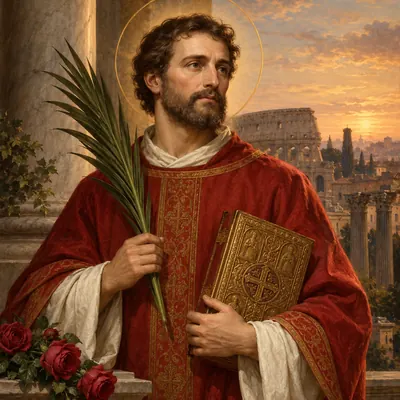
Saint Pionius (Pionios in Greek) was a priest of Smyrna, today Izmir in Turkey, burned alive in 250 during the persecution of Emperor Decius. The account of his martyrdom, written shortly after the events, is one of the most vivid documents we have on the life of a Christian community in the 3rd century. His feast day is March 11.
Who was Saint Pionius?
Pionius was a priest of the Church of Smyrna, the community governed a century earlier by the great martyr bishop Saint Polycarp. We know him through the Martyrdom of Pionius, an ancient text that relates his arrest, his speeches and his death. The historian Louis Robert, a great specialist of ancient Asia Minor, stressed its historical value: the places, institutions and officials it mentions match what is known of Smyrna at that time. Pionius appears in it as a cultured, eloquent man, able to quote Homer to the pagans and Scripture to the Jews, and deeply attached to the memory of Polycarp.

Smyrna in the time of Decius
In 250, Emperor Decius required every inhabitant of the Empire to offer a sacrifice to the gods and to receive a certificate proving it. This was not only a persecution: it was a general test of loyalty. Many Christians gave in out of fear; they would be called the lapsi, those who had fallen. The account of the martyrdom of Pionius suggests that even the bishop of Smyrna had agreed to sacrifice. In this climate of failure, the priest's firmness stands out all the more.
The arrest and the speeches
On February 23, the day the Church of Smyrna remembered Polycarp, Pionius, Sabina and Asclepiades were keeping the anniversary of the martyr. According to their account, they knew they would be arrested and prepared for it. The temple warden, Polemon, came to fetch them and led them to the agora, where the crowd gathered. Pionius then spoke. To the pagans, he recalled a line of Homer: one must not rejoice at the misfortune of those who die. To the Jews present, he quoted Proverbs: "Do not rejoice when your enemy falls." He refused to sacrifice, despite the pleas of those who admired him and wanted to save him.
During the interrogations, he was asked what God he worshiped. He answered: the one who made heaven and earth, and who sent his Son, Jesus Christ, to save mankind. In prison, the companions shared what remained of their blessed bread and went on praying. They comforted the Christians who came to see them, including those who had given in.
The martyrdom
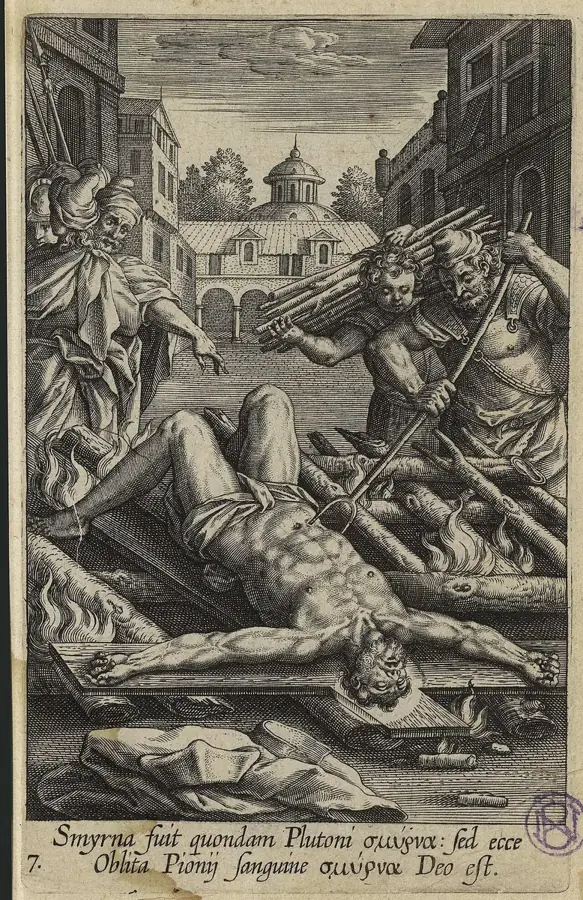
The proconsul Quintilian, back in Smyrna, questioned Pionius and sentenced him to be burned alive. The account says that at the place of execution he undressed himself, lay down on the wood and let himself be nailed to it. As the fire rose, he closed his eyes, prayed, said "Amen", then: "Lord, receive my soul." Witnesses said that after death his body seemed intact and his face shone. According to the same account, a priest of the Marcionite sect, Metrodorus, was executed the same day.
Pionius and the memory of Polycarp
The name of Pionius is linked to that of Polycarp. An ancient tradition credits him with preserving the account of Polycarp's martyrdom and with a Life of Polycarp. Historians remain cautious: the Life seems much later, and it is not certain that the Pionius mentioned in the manuscripts is the martyr of 250. What is sure is that the Church of Smyrna saw in him a faithful heir of its great bishop.
What can we learn from Saint Pionius?
Pionius lived in a wounded Church, where many had given in to fear, including some of its leaders. He did not judge the weak: he comforted them. But he did not give in himself. His words in the agora, nourished by culture and Scripture, show that one can bear witness to Christ with intelligence and without hatred. You can pray to him for priests, for those who must stay faithful when others give up, and for Christians who must give an account of their faith in public.
To pray with him, see the prayer to Saint Pionius and the novena to Saint Pionius.
Where to pray to Saint Pionius
- Izmir (Turkey): ancient Smyrna, the city of his martyrdom, where the remains of the Roman agora can still be seen.
- In any church on March 11, the day the Roman Martyrology remembers him.
Discover also
- Saint Polycarp, martyr bishop of Smyrna, whose memory Pionius honored.
- Saint Germanicus of Smyrna, a young martyr of the same Church.
- Saint Cyprian of Carthage, a bishop who also faced the persecution of Decius and the question of the lapsi.