Saint Peter Nolasco was a merchant born in the Lauragais, in Languedoc in the south of France, around 1180. In Barcelona, in 1218, he founded the Order of Our Lady of Mercy, devoted to ransoming Christians held captive in Muslim lands. His religious, the Mercedarians, even vowed to give themselves up as hostages to free prisoners in danger of losing their faith. He died in Barcelona in 1245 and is celebrated on May 6.
Who was Saint Peter Nolasco?
Peter was born around 1180-1182 at Mas-Saintes-Puelles, near Castelnaudary, in what is now the department of Aude in southern France. At a date we do not know, his family settled in Barcelona, where his father, Bernard, trained him in the merchant's trade.
The western Mediterranean was then divided between Christian kingdoms and the Muslim states of Spain and North Africa. Wars, piracy and raids produced large numbers of captives on both sides, who were reduced to slavery. A merchant who traded across these frontiers saw this suffering at close range.
Early sources on his life are scarce, and many stories were embellished later, especially by the painters and chroniclers of his order. The main outlines of his work, however, are well established by documents of the time, including the papal bulls that approved his foundation.
The merchant and the captives
Merchants could travel between Christian and Muslim territories, and they often acted as go-betweens for the ransom of prisoners. This is how Peter discovered the distress of Christian captives, separated from their families, living in poverty and exposed to the risk of abandoning their faith. Deeply moved, he decided to devote his wealth and his life to setting them free.
Around 1203 he gathered a few young men who shared this desire. Together they collected alms in Catalonia and Aragon, then negotiated ransoms. For some fifteen years this small group of laymen, united in prayer, bought back prisoners. But the number of captives kept growing, and Peter understood that the work needed a more lasting form.
The founding of the Order of Mercy
According to the tradition of the order, on the night of August 1 to 2, 1218, the Virgin Mary appeared to him and asked him to found a religious order for the redemption of captives. On August 10, 1218, before the high altar of the cathedral of Barcelona, in the presence of Bishop Berenguer de Palou and King James I of Aragon, Peter and his companions received the habit. The Dominican Saint Raymond of Peñafort, the king's adviser, supported the project. The order adopted the Rule of Saint Augustine.
To the three usual vows of poverty, chastity and obedience, the Mercedarians added a fourth: to give themselves up as hostages, if necessary, to free a captive in danger of losing the faith. The first constitutions, in 1227, asked the brothers to be "always joyfully ready to give their lives," in the image of Christ, who handed himself over to the mercy of his enemies. The Spanish word merced, meaning "mercy" or "grace," gave the order its name.
An order at the service of freedom
In 1235, Pope Gregory IX officially approved the order with the bull Religionis vestrae. When the founder died on May 6, 1245, the Order of Mercy numbered about a hundred brothers in eighteen houses in Aragon, Catalonia and the south of France. According to the order's chronicles, nearly four thousand captives were ransomed during its first twenty-seven years. The order already had a martyr, Saint Serapion, who died in Algiers.
Peter was buried in the Mercedarian convent in Barcelona. His cult, which remained alive among the Mercedarians and among the people, was confirmed by Urban VIII in 1628 and extended to the whole Church in 1664. In the seventeenth century, the painter Francisco de Zurbarán devoted a famous series of paintings to his life.
Why is Saint Peter Nolasco the patron saint of captives and prisoners?
Peter Nolasco looked at captives not as merchandise but as brothers whose freedom and faith were under threat. He put his merchant's skills at the service of mercy, and he founded an order ready to go as far as the gift of self. That is why he is invoked for prisoners, hostages and all people deprived of their freedom. Today the Mercedarians still work with prisoners and with victims of new forms of slavery, such as human trafficking.
Symbols and how to recognize Saint Peter Nolasco in art
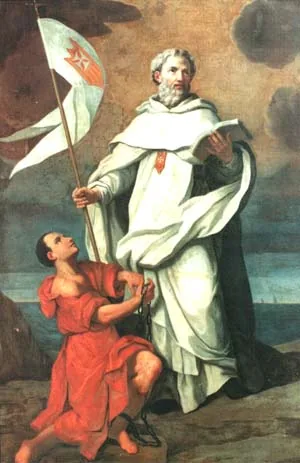
Saint Peter Nolasco is shown in the white habit of the Mercedarians, with the order's shield on his chest: the arms of Aragon beneath a white cross on a red field. Painters, Zurbarán above all, illustrated the visions told by the order's tradition: the Virgin Mary giving him the habit, the Apostle Peter appearing to him crucified upside down, or an angel showing him the heavenly Jerusalem. Chains or freed captives sometimes appear at his feet.
Where to pray to Saint Peter Nolasco
- Barcelona: the Basilica of La Mercè, mother house of the order, dedicated to Our Lady of Mercy, patroness of the city.
- Barcelona: the Cathedral of the Holy Cross and Saint Eulalia, where the order was founded in 1218.
- Mas-Saintes-Puelles (Aude, France): his native village, which keeps his memory.
To pray with him, use the prayer to Saint Peter Nolasco or the novena to Saint Peter Nolasco.
Discover also
- Saint John of Matha, founder of the Trinitarians, another order devoted to ransoming captives.
- Saint Felix of Valois, co-founder of the Trinitarians according to tradition.
- Saint Raymond Nonnatus, a Mercedarian who gave himself up as a hostage.
- Saint Ferdinand III of Castile, a king of the Reconquista in the same period.
- Saint Peter Claver, apostle of African slaves in the seventeenth century.