Saint Thomas More was an English lawyer, writer and statesman of the Renaissance. A friend of Erasmus and the author of Utopia, he became Lord Chancellor of England under Henry VIII, then resigned rather than approve the king's break with Rome. Imprisoned in the Tower of London for refusing to swear an oath against his conscience, he was beheaded on July 6, 1535. Canonized in 1935, he is celebrated on June 22 with Saint John Fisher, and in 2000 Saint John Paul II proclaimed him patron of statesmen and politicians.
Who was Saint Thomas More?
Thomas More was born in London on February 7, 1478, the son of John More, a lawyer and later a judge. As a teenager he served as a page in the household of Cardinal John Morton, Archbishop of Canterbury, who noticed his quick wit. He then studied at Oxford, and law in London at Lincoln's Inn.
For a few years he lived near the London Charterhouse and shared in part the prayer of the Carthusian monks, asking himself whether he was called to religious life. In the end he chose marriage and public life, but all his life he kept discreet habits of prayer and penance.
A Christian humanist
Thomas More belonged to the circle of humanists who wanted to renew Christian culture by returning to ancient texts. His friend Erasmus dedicated The Praise of Folly to him; its Latin title, Moriae Encomium, plays on his name. In 1516, More published Utopia, the story of an imaginary island governed by reason, which allowed him to criticize the injustices of the Europe of his day with humor. The word "utopia," which he coined, has passed into every language.
His house at Chelsea, on the Thames, was known for its studious and cheerful atmosphere. More had his daughters educated as well as his sons, which was rare at the time; his eldest daughter, Margaret Roper, became a respected Latin scholar. The family prayed together, read Scripture at table and welcomed scholars and artists, among them the painter Hans Holbein the Younger, who made several portraits of the household.
In the service of the king
A respected lawyer and a judge known for his integrity, More entered the service of Henry VIII and rose to the highest office in the kingdom, succeeding Cardinal Wolsey as Lord Chancellor in 1529. But the king wanted his marriage to Catherine of Aragon annulled so that he could marry Anne Boleyn, and he would soon declare himself Supreme Head of the Church of England.
More did not oppose the king publicly, but he could not approve. When the English clergy submitted to the king in May 1532, he returned the Great Seal and withdrew, much poorer, with his family.

Prison and martyrdom
In April 1534, summoned to Lambeth, he refused the oath required by the Act of Succession, which implied rejecting the authority of the pope. He was willing to accept the succession to the throne set by Parliament, but not the rest, and he condemned no one for taking the oath. He was locked in the Tower of London, where he spent fifteen months.
There he wrote spiritual works, including A Dialogue of Comfort against Tribulation and a meditation on Christ's agony in Gethsemane. His letters to his daughter Margaret show a clear-sighted man, worried for his family, yet at peace.
Tried at Westminster Hall on July 1, 1535, he was condemned for treason on the strength of disputed testimony. He was beheaded on Tower Hill on July 6, two weeks after Bishop John Fisher. According to an account of the time, he declared on the scaffold that he died "the king's good servant, and God's first." His body was buried in the chapel of the Tower; his head, displayed on London Bridge, was recovered by his daughter Margaret.
Why is Saint Thomas More the patron saint of politicians and lawyers?
Thomas More showed that one can be fully engaged in the world, in law, politics and family life, without giving up one's conscience. He did not seek martyrdom: he used every resource of the law to protect himself, kept silent as long as he could, and never stopped loving his king and his country. That is why John Paul II gave him to statesmen and politicians as their patron in 2000, and why lawyers, judges and many Catholic law societies in the English-speaking world honor him. His humor, even on the scaffold, shows his inner freedom. His story reached a wide public through Robert Bolt's play A Man for All Seasons.
Symbols and how to recognize Saint Thomas More in art
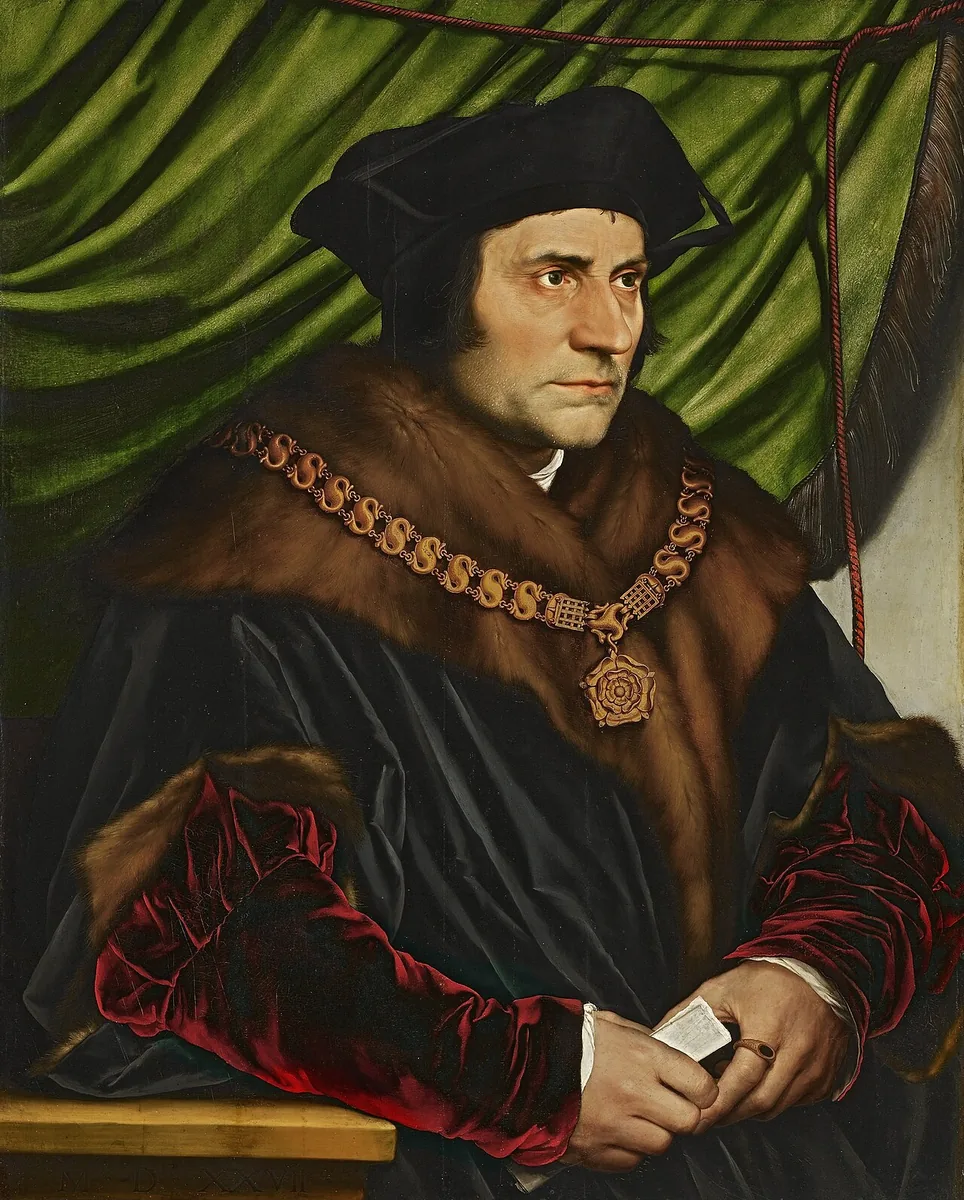
- The Lord Chancellor's robes, often trimmed with fur, as in Holbein's famous portrait.
- The chain of office, a gold collar of linked "S" shapes.
- A book, for the writer and scholar.
- An axe, the instrument of his martyrdom.
- His family around him, as in Holbein's group drawing, a reminder of the father and husband.
Where to pray to Saint Thomas More
- Tower of London: the Chapel Royal of Saint Peter ad Vincula, where his body was buried.
- Canterbury: Saint Dunstan's Church, where his head rests in the Roper family vault.
- Chelsea, London: Chelsea Old Church, where he prayed, and his statue on Cheyne Walk.
- Westminster, London: Westminster Hall, where he was tried in 1535.
To pray with him, use his prayer "Give me thy grace, good Lord," written in the Tower, or follow the novena to Saint Thomas More from June 13 to 21, ending on the eve of his feast.
Discover also
- Saint John Fisher, Bishop of Rochester, martyred for the same cause and celebrated on the same day.
- Saint Thomas Becket, chancellor and then archbishop, killed in the twelfth century for resisting his king.
- Saint John Henry Newman, another great figure of English Christian thought.
- Saint Louis, a model of the Christian ruler.
- Saint Thomas Aquinas, master of Christian reflection on law and conscience.