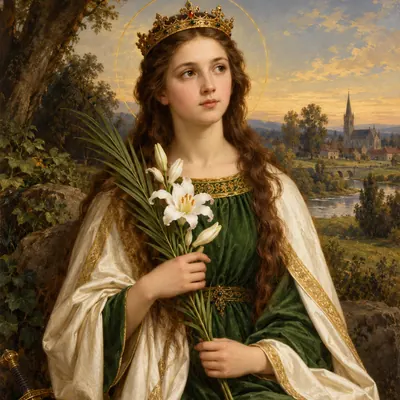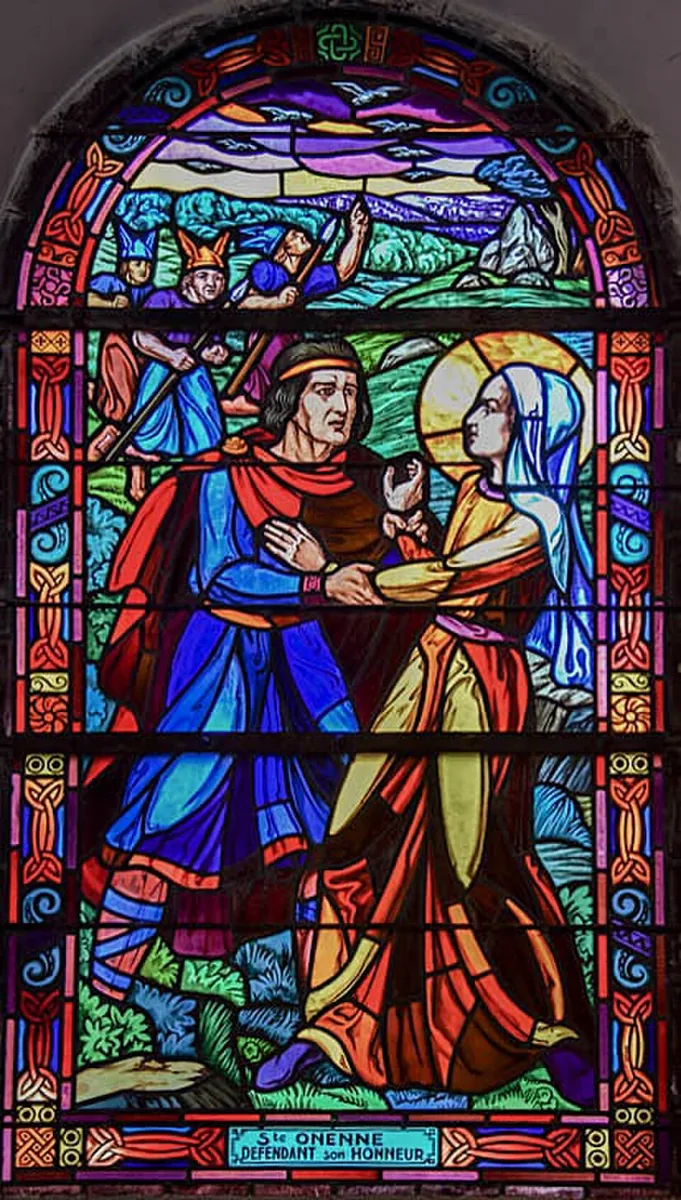
Saint Onenne is a very local Breton saint, honored only at Tréhorenteuc, in Morbihan, on the edge of the forest of Brocéliande. Tradition makes her a 7th-century princess, the youngest sister of Saint Judicael, king of Domnonée, who chose a humble life as a goose-girl. Her life is known only through very late accounts, and her historical existence is uncertain. Her feast day is April 30; a procession is held at Tréhorenteuc on September 29.
Who was Saint Onenne?
Onenne (Onenn in Breton, sometimes Onenna or Ouenne) is an endearing figure of popular Breton Christianity. Her cult never spread beyond a single parish, Tréhorenteuc, whose church partly bears her name. The faithful see in her a pious girl, poor by choice, protected by the Virgin Mary and defended by her geese.
Historians are much more cautious. Her first written mention dates from the 11th century, four centuries after the time she is said to have lived: the Chronicle of Saint-Brieuc lists her name among the brothers and sisters of Judicael, without saying anything of her holiness. The accounts of her life were only written down from the 18th century onward. Several scholars, such as Philippe Walter, think her legend christianizes ancient Celtic tales linked to water and birds. Saintspedia therefore presents her life for what it is: a local tradition carrying a spiritual message, rather than a biography.

The princess who became a goose-girl
The accounts of her life exist in several versions. According to the oldest, taken from an 18th-century manuscript now lost, Onenne secretly leaves her parents' castle at the age of ten. On the way, she exchanges her princess's clothes for those of a poor woman, so as not to be recognized. She settles near a spring at Tréhorenteuc. One day, a young lord tries to carry her off to abuse her. Onenne cries out, and the ducks (or geese, depending on the version) near her cry out with her, alerting soldiers and peasants who come to rescue her.
A tale collected in the 19th century by Adolphe Orain puts her devotion to the Virgin at the center. Hired as a goose-girl at the castle of Tréhorenteuc, Onenne picks roses every day in the lady's garden to offer them to Mary. Intrigued, the lady follows her to the church, where she sees two angels lift the child up to an image of the Virgin, who gives her a kiss. Onenne then returns to her parents and dies young, serene, sure of joining Mary.
A saint of humility
No miracle is attributed to Saint Onenne. What touched the faithful was her choice: a king's daughter who preferred poverty, service and prayer to rank and honors. Her legend also speaks of a young woman who defends her dignity in the face of violence, and whom God protects through the humblest of his creatures. From the 17th century, when the parish depended on the abbey of Paimpont, her cult was closely associated with that of the Virgin Mary.
Devotion and art
The cult of Saint Onenne has remained attached to Tréhorenteuc. In the 19th century, her tomb, in the church, drew many pilgrims; it was moved several times and then removed in 1943. A marble plaque now recalls that she was buried there. The fountain of Saint Onenne, near the village, has become the main place of devotion to her. People prayed there for the healing of children and of those with fever, and invoked the saint against dropsy, a belief that came from her association with Saint Eutropius, also celebrated on April 30.
She is shown as a poor young girl, often with a duck or geese. Six stained-glass windows in the church of Tréhorenteuc tell her life, and a 17th-century banner, listed as a historic monument, shows her kneeling with Saint Eutropius near the Virgin and Child, with a white duck and three ducklings.
What can we learn from Saint Onenne?
Even if her story reaches us mainly through legend, Saint Onenne carries a clear message: true nobility is that of a humble heart. She invites us to choose simplicity, to pray to Mary with trust, and to defend the dignity of everyone, especially the most vulnerable. You can pray to her for sick children, for girls and women who are victims of violence, and for all who serve humbly.
To pray with her, see the prayer to Saint Onenne and the novena to Saint Onenne.
Where to pray to Saint Onenne
- Tréhorenteuc (Morbihan): the church of Saint-Eutrope-and-Saint-Onenne, known as the "Grail church", with its windows and the plaque of her former tomb.
- Tréhorenteuc: the fountain of Saint Onenne, destination of the procession on September 29.
Discover also
- Saint Judicael, king of Domnonée, whom tradition makes her elder brother.
- Saint Eutropius of Saintes, patron of the church of Tréhorenteuc, celebrated on the same day as her.