Saint Maxellendis (Maxellende in French) was a young Christian woman of the 7th century, born around 650 at Caudry, in the Cambrésis region of northern France. According to tradition, she was killed around 670 by the suitor she had refused because she wished to give herself to God. Virgin and martyr, patron saint of Caudry, she is invoked for diseases of the eyes. Her feast day is November 13, or the following Sunday, in the basilica of Caudry that keeps her reliquary.
Who was Saint Maxellendis?
Maxellendis belongs to the Merovingian period, the time when northern Gaul, evangelized by bishops and monks such as Saint Vedast, Saint Gaugericus (Géry) and Saint Amand, was being covered with parishes and monasteries. Her story has come down to us through the tradition of the Church of Cambrai and through ancient liturgical texts, especially the diocesan breviary and the chronicle attributed to Baldric, written in the 11th century. Like many accounts from that age, it mixes real memories with edifying elements. Yet it keeps the essential: a young woman who preferred Christ to an imposed marriage, and who paid for it with her life. Her cult has never ceased since the 7th century, which makes her one of the great popular saints of the Cambrésis.

A young woman given to God
According to the traditional account, Maxellendis was the daughter of a wealthy landowner of Caudry, respected for his qualities, and of a very devout mother. From childhood she loved to withdraw in order to pray. Her parents, as was the custom, arranged her marriage to Harduin, a young lord of the neighborhood whom tradition links to Solesmes, in the Cambrésis. But Maxellendis had already given herself inwardly to the Lord. She refused the marriage and, to escape her suitor, she went into hiding.
This refusal was no whim. In Merovingian society, a young woman of good family had little freedom when faced with her parents' marriage plans. Choosing consecrated virginity meant declaring that life belongs first to God. Many women saints of that time in northern Gaul made the same choice, sometimes at the cost of great trials.
Martyrdom and forgiveness
Wounded in his pride, Harduin tried to carry her off. He finally found her and, as she still refused to follow him, he struck her dead. Tradition places this tragedy on November 13, around 670. The account adds that immediately after his crime Harduin lost his sight. Maxellendis was first buried in the church of Saint-Souplet, which the ancient breviary describes as a basilica dedicated to the apostles Peter and Paul and to Saint Sulpice.
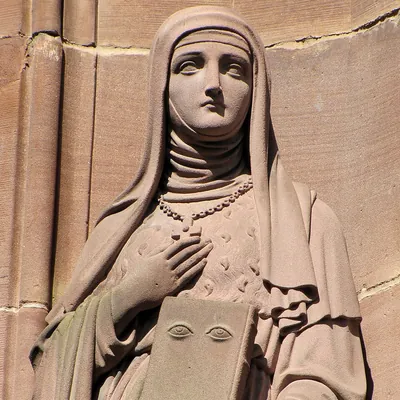
Some years later, under the episcopate of Saint Vindicianus, her remains were carried back in procession to Caudry. Harduin, now blind, stood along the way. When the young woman's body passed in front of him, he burst into tears, asked forgiveness and recovered his sight. This miracle, the best known of her life, is at the heart of devotion to her: the victim obtains healing for her murderer. That is why she is invoked for the eyes, but also for inner light and reconciliation.
Devotion and art
Saint Maxellendis is honored on November 13, the day of her death; at Caudry, her feast is celebrated on that day or the following Sunday. Her relics traveled over the centuries, from Cambrai to Le Cateau-Cambrésis, before returning to Caudry. They now rest in a 14th-century reliquary, a listed historic monument, placed in the chapel dedicated to her in the right arm of the basilica's transept.
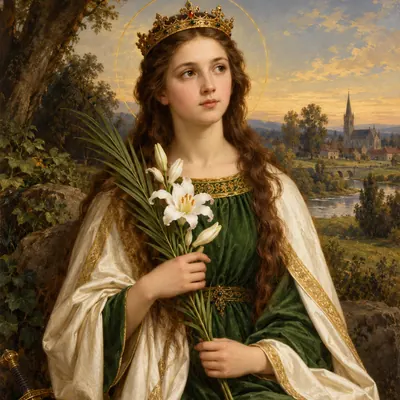
Patron of the people of Caudry and of the visually impaired, she has made Caudry a place of pilgrimage for the blind and those with eye problems. The building, at the end of the 19th century, of a huge church for a medium-sized town shows the strength of this devotion. She is depicted as a young woman bearing the martyr's palm, sometimes with the sword or knife of her death. The stained-glass windows of the basilica, by the Chartres master glazier Charles Lorin, tell her story.

What can we learn from Saint Maxellendis?
Maxellendis reminds us that a vocation is a personal call that no one can impose or erase. She chose Christ freely, despite the pressure of those around her. Her story also speaks of the power of forgiveness: the young martyr did not call for revenge, and it was as she passed by that her murderer saw again. We can pray to her for young people looking for their path, for women who suffer violence, for those with eye diseases, and for all who need to see clearly in their lives.
Where to pray to Saint Maxellendis
- Caudry (Nord): the basilica of Saint Maxellendis, which keeps her reliquary, a place of pilgrimage for the visually impaired.
- Saint-Souplet (Nord): the village where, according to tradition, she was first buried.
- Le Cateau-Cambrésis and Cambrai (Nord): the towns where her relics were kept in the Middle Ages.
Discover also
- Saint Gaugericus (Géry), bishop of Cambrai, one of the fathers of the faith in the Cambrésis.
- Saint Autbert of Cambrai, bishop of Cambrai and Arras in the 7th century.
- Saint Vedast, first bishop of Arras, evangelizer of the region.
- Saint Columba of Córdoba, another virgin martyr who stayed faithful to her consecration.