Saint Hernin (sometimes spelled Thernin) was a 6th-century Breton hermit who came from Britain with the Breton emigrants. He lived and died in a hermitage in the heart of Brittany, on the spot where the parish of Locarn, in the Côtes-d'Armor, later grew up. His relics, kept in precious silver reliquaries, are carried every year at the pardon of Locarn. His feast is November 3 in the Catholic calendar, and he is honored at Locarn on the Sunday after May 1.
Who was Saint Hernin?
Hernin belongs to the host of hermit saints who, in the 5th and 6th centuries, left the island of Britain to settle in Armorica and found places of prayer there. The sources about him are scanty and late. Most of what is told of him comes from the Lives of the Saints of Armorican Brittany, published in the 17th century by the Dominican Albert Le Grand, who gathered local traditions. Hernin's name also appears in the cartulary of the abbey of Redon. His story should therefore be read as a pious tradition rather than a biography. His cult, however, is old, well attested and still alive.

A hermit in the heart of Brittany
According to Albert Le Grand, Hernin arrived in Armorica in 528, at the time of the great Breton emigration. He looked for a secluded place and stopped in the parish of Duault, on the edge of moors and woods. The lord of the place, of the Quelen family, agreed to give him a piece of land, on condition that he marked its limits with a ditch, and in a single day. Hernin, the story says, simply walked along dragging his staff behind him: a ditch half a league around opened up in his path. This kind of story, common in the Lives of Breton saints, says in its own way that the hermit's land is given by God.
Hernin spent the rest of his life there, in prayer and poverty. He died in his hermitage on a May 1, in 535 according to Albert Le Grand or in 540 according to other sources. The local people buried him where he had lived and laid a large stone on his grave.
The stag, the count and the church
The memory of the hermitage had almost been lost when, according to tradition, a count of Poher, hunting a stag, chased the animal to this spot. The stag lay down on Hernin's grave. The hounds, coming near it, could neither advance nor retreat; the horses of the count and his men were struck with the same stillness. The count had the stag released, learned from the local people that he stood on the tomb of Saint Hernin, and decided to build a church there. During the work, the story adds, a flock of birds built a dome over the grave.
Relics, pardon and holy wells
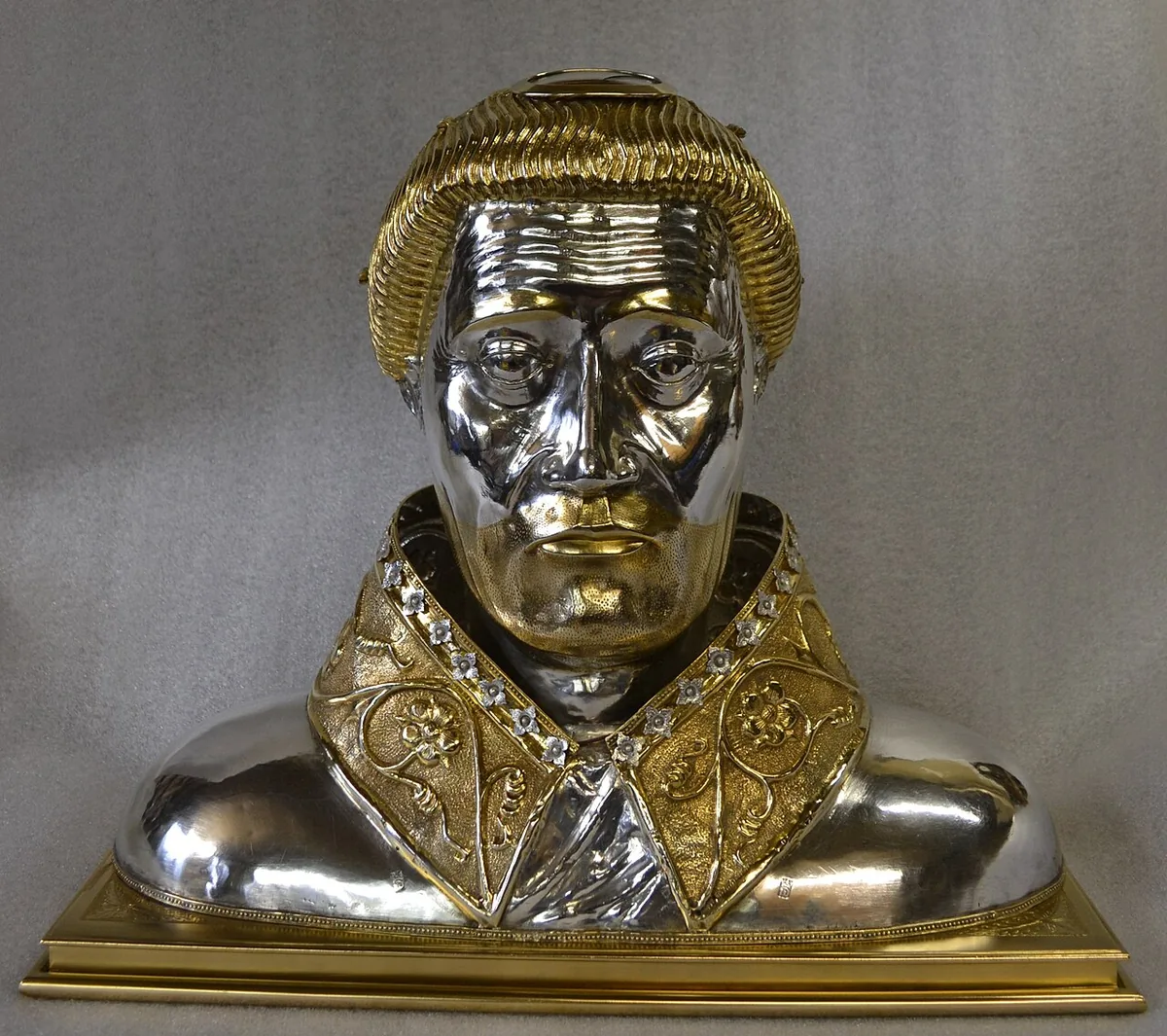
Saint Hernin is the patron of Locarn, whose church bears his name, and of Saint-Hernin, in Finistère. He is also found at Trevarn, in Saint-Urbain, at Dirinon, at the hamlet of Saint-Hernin in Ploumagoar and at Leshernin, in Séglien. The treasury of Locarn keeps two reliquaries devoted to him: a 15th-century arm reliquary and above all a silver bust from the late 14th or early 15th century, signed by the goldsmith Jean Dieu, probably from Tréguier. This bust is considered one of the finest examples of Breton goldsmithing of the late Middle Ages. An early 17th-century processional cross shows him as a bishop.
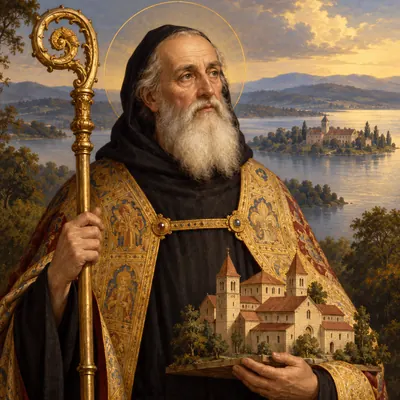
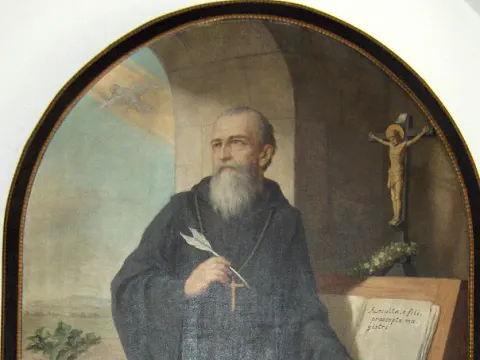
Every year, on the Sunday after May 1, the anniversary of his death, Locarn celebrates his pardon (a traditional Breton religious festival), and the reliquary bust is carried at the head of the procession. Two holy wells are dedicated to him, at Locarn and at Saint-Hernin. They were said to help the paralyzed, and people came to the one at Saint-Hernin on the day of the pardon to dip their heads three times in the water to be freed from migraines. Hernin is shown with a staff and a book.
What can we learn from Saint Hernin?
Saint Hernin founded neither an abbey nor a diocese. He simply prayed, for a long time, in a corner of land that people had forgotten. But God willed that his tomb should become a church, and that generations of Bretons should come there seeking healing and peace. He reminds us of the hidden fruitfulness of silent prayer. You can pray to him for the sick, especially those suffering from headaches or paralysis, for those seeking silence, and for the rural parishes of Brittany.
To pray with him, see the prayer to Saint Hernin and the novena to Saint Hernin.
Where to pray to Saint Hernin
- Locarn (Côtes-d'Armor): the church of Saint-Hernin, the treasury and its reliquaries, the holy well, and the pardon on the Sunday after May 1.
- Saint-Hernin (Finistère): the parish church, which keeps part of his relics, and the holy well of Saint Hernin.
- Dirinon (Finistère) and Trevarn, in Saint-Urbain (Finistère): places that have him as patron.
Discover also
- Saint Winwaloe of Landévennec, founder of an abbey from the same generation of Breton saints.
- Saint Ronan, another hermit from overseas, honored at Locronan.
- Saint Hervé, a hermit and popular saint of Brittany.
- Saint Tugdual, one of the seven founding saints of Brittany.