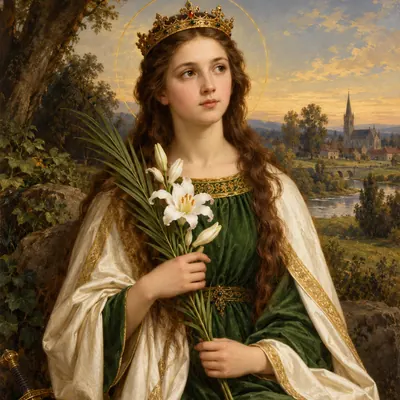
Saint Glodesind (Glossinde in French) was a young noblewoman of Austrasia at the end of the 6th century who refused marriage in order to consecrate herself to God and founded in Metz a community of nuns, the abbey that bears her name today. She died young, on a July 25, around 608 or 610. Her life is known only through accounts written three centuries later, strongly marked by legend. Her feast day is July 25.
Who was Saint Glodesind?
Glodesind is one of the first great female figures in the Christian history of Metz. What is told of her comes first from an anonymous Life, dated to the late 9th or early 10th century, and then from a second Life written between 960 and 984 by John, a monk of the abbey of Saint-Arnoul, at the request of the nuns of Sainte-Glossinde. These texts present Glodesind as the foundress of their community and credit her with wondrous episodes. Historians therefore read them with caution, and some writers go so far as to consider her biography largely legendary. The cult paid to her in Metz is nevertheless ancient: as early as the 830s, Bishop Drogo had her relics transferred into the abbey church, inside the city.

A bride who chose Christ
Glodesind was born into a great family of the Frankish aristocracy. Her father, Wintrio, was duke of Champagne and one of the leaders of the nobility of Austrasia, the eastern Frankish kingdom whose capital was then Metz. Like many young women of her rank, she was promised to an advantageous marriage: her father chose for her a young Frank of good family, Obolenus. But Glodesind had already decided to remain a virgin and to consecrate her life to God.
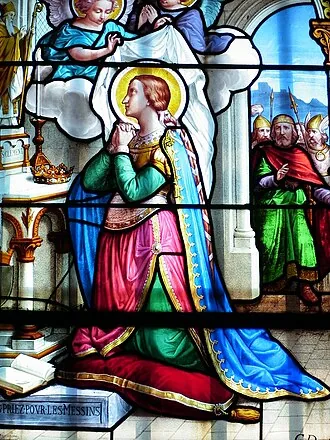
The account tells that on the very day of the wedding, Obolenus was arrested on the king's orders, then executed. Glodesind saw in this tragic event a sign that God approved her plan. Her father, however, still wanted to marry her off. She then fled to the cathedral of Metz and shut herself in. For a week, her parents had the doors guarded to force her to give in, and she remained without food or drink. On the last day, the Life says, three young men appeared and placed the veil of a nun on her head: tradition saw in them angels come to set her free. Her parents then gave up their plan.
Foundress of Sainte-Glossinde
Glodesind then went to Trier, to her aunt Rothilde, who led a community of young nuns. There she learned community life, prayer and obedience. Once trained, she returned to Metz and gathered there, according to the Life, about a hundred young women, on lands given by her parents. The community settled near one of the city gates, and the abbey of Sainte-Glossinde is one of the few monasteries in Metz to have always kept its original site.
Glodesind did not lead her community for long: she died about six years later, on a July 25, around 608 or 610, aged about thirty.
Devotion, relics and memory
According to the Life, some twenty years after her death, Glodesind appeared in a dream to a nun and asked for a church to be built outside the city walls; her body was moved there and found intact. In the 9th century, Bishop Drogo had her relics transferred into the abbey church, inside the city, perhaps to better protect the nuns' enclosure and gather the saint's cult in a single place. In the 10th century, Bishop Adalbero I placed his niece Himiltrude at the head of the abbey, whose church and buildings were then rebuilt and enlarged.
Since 1802, the abbey buildings have housed the bishop's residence of Metz, and the former abbey church, rebuilt in the 18th century, has become the chapel of the bishop's house. A reliquary of the saint is kept there behind the high altar, along with a 17th-century painting showing the angels giving her the veil. Saint Glodesind is celebrated on July 25. She is shown as a nun or abbess, with the veil, sometimes with the angels who consecrated her according to the legend.

What can we learn from Saint Glodesind?
Behind the wondrous accounts, the figure of Glodesind is that of a young woman who dared to say no to a future mapped out for her, in order to follow the call she felt in her heart. She held firm despite pressure from her family, then took time to be formed before founding. Her short life gave birth to a community that lasted nearly twelve centuries. You can pray to her for young people discerning their vocation, for those under family pressure, for nuns, and for the Church of Metz.
To pray with her, see the prayer to Saint Glodesind and the novena to Saint Glodesind.
Where to pray to Saint Glodesind
- Chapel of Sainte-Glossinde (bishop's house of Metz): the former abbey church, which keeps her reliquary; it is mainly open to the public during European Heritage Days.
- Saint-Étienne Cathedral in Metz: the church where, according to the Life, she took refuge and received the veil.
- Basilica of Notre-Dame de Sion (Saxon-Sion, Meurthe-et-Moselle): a stained-glass window shows her.
Discover also
- Saint Arnulf of Metz, bishop of Metz a few years after her death.
- Saint Cathróe of Metz, a 10th-century abbot in Metz.
- Saint Odile, another great abbess of eastern France.