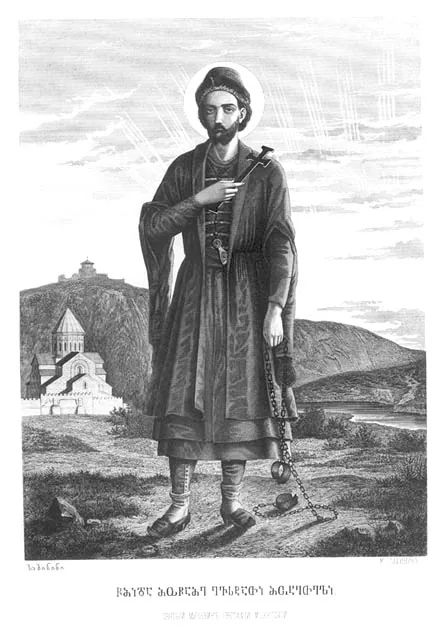
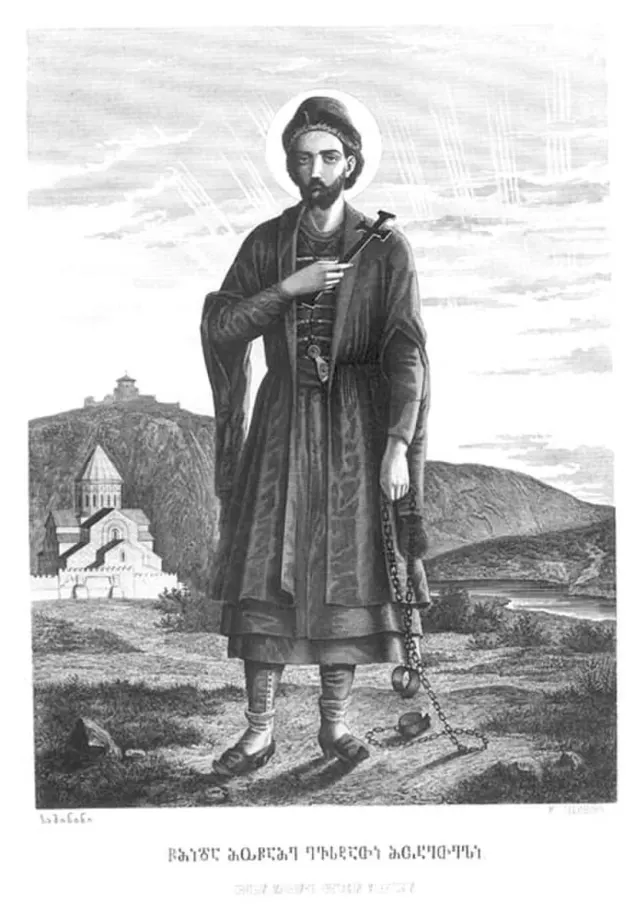
Saint Eustathius of Mtskheta was a 6th-century martyr in Georgia. Of Persian origin, born into a family of Magi who worshipped fire, he converted to Christ at Mtskheta, the old capital of the kingdom of Iberia. Denounced for refusing to take part in a pagan feast, he was imprisoned in Tbilisi, tortured and then beheaded, in 589 according to the most commonly accepted date. His feast day is July 29.
Who was Saint Eustathius of Mtskheta?
Eustathius was first called Gvirobandak. He came from a Persian family devoted to the cult of the Magi, the official religion of the Persian Empire. In the 6th century, Kartli, that is, eastern Georgia, had been a Christian country since the preaching of Saint Nino in the 4th century, but it had come under the rule of the kings of Persia, and Persians had settled there. It was among them that Eustathius discovered the faith of the Christians around him. His story is known to us through the account of his martyrdom, written in Georgian and counted among the oldest texts of that literature. Like many passions of martyrs, this account aims above all to bear witness to the faith; the dates that can be drawn from it remain debated.
A Persian who became a Christian
Born into a family of Magi, Gvirobandak grew up in the religion of his fathers, which venerated fire. Around the age of thirty, he settled in Mtskheta, the old royal city of Georgia, at the meeting of the Aragvi and Kura rivers. There he lived among Christians and came to admire their faith. He asked for baptism and took the name Eustathius. He then married a Christian woman and started a family with her.
This change did not go unnoticed. For the Persians of the city, abandoning the religion of the Magi was a betrayal. When Eustathius refused to take part in a feast of his former religion, fellow Persians denounced him. He was arrested, together with seven other Persians who had become Christians, and taken to Tbilisi, where the Persian authorities who then governed the country were based.
Twice in prison
Before his judges, Eustathius refused to deny Christ. He was tortured, then locked up. After six months he was released, but the respite did not last: he was denounced again and returned to prison. The account of his martyrdom insists on this perseverance. Eustathius could have kept quiet, made himself forgotten or outwardly returned to his family's religion. He chose to remain a Christian to the end.
The confession of faith and death
At his final trial, Eustathius spoke out in defense of the Christian faith. According to the account, he declared that no other belief could equal the faith of Christians. His judges condemned him: he was tortured once more, then beheaded. The date of 589 is the one most often given, but some authors place his death a few decades earlier, around the middle of the 6th century. What is certain is that he was venerated very early as a martyr by the Church of Georgia.
Devotion and relics
The relics of Eustathius are kept at Mtskheta, in the patriarchal cathedral of Svetitskhoveli, one of the most venerated sanctuaries in Georgia. Tradition credits them with many miracles. He is celebrated on July 29 by the Eastern Churches, and he is also listed on that date in Catholic calendars of saints, such as Nominis. His memory recalls that Christian Georgia, too, had its martyrs, and that faith can cross the boundaries of peoples and religions.

What can we learn from Saint Eustathius of Mtskheta?
Saint Eustathius discovered Christ by watching Christians live: his conversion was first the fruit of a silent witness. He then paid the price of his faithfulness, in the face of his own community of origin. His example speaks to those who convert as adults, to those who are rejected by their loved ones because of their faith, and to all persecuted Christians. You can pray to him for the courage to remain faithful, even when giving in would bring peace and quiet.
To pray with him, see the prayer to Saint Eustathius of Mtskheta and the novena to Saint Eustathius of Mtskheta.
Where to pray to Saint Eustathius of Mtskheta
- Mtskheta (Georgia): Svetitskhoveli Cathedral, where his relics rest.
- Tbilisi (Georgia): the city where he was imprisoned and put to death.
- Anywhere, on July 29, praying for persecuted Christians and for converts.
Discover also
- Saint Christina of Persia, a Persian noblewoman who converted and was martyred in the 6th century.
- Saint Benjamin of Persia, a deacon and martyr of the Church of Persia.
- Saint George, a martyr of antiquity and one of the most venerated saints in Georgia.