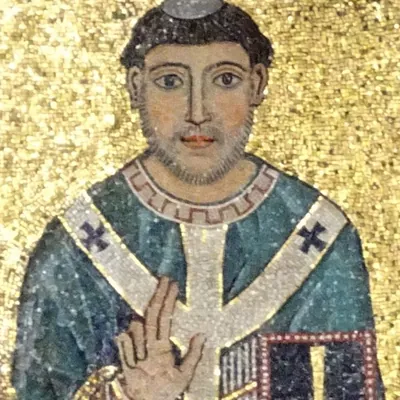
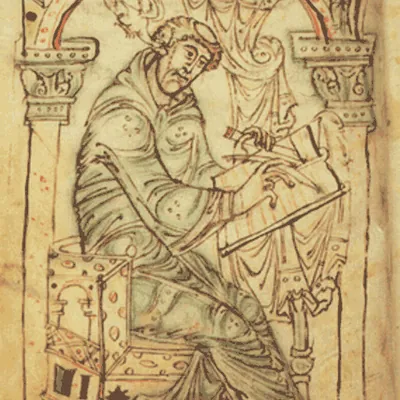
Saint Erkembode was an eighth-century monk, said by tradition to have come from Ireland, who became abbot of Saint-Bertin, at Saint-Omer, and bishop of Thérouanne. A tireless pastor of an immense diocese, he died almost paralyzed on an April 12, around 742. His tomb, in the cathedral of Saint-Omer, is covered with small shoes left by parents who entrust their children to him: he is called "the saint who makes people walk." His feast day is April 12.
Who was Saint Erkembode?
Erkembode was one of the successors of Saint Omer, the founder of the town, and of Saint Bertin, the great abbot of Sithiu. His life is poorly known. A Life was written about him much later, at the abbey of Saint-Bertin in the Middle Ages, and the dates of his episcopate vary according to the authors. His name, of Germanic origin, is said to mean "recognized messenger." What is certain is the fervor that his tomb has inspired for more than twelve centuries, and the very special bond between this holy bishop and sick children and all who struggle to move forward.

A monk from Ireland
In the seventh and eighth centuries, many Irish monks crossed the sea to proclaim the Gospel on the continent, in the wake of Saint Columbanus. According to tradition, Erkembode was one of them. He joined the monastery of Sithiu, founded a few decades earlier by Saint Omer and his companions and made famous by Saint Bertin. He lived the monastic life there so well that the monks, struck by the holiness of his life, chose him as their abbot.
Bishop of an immense diocese
Erkembode was then called to become bishop of Thérouanne, the see of Saint Omer, while keeping the leadership of the abbey. The diocese of Thérouanne was then immense: it stretched from Ypres, in present-day Belgium, to the Somme valley. Erkembode traveled it without rest. Tradition reports that he bought back land to redistribute to the poor.
These long journeys wore out his body. At the end of his life he found it harder and harder to walk, and he died almost paralyzed on an April 12, around 742. He was buried in the church of Sithiu where Saint Omer already lay, which over the centuries became the present Cathedral of Notre-Dame in Saint-Omer.
The saint who makes people walk
Very soon, pilgrims came to pray at his tomb. They left their worn-out shoes there, in memory of their long walk and in tribute to the man who had walked so much, and then suffered so much from no longer being able to walk. Today it is mostly children's shoes that cover the sarcophagus: parents come to entrust to the saint a child who is slow to walk, or who is disabled or ill. He is also invoked for people suffering from depression, when "nothing works anymore." The cathedral staff regularly remove the shoes to make room for new ones.
Devotion and relics
On November 1, 1085, at the request of the faithful, Erkembode's body was raised into a shrine. In 1466 the pope authorized his head to be placed in a precious reliquary of silver and gold. During the Revolution, in 1793, the church's caretaker saved the reliquary from looting, and the clergy recovered it intact in 1804. The relics, long hidden and then forgotten under the high altar, were restored to their place in 1902. The present tomb is a very ancient monolithic trough of dark gray porphyry, placed in the north ambulatory of the cathedral. Erkembode is honored on April 12, in the Roman Martyrology and in the diocese of Arras.
Why pray to Saint Erkembode?
Erkembode spent his strength walking toward others, until he could no longer walk himself. His final weakness became, for generations of pilgrims, a sign of hope. He speaks to all who are stopped in their tracks: by illness, disability, age or depression. He also reminds parents of sick children that they are not alone in carrying their worry.
Where to pray to Saint Erkembode
- Saint-Omer (Pas-de-Calais, France): the Cathedral of Notre-Dame, where his sarcophagus covered with shoes stands in the north ambulatory.
- Saint-Omer: the ruins of the abbey of Saint-Bertin, of which he was abbot.
- Thérouanne (Pas-de-Calais, France): the site of the former cathedral, seat of his diocese, destroyed in 1553.
To pray with him at home, you can use the prayer to Saint Erkembode or the novena to Saint Erkembode.
Discover also
- Saint Omer, founder of Sithiu and bishop of Thérouanne before him.
- Saint Bertin, the great abbot whose successor he was.
- Saint Columbanus, the father of the Irish monks on the continent.
- Saint Vedast, another bishop from the Christian beginnings of Artois.