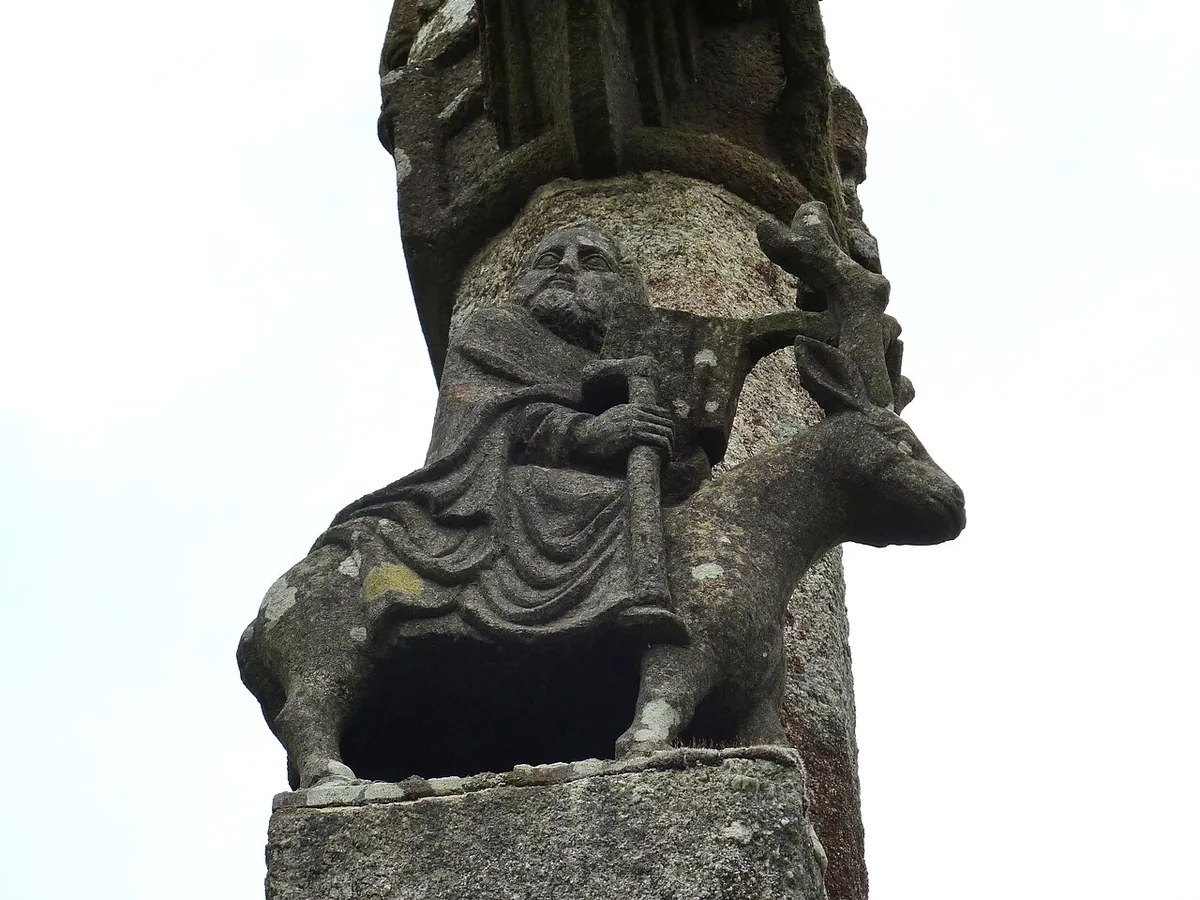
Saint Edern was a hermit monk who came to Brittany from Ireland or Wales at the end of the 9th century. According to tradition, he lived in Cornouaille, between Quimper and the Monts d'Arrée, and died at Lannédern, where his tomb is still venerated. He is almost always shown riding a stag. His feast day is August 26.
Who was Saint Edern?
Edern is one of the many Breton saints whose life has come down to us mainly through popular tradition. The great Breton hagiographers, Albert Le Grand in the 17th century and Dom Lobineau in the 18th, do not mention him. What is told of his life comes from two late sources: a notice published in 1892 by the Benedictine Dom François Plaine, and a gwerz, a popular song in Breton collected at Plouvorn by Anatole Le Braz. The old archives of Plouédern mentioned a Life of the saint on parchment, now lost. Despite these fragile sources, his cult is real and ancient: three parishes in Finistère bear his name, and the diocese of Quimper and Léon counts him among the saints it celebrates.

A monk from across the sea
According to tradition, Edern was a wealthy young man, perhaps a warrior or a nobleman, who left everything to become a monk. Some accounts link him to the monastic tradition of Saint Columbanus. He left his native land, Cambria (Wales) or Ireland, in the time of King Alan the Great, and around 894 landed on the coast of Cornouaille near Douarnenez. Legend gives him his sister as a traveling companion, sometimes associated with Saint Genevieve, honored at Loqueffret. He is said to have built a house for her and a simple hut for himself.
Edern first settled in a forest a few leagues from Quimper, where he made his hermitage and built a chapel: this is the origin of the parish of Edern. He ended his life further north, at Lannédern, whose name means "the hermitage of Edern". A 16th-century chapel, Notre-Dame de Coat ar Roc'h, stands where tradition places his cell.
The stag, the cow and the duke
Three legendary stories are attached to Saint Edern. The most famous is that of the stag: pursued by a lord's hounds, a stag took refuge under the monk's habit. Tamed, it never left him until his death. Another version says that Edern, riding the stag all night long, marked out the boundaries of the territory he was to evangelize. That is why he is almost always shown mounted on a stag.
The second legend tells of the hermit's poor cow, which strayed onto the lands of a neighboring lord and was left for dead by his hounds: Edern is said to have brought it back to life. The third features a duke of Brittany and his troop. A soldier struck the monk, who was slow to show him the way; Edern, following the Gospel, turned the other cheek. The whole troop was then struck blind, and the duke vowed to build a church where he recovered his sight: this would be the origin of the church of Plouédern.
These stories, which are not historical, show how Bretons understood Edern's holiness: a gentle man, at peace with animals, protecting the poor and answering violence with forgiveness. Some authors also see in the stag, an ancient symbol of renewal, a Christian image of the resurrection.
Devotion and art
Edern is the original patron of Edern, Lannédern and Plouédern, in Finistère. His tomb at Lannédern bears his recumbent statue, dressed in the habit and the almuce, hands joined, feet resting on the stag. The church also keeps a reliquary, a 16th-century triptych telling his life, and many statues. He was invoked especially for diseases of the eyes, perhaps in memory of the legend of the blinded soldiers. A pardon (a traditional Breton religious festival) in his honor long drew many faithful to Lannédern.
His feast is set on August 26; old calendars placed it on August 30 or September 1, the day of his death according to the gwerz. He should not be confused with Saint Teilo (Théleau), patron of Landeleau, who is also shown on a stag, but as a bishop.

What can we learn from Saint Edern?
Behind the legends, Saint Edern is one of those monks from overseas who rooted the Gospel in the Breton countryside through prayer and a simple life. He chose solitude, poverty and gentleness. The stag at his side reminds us that the peace of Christ extends to all creation, and the episode of the other cheek, that the disciple answers evil with good. You can pray to him for Brittany, for those who suffer from eye diseases, for animals, and to learn gentleness.
Where to pray to Saint Edern
- Lannédern (Finistère): the church of Saint Edern, with his tomb, his relics and its parish close.
- Edern (Finistère): the parish church, with a stained glass window showing three episodes of his life.
- Plouédern (Finistère): the parish which, according to legend, owes its church to the vow of a duke of Brittany.
- Plougar (Finistère): the church keeps an old statue of the saint.
Discover also
- Saint Teilo, another saint of Cornouaille shown riding a stag.
- Saint Ronan, a hermit who came from Ireland to Cornouaille.
- Saint Winwaloe, founder of the abbey of Landévennec.
- Saint Corentin, first bishop of Quimper.