Saint Ebrulf, in French Évroult and in Latin Ebrulfus, was a Frankish monk and abbot, born in Bayeux according to tradition. An officer at the court of the Frankish kings, he renounced the world by mutual agreement with his wife, became a monk, and then founded in the forest of Ouche, in Normandy, the abbey that bears his name today. The hagiographers place his life in the 7th century and his death on December 29, 706, but another tradition places him in the 6th century. His feast day is December 29.
Who was Saint Ebrulf?
Ebrulf is one of the great monastic saints of Normandy, and one of the most popular in the Pays d'Ouche and the Perche. His name, of Germanic origin, goes back to Eberwulf, "boar-wolf", and took in the Middle Ages the forms Evroul, Evrou or Yvrou. His Life, written long after him, presents the typical journey of a Frankish nobleman who leaves honors behind for solitude. Historians do not agree on when he lived: most hagiographers opt for the 7th century, but an older version places the founding of his monastery in 567. The abbey of Ouche itself is attested in a charter of King Charles the Simple in the year 900.

From the court to the cloister
According to tradition, Ebrulf was born in Bayeux into a noble family and served as an officer under King Childeric II. He was married. One day, the couple decided together to live apart in order to consecrate themselves to God, each in a monastery. This choice, found among several saints of the Merovingian period, presupposes mutual consent: it is not an escape, but a shared offering. Ebrulf entered the monastery of Deux-Jumeaux, near Bayeux, where he learned the life of prayer and obedience.
The founder of the abbey of Ouche
Longing for greater solitude, Ebrulf left Deux-Jumeaux and went deep into the forest of Ouche, a wooded and isolated area of southern Normandy that has kept the name of Pays d'Ouche. Disciples joined him, and a monastery was born, placed under the patronage of Saint Peter. The version that places him in the 6th century even credits him with leading fifteen monasteries and fifteen hundred religious, figures that belong more to praise than to history. He died on December 29, 706, according to the hagiographers. His isolation may have protected his monastery: the abbey of Ouche seems to have escaped the Norse raids that ruined so many abbeys in the region.
Devotion and art
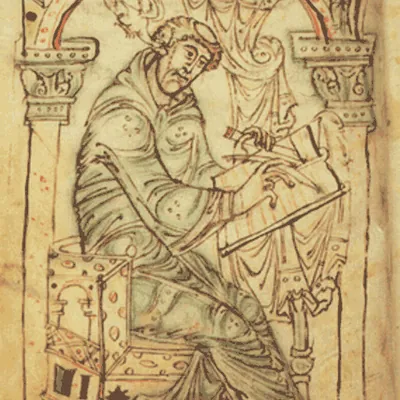
Saint Ebrulf is celebrated on December 29. In the 11th century, the abbey was rebuilt under his name and became one of the great intellectual centers of Normandy: the chronicler Orderic Vitalis lived and wrote there. Traditions differ on the fate of his relics: some are said to have been taken to Orléans, while the abbey kept others; from the 12th century, they were shared among several churches. A pilgrimage is dedicated to him at Pré-Saint-Évroult, in Eure-et-Loir, and the collegiate church of Mortain, in the Manche, bears his name.
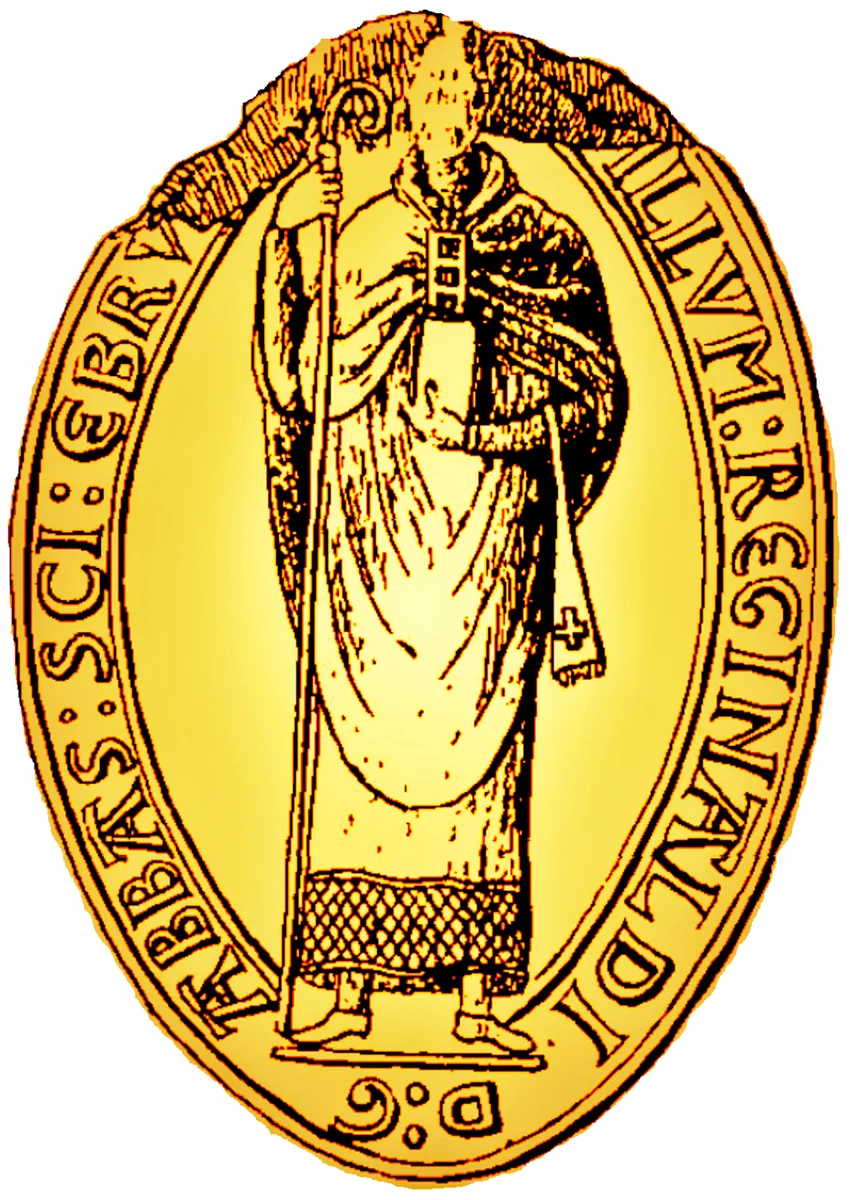
Popular devotion called on him against skin diseases and blood diseases, against fever and madness, and for the protection of herds. Outbreaks of pimples were even called "flowers of Saint Yvrou". A 15th-century seal of the abbey shows him as an abbot, with crozier and book.

What can we learn from Saint Ebrulf?
Ebrulf left a brilliant career to seek God, and he did so in agreement with his wife, in a shared choice. He sought solitude, and that solitude became a community that lasted for centuries. He reminds us that life's great decisions are made in dialogue and prayer. You can pray to him for the sick, especially those suffering from skin conditions or fever, for farmers and their herds, for couples who discern together, and for Normandy.
To pray with him, see the prayer to Saint Ebrulf and the novena to Saint Ebrulf.
Where to pray to Saint Ebrulf
- Saint-Evroult-Notre-Dame-du-Bois (Orne): the ruins of the abbey he founded, its museum and the parish church of Saint-Évroult.
- Pré-Saint-Évroult (Eure-et-Loir): a place of pilgrimage in his honor.
- Mortain (Manche): the collegiate church of Saint-Évroult.
- Bayeux (Calvados): his birthplace according to tradition.
Discover also
- Saint William Firmatus, whose relics rest in the collegiate church of Saint-Évroult in Mortain.
- Saint Leutfred, another founding abbot of Frankish Normandy.
- Saint Vigor, bishop of Bayeux, Ebrulf's hometown.