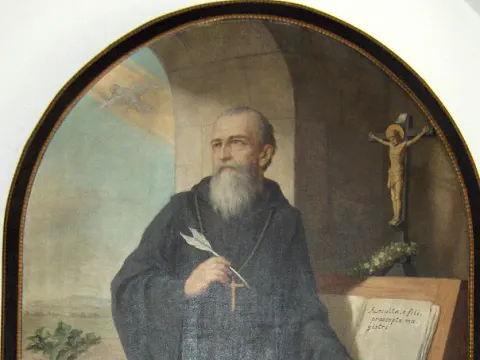
Saint Maglorius (Magloire in French, Maelor in Breton) was a 6th-century monk and bishop, born in Wales around 535. A cousin of Saint Samson, he is said to have succeeded him at the head of the Church of Dol, before withdrawing to the island of Sark, where he led a monastery until his death. His relics, taken to Léhon and then to Paris, made his name known far beyond Brittany. His feast day is October 24.
Who was Saint Maglorius?
Maglorius belongs to the great generation of monks from across the Channel who founded the Church of Brittany in the 5th and 6th centuries. His life is known mainly through a Latin Life followed by a collection of Miracles, probably written between the mid-9th and mid-10th centuries, at least three centuries after him. This text, which the historian François Duine called a "masterpiece of early Breton literature", is precious but late. Authors do not agree on the date of his death: 586 according to the historian Lobineau, 617 according to Albert Le Grand. His story must therefore be read with care, distinguishing what is certain, his ancient cult and the history of his relics, from what belongs to tradition.
The cousin of Saint Samson
According to tradition, Maglorius was Saint Samson's first cousin twice over, through his father and through his mother. Like him, he was trained in the monastic school of Saint Illtud, in Wales, where Scripture, prayer and asceticism were taught. When Samson left to found the monastery of Dol in Armorica, he called Maglorius to join him. The troparion sung in his honor also mentions a stay at the monastery of Lanmeur, in the Trégor. Maglorius thus lived in the shadow of his cousin, at the heart of the movement that gave Brittany its first dioceses.
From the see of Dol to the island of Sark
When Samson died, Maglorius was chosen to succeed him. According to his Life, he did not keep this office for long. It tells that an angel invited him to give it up: he then handed the government of Dol to Budoc and left for the island of Sark, in the Channel Islands. There he founded a monastery where he lived at the head of sixty-two disciples, in prayer and work. It was there that he died, on an October 24, at the age of eighty-two according to Albert Le Grand.
The travels of his relics
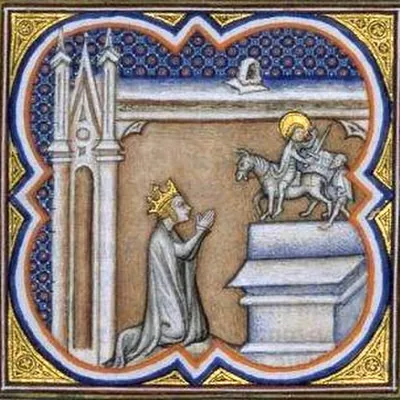
The body of Maglorius did not stay on Sark. The tradition of Léhon tells that monks from Wales, to whom King Nominoe had promised land if they brought him the relics of a Breton saint, went by night to carry off his body from the island. On the way back, a barren apple tree under which they had rested is said to have become covered with fruit. The monastery of Léhon, on the banks of the Rance, was thus placed under his name. Around the beginning of the 10th century, the Viking threat forced the monks to leave for Paris with his relics. They were placed on the Île de la Cité, then in an abbey built for them on the rue Saint-Denis, the abbey of Saint-Magloire. In 1572, they were taken to the church of Saint-Jacques-du-Haut-Pas.
Devotion and art
Saint Maglorius is celebrated on October 24, and on October 27 in the diocese of Quimper and Léon. In Brittany, the parish churches of Telgruc-sur-Mer and Mahalon are dedicated to him, as well as churches at Châtelaudren and Trélivan. On Jersey, he is honored under the name of Saint Mannelier. In Paris, his name remained attached to the former abbey on the rue Saint-Denis and to the Saint-Magloire seminary. He is shown as a bishop, with mitre and crozier, often beside Saint Samson, as in the procession of Breton saints in Rennes Cathedral.

What can we learn from Saint Maglorius?
Maglorius received his cousin's office without seeking it, and he left it in the same way, to return to the life of prayer he loved. His life shows that one can serve the Church by accepting a responsibility, and then by knowing how to hand it on. You can pray to him for bishops and their successors, for monks and nuns, for families in which faith is passed on between cousins and generations, and for those who seek silence in the midst of their duties.
To pray with him, see the prayer to Saint Maglorius and the novena to Saint Maglorius.
Where to pray to Saint Maglorius
- Léhon (Dinan, Côtes-d'Armor): the former abbey of Saint-Magloire, on the Rance, which kept his body in the 9th century.
- Telgruc-sur-Mer and Mahalon (Finistère): parish churches dedicated to him.
- Dol-de-Bretagne (Ille-et-Vilaine): the cathedral of Saint-Samson, seat of the Church he governed.
- Paris: the church of Saint-Jacques-du-Haut-Pas, where his relics were moved in 1572.
Discover also
- Saint Samson of Dol, his cousin, whom he succeeded at Dol.
- Saint Illtud, the Welsh master who trained them both.
- Saint Winwaloe, another founding monk of early Brittany.
- Saint Tugdual, one of the seven founding saints of Brittany.