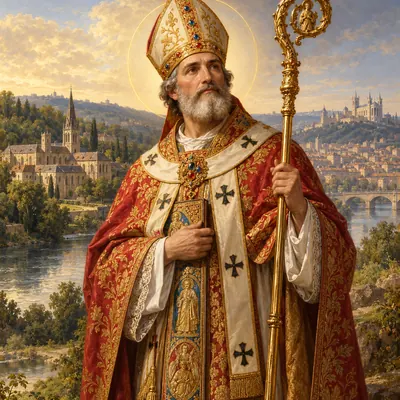
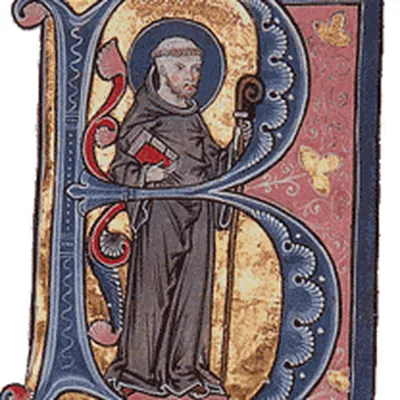
Saint Bénézet is the young shepherd from the Vivarais region of southern France whom tradition credits with building the famous bridge of Avignon in the twelfth century. Arriving in Avignon around 1177 and claiming to be sent by God, he launched, against all odds, the construction of a bridge over the Rhône. He died in 1184, a year before it was finished. Patron saint of Avignon and of bridge builders, he is celebrated on April 14.
Who was Saint Bénézet?
Bénézet is the Provençal form of Benedict: the name means "little Benedict," perhaps because of his youth. In English he is sometimes called Saint Benedict of the Bridge. On his tomb effigy in Avignon, a Latin inscription calls him sancte Benedicte.
His story mixes history and legend. The history rests on a few charters from the 1180s, which show a certain "Brother Benedict" at the head of the bridge works, and on the chronicle of Robert, a canon of Saint-Marien in Auxerre, written from 1190 onward. The legend, set down in the thirteenth century, turned him into a young shepherd moved by a voice from heaven.
Historians remain careful about his age. Several think that a teenager could not have signed contracts or directed such a project, and that Bénézet may have been an older man. An examination of his relics in 1980 showed a man who had died between the ages of 25 and 30. One thing remains: a humble layman, without wealth or power, managed to rally a whole city around a work of charity for travelers.
The shepherd who wanted a bridge
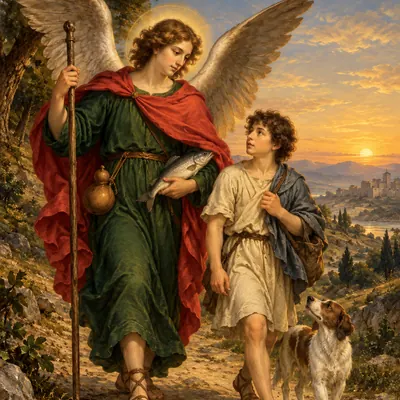
According to the legend, Bénézet was tending his mother's sheep in the mountains of the Vivarais when he heard a voice telling him to go and build a bridge over the Rhône. He objected that he did not know the way and had no money. An angel, disguised as a pilgrim, led him to the river. In Avignon, the bishop, and then the city's provost, laughed at this boy who had come from nowhere.
Robert of Auxerre summed up the event in these words:
"In that same year a young man named Benedict came to Avignon, saying that he was sent by God to build a bridge over the Rhône. He was mocked, because he had no means of doing what he promised. But he insisted with such conviction, and the will of God showed itself so plainly, that the very difficult work was undertaken with enthusiasm."
The most famous story says that, when challenged, Bénézet lifted an enormous stone, one "that thirty men could not have moved," and carried it to the riverbank to serve as the foundation of the first pier. The witnesses cried out at the miracle, and gifts began to pour in. This is the scene that artists remember: a young man carrying a large stone on his shoulder.
A work of charity
In the Middle Ages, building a bridge was seen as a work of mercy. Crossing the wide and violent Rhône was dangerous for merchants and above all for pilgrims on their way to Rome, Santiago de Compostela or the shrines of Provence. Bénézet traveled through the region collecting alms, preached the Gospel and showed great care for the poor who passed by. A confraternity of lay people and religious formed around the work, and it also ran a hospital for travelers, founded in 1181.
After his death, his companions carried on. Tradition links them with the "bridge brothers" (frères pontifes), hospitaller confraternities that built and maintained bridges and welcomed travelers. Completed in 1185, the bridge had more than twenty arches. Damaged many times by wars and floods, it was abandoned in the seventeenth century. Four arches remain today, made famous around the world by the children's song Sur le pont d'Avignon.

The tomb on the bridge
Bénézet died in 1184. The bishop and canons wanted to bury him in the cathedral of Notre-Dame-des-Doms, but, according to tradition, he was laid to rest as he had wished, in a chapel built on the second pier of the bridge. His tomb at once became a place of pilgrimage. The legend tells of many healings of the blind, the deaf and the paralyzed. An inquiry gathered some twenty years after his death, kept in the Vaucluse archives, records the testimonies.
In 1670, as the bridge was falling into ruin, the archbishop had the body moved. After quarrels between parishes and the intervention of King Louis XIV, the relics were entrusted in 1674 to the Celestine monks of Avignon. During the Revolution they were hidden in the church of Saint-Didier, then partly desecrated when the church became a prison. The faithful saved a few fragments, and his skull, hidden in a gilded wooden box, was found again in the nineteenth century. On January 1, 1854, the gathered relics were solemnly returned to Saint-Didier.
Why is Saint Bénézet the patron saint of bridge builders?
Because the bridge of Avignon is his life's work, Bénézet is the patron of engineers and bridge builders. He is one of the patron saints of Avignon, alongside Saint Martha and several holy bishops of the city. Since the late sixteenth century he has also been the patron of the Rhône porters, who formed a confraternity in his name. He is invoked for travelers and for anyone facing a task that seems beyond their strength. In Burzet, his home village according to tradition, a chapel has been dedicated to him since 1727.
Bénézet reminds us that God often chooses the little ones to do great things. Mocked, without money or support, he believed that charity could join two riverbanks. His bridge has become a symbol of bonds to be restored: between peoples, between persons, between earth and heaven.
Symbols and how to recognize Saint Bénézet in art
- A large stone on his shoulder: the first stone of the bridge, his best-known attribute.
- Shepherd's crook: he is shown as a young shepherd, sometimes with a sheep or a fife.
- A bridge over a river: he often stands in front of a river spanned by a bridge.

Where to pray to Saint Bénézet
- Avignon: the collegiate church of Saint-Didier, which keeps his skull and his tomb effigy.
- Avignon: the cathedral of Notre-Dame-des-Doms, which holds other relics and a statue of the saint.
- Avignon: the Saint-Bénézet bridge and its chapel, on the pier where he was first buried.
- Burzet (Ardèche): the chapel of Saint-Bénézet in the hamlet of Le Villard, in his traditional homeland.
To pray with him, see the prayer to Saint Bénézet or follow the novena to Saint Bénézet, from April 5 to 13, ending on the eve of his feast.
Discover also
- Saint Martha, patroness of Provence and one of the patrons of Avignon.
- Saint Benedict of Nursia, whose name Bénézet bears in Provençal.
- Saint Christopher, who carried travelers across the river, patron of travelers.
- Saint Nicholas, protector of boatmen, to whom the bridge chapel is dedicated.