Saint Astius was a bishop of Dyrrachium, today Durrës in Albania, who according to tradition died a martyr at the beginning of the second century under the Emperor Trajan. He is the patron saint of Durrës and one of the oldest figures of Albanian Christianity. The Roman Martyrology commemorates him on July 7.
Who was Saint Astius?
Astius, in Albanian Shën Asti, is known almost only through hagiographical tradition and the martyrologies. No contemporary document tells us about his life, and the accounts of his passion were written much later. It is therefore important to distinguish what is known, his name, his office as bishop of Dyrrachium and his very ancient cult, from what the legend reports.
In the second century, Dyrrachium was a large port city of the Roman province of Macedonia, on the Adriatic coast. It stood at the start of the Via Egnatia, the great road that linked the Adriatic to Thessalonica and Byzantium. Christianity arrived there very early: in his Letter to the Romans, the apostle Saint Paul says he preached the Gospel "as far as Illyricum" (Romans 15:19). Local tradition links the founding of the Church of Durrës to the apostolic age.
The passion of Saint Astius
According to the traditional account, Astius saw in a dream the sufferings that awaited him. Arrested by Agricola, the governor of the city, he was ordered to offer sacrifice to Dionysus. He refused. He was beaten with lead-weighted whips, and then, to increase his suffering, his body was smeared with honey so that insects would sting him. Finally he was crucified. Christians took his body and buried it.
The seven martyrs from Italy
Tradition joins to his memory that of seven Christians who had come from Italy to escape persecution: Peregrinus, Lucian, Pompeius, Hesychius, Papias, Saturninus and Germanus. Having seen the bishop's steadfastness, they publicly praised his courage. Arrested in their turn, they were thrown into the sea. Their bodies, washed ashore by the waves, were buried on the coast. These martyrs are honored on the same day as Astius in tradition.
These accounts follow patterns common to the passions of martyrs, and their details are hard to verify. But they bear witness to an ancient memory of the first persecutions on the shores of the Adriatic.
Devotion to Saint Astius
Astius is venerated by both the Catholic Church and the Orthodox Churches. The Roman Martyrology names him on July 7 as bishop and martyr of Dyrrachium. In the Orthodox Church he is commemorated on a nearby date in early July, and the Orthodox Church of Albania holds him in special honor.
Durrës regards him as its patron saint. After decades of state atheism, which had closed or destroyed most places of worship in the country, a large Orthodox cathedral dedicated to Saint Paul and Saint Astius was built in Durrës and opened in 2009. Catholics of the Archdiocese of Tirana-Durrës also keep his memory, together with that of the other martyrs of Albania, from the first centuries to the twentieth.

Why is Saint Astius the patron saint of Durrës?
Astius is the patron of Durrës because, according to tradition, he was its bishop and shed his blood there for Christ. He represents the earliest roots of the local Church, planted in a busy Roman port where travelers, merchants and missionaries passed on their way between Italy and the East.
His witness has taken on a new meaning since the twentieth century. Albania lived through a persecution without precedent, when the communist regime declared the country officially atheist in 1967 and banned all religious practice. For Albanian Christians, Catholic and Orthodox alike, the memory of a first-century martyr speaks of a faith that has survived many trials. He can be invoked for the Church in Albania, for unity between Catholic and Orthodox Christians, and for all who are persecuted for their faith.
What Saint Astius teaches today
We know very little about Astius, and that is part of his lesson. Most of the early martyrs left no writings and no detailed biography. What the Church has kept is their faithfulness: they would not put anything above Christ. For English-speaking Catholics who may never have heard of him, Astius is a reminder that the faith reached many lands, including the Balkans, long before it reached our own, and that it was handed on at great cost.
The seven Christians who praised his courage and died for it also speak to us. They were refugees, far from home, yet they did not keep silent. Their story honors everyone who speaks up for a person who is being treated unjustly.
Symbols and how to recognize Saint Astius in art
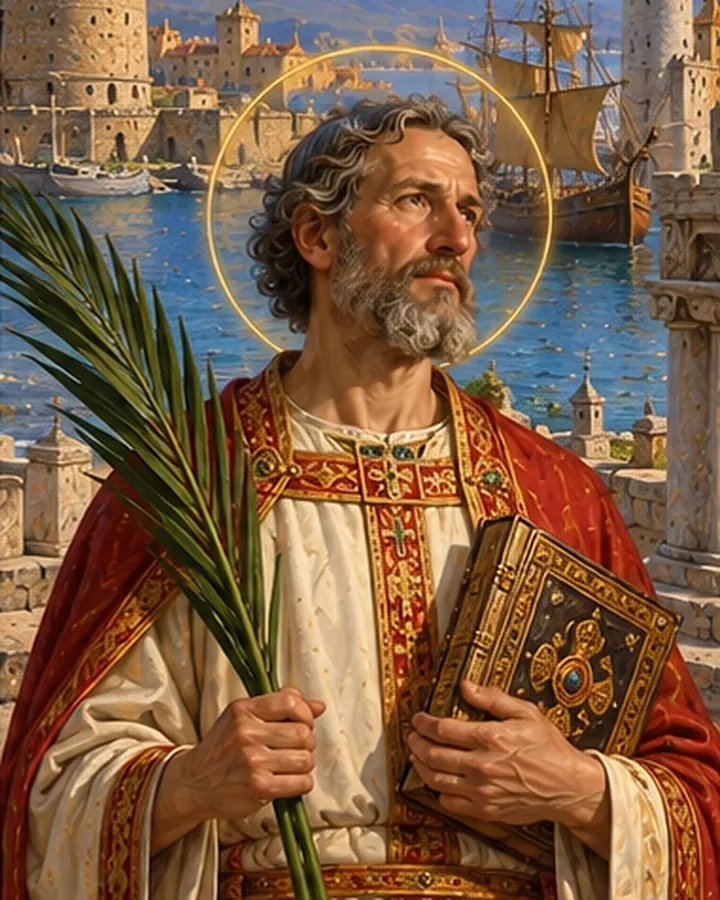
In icons, Astius is shown as a bishop of the Eastern tradition, wearing the omophorion, the broad stole decorated with crosses, and holding the Gospel book. He is sometimes shown crucified, or surrounded by the seven martyrs who witnessed his death.
Where to pray to Saint Astius
- Durrës (Albania): the Orthodox Cathedral of Saint Paul and Saint Astius.
- Durrës: the Catholic churches of the city, which keep his memory.
- Durrës: the Roman amphitheater, which contains an early Christian chapel decorated with mosaics, a witness to the city's first Christians.
To pray with him, you can use the prayer to Saint Astius or the novena to Saint Astius, prayed from June 29 to July 7.
Discover also
- Saint Paul, who preached the Gospel as far as Illyricum.
- Saint Ignatius of Antioch, a bishop martyred under the same emperor, Trajan.
- Saint Clement of Rome, pope and martyr of the same period.
- Saint Teresa of Calcutta, born into an Albanian family, the best-known Christian figure of this people.