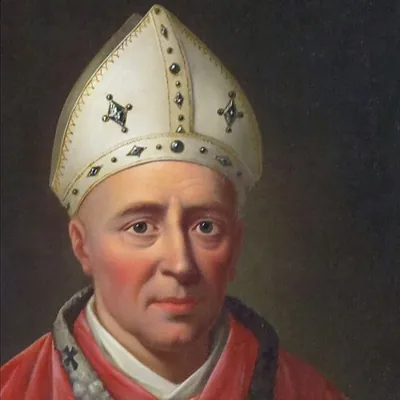
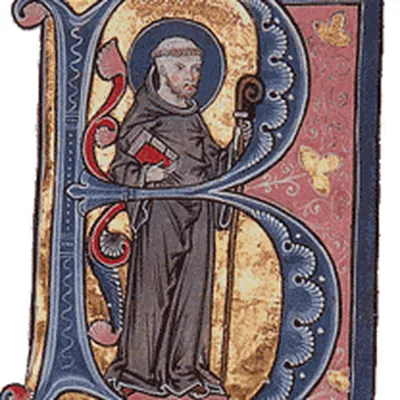
Saint Allucio of Campugliano was a Tuscan layman of the 11th and 12th centuries. A cattle breeder in the Valdinievole, between Florence and Lucca, he devoted his life to welcoming travelers and pilgrims: he founded a hospice, gathered a brotherhood of charity around him and had a bridge built over the Arno to protect pilgrims on their way to Rome. He died on October 23, 1134, and was proclaimed a saint by the bishop of Lucca in 1182. His relics rest in the cathedral of Pescia. His feast day is October 23.
Who was Saint Allucio?
Allucio belongs to the movement of lay people in the central Middle Ages who, without entering a monastery or becoming priests, made their lives a service to the poor and to travelers. He was born around 1070 at Campugliano, today Sant'Allucio, in the municipality of Uzzano, in the present province of Pistoia. The son of a man named Omodeo, he earned his living as a cattle breeder. But his home stood near a busy road, the old route linking Florence to Lucca, along the line of the Via Cassia and the Via Clodia. He saw merchants, poor people and pilgrims pass by, often exhausted or in danger, and decided to take them in.
What we know of him comes from chronicles and traditions gathered by the Church of Lucca and Pescia, to which hagiography added miracles. The main lines of his life, his hospice, his brotherhood and his bridge, are however well attested, and historians such as André Vauchez cite him among the typical lay saints of his time.

The hospice of Campugliano
Near his home, Allucio founded a xenodochium, that is, a house of hospitality for strangers and pilgrims, like those found along the great medieval roads. He added a church dedicated to Saint Luke and Saint Herculanus. Travelers found a meal there, shelter for the night, and care if they were sick. His simple but resolute faith and his kindness attracted men who wanted to help him: they formed a kind of lay brotherhood of charity, the fratres Allucii, the "brothers of Allucio".
His work was encouraged by the priests of Pescia and by the bishop of Lucca himself. It gradually spread beyond the Valdinievole, as far as the Po plain.
A bridge for pilgrims
On the road to Rome, pilgrims had to cross the Arno. At one point on the river, a local lord charged them dearly to ferry them from one bank to the other. Allucio had a bridge built, putting an end to this racket and making the crossing free. This very practical gesture is typical of the lay holiness of his time: building a bridge, maintaining a road or a hospice, was a work of mercy, just like feeding the hungry.
Prayer, penance and peace
Allucio was a man of action, but also a man of prayer, with a deep devotion to the Eucharist. He often fasted, especially during Lent. Tradition attributes miracles to him, and a devotional account says that his moral authority led to the suspension of a war between the cities of Faenza and Ravenna. These elements belong to hagiography, but they show the esteem in which he was held: that of a man of peace, listened to far beyond his village.
Death and devotion
Allucio died on October 23, 1134, at Campugliano. His brothers buried him in the church of the hospice. Forty-eight years later, to the day, on October 23, 1182, the bishop of Lucca proclaimed him a saint, at a time when bishops could still recognize the holiness of a believer themselves. In 1344, his bones were placed in a stone urn on the high altar. The hospice later passed to the Knights of Saint John of Jerusalem, then to the Order of Malta, which kept it until 1791. That year, the establishment was closed and sold, and the bishop of Pescia had the relics transferred to the cathedral, despite the protests of the neighboring parish of Uzzano, which wanted to keep them.
In 1934, a chapel of Saint Allucio was fitted out in the cathedral of Pescia to display the urn for the veneration of the faithful. In 2000, he was declared secondary patron of the diocese of Pescia, alongside Our Lady of Fontenova of Monsummano.
What can we learn from Saint Allucio?
Allucio shows that one can become a saint without leaving one's trade or one's land, by opening one's door to those who pass by. He saw a concrete need, the welcome of travelers and the safety of pilgrims, and he answered it with the means he had, drawing others along with him. You can pray to him for migrants and travelers, for those who work in hospitality and shelters, for livestock farmers and for all lay people committed to charity.
To pray with him, see the prayer to Saint Allucio and the novena to Saint Allucio.
Where to pray to Saint Allucio
- Pescia (Tuscany): the cathedral, where his relics rest in the chapel dedicated to him.
- Sant'Allucio, at Uzzano (Tuscany): the former Campugliano, where his hospice stood.
Discover also
- Saint Bénézet, the young shepherd who built the bridge of Avignon.
- Saint Dominic de la Calzada, who built roads and bridges for the pilgrims of Compostela.
- Saint Zita of Lucca, another lay saint of the diocese of Lucca.
- Saint Homobonus of Cremona, a lay merchant and friend of the poor.