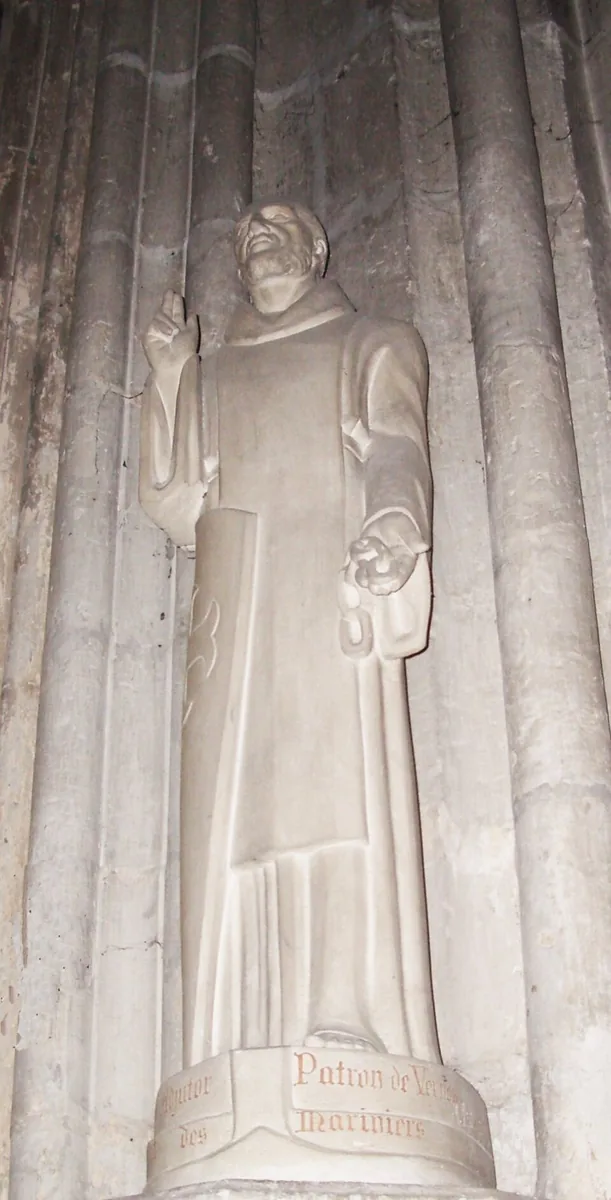
Saint Adjutor (also found as Adjuteur, Ajutre or Ustre) was a Norman knight of the 11th and 12th centuries. Born around 1070, probably at Vernon, he went on the First Crusade, then came home to give himself to God, first as a Benedictine monk of the abbey of Tiron, then as a hermit at Pressagny-l'Orgueilleux, on the bank of the Seine, where he died on April 30, 1131. Patron of Vernon and of boatmen, his feast day is April 30.
Who was Saint Adjutor?
Adjutor was the son of John, lord of Vernon, and Rosamonde of Blaru. His name comes from the Latin adjutor, "the one who helps", and popular piety saw a whole program in that name. His life is known mainly through late accounts, such as the Life of Saint Adjutor published by Jean Théroude in 1638, which mix historical elements with many legends. Historians retain a Norman nobleman who took part in the crusade, became a monk, then lived as a solitary on his own lands, where he welcomed the sick and the troubled. After his death, the monks of Tiron built a priory around his tomb. He should not be confused with Saint Maxentius, who is sometimes also called Adjutor.
The crusader faithful in trial
In 1095, Pope Urban II called on the knights of the West to help the Christians of the East and free Jerusalem. Adjutor joined the army of Robert Curthose, the eldest son of William the Conqueror. Tradition reports an episode near Antioch: caught in an ambush with his companions, he called on Saint Mary Magdalene and promised, if he escaped, to build her a sanctuary and give his property to the abbey of Tiron. A violent storm then broke out and put the attackers to flight.
Later, Adjutor was taken prisoner. His biographers insist on this point: despite ill treatment and chains, he kept his faith. According to legend, he was miraculously freed and carried back to Vernon. In fact, we do not know what he did between the capture of Jerusalem, in July 1099, and his return to Normandy, which is placed between 1112 and 1130. The chains he holds in his hand, in his statues, recall this captivity.
From knight to monk and hermit
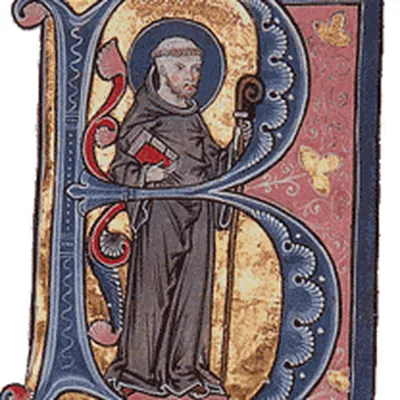
Back on his lands, Adjutor kept the promise he had made in danger. He built a chapel to Saint Mary Magdalene and gave his estates to the abbey of the Holy Trinity of Tiron, founded shortly before in the Perche by Saint Bernard of Tiron. He himself became a Benedictine monk there. But he was drawn to a more solitary life: he withdrew to a hermitage on his property of Le Mont, at Pressagny-l'Orgueilleux, on the bank of the Seine. He spent his last years there in prayer and penance. People came to see him, and he received the sick and the afflicted with kindness; several of them, it is said, recovered their health.
A charming legend is attached to his return. Arriving near the castle of Blaru, he sent a shepherd to announce his coming to his mother, who refused to believe it. Adjutor sent the shepherd back with this message: her son was coming, as surely as the rooster roasting on the spit would crow. And the rooster crowed. This popular story is not historical, but it shows the affection the Normans had for their saint.
The miracle of the Seine whirlpool
The most famous episode of his life took place on the Seine, near Vernon. A whirlpool, whose eddies dragged boats down, caused many shipwrecks. According to the account, Adjutor got into a boat with Hugh, Archbishop of Rouen, and a few boatmen. Above the whirlpool, he called on Saint Mary Magdalene and threw his chains into the water. At once the eddies calmed, and the boatmen could sail again without danger. That is why the boatmen of the Seine chose him as their patron. Tradition also credits him with protecting Vernon from fire and plague.
Devotion and art
Adjutor died on April 30, 1131, in his hermitage. The monks of Tiron, heirs to the estate, built the priory of La Madeleine around his tomb. His cult, which has remained very much alive in Normandy, was never the subject of a formal canonization: it is an ancient cult, recognized locally, and the diocese of Évreux counts him among its saints. Vernon honors him as its patron: a district and a Catholic school bear his name.
He is shown as a knight monk, dressed in a rough habit, a shield at his side, chains in his hand. The collegiate church of Notre-Dame in Vernon keeps a statue of him and a painting by Julien Devos, made around 1873, showing the miracle of the Seine. A bas-relief on the rue Bourbon-Penthièvre, in Vernon, depicts the same scene, and the abbey church of Thiron-Gardais has a statue of the saint in chains.

What can we learn from Saint Adjutor?
Adjutor was a man who kept his word. In danger, he made a promise to God, and once saved, he did not forget it: he gave his goods and his life. The knight became a monk, then a hermit, and the man of arms became the friend of the sick and of boatmen. His chains, a sign of his captivity, become in the miracle of the Seine an instrument of peace. You can pray to him for those who work on the water, for those going through a trial, and to learn to be faithful to your commitments.
To pray with him, see the prayer to Saint Adjutor and the novena to Saint Adjutor.
Where to pray to Saint Adjutor
- Vernon (Eure): the collegiate church of Notre-Dame, with his statue and the painting of his miracle.
- Pressagny-l'Orgueilleux (Eure): the place of his hermitage and his death, where the priory of La Madeleine was built.
- Thiron-Gardais (Eure-et-Loir): the abbey church of the former abbey of Tiron, where he was a monk.
Discover also
- Saint Mary Magdalene, whom he called on in danger and to whom he dedicated his chapel.
- Saint Bernard of Tiron, founder of the abbey where Adjutor became a monk.
- Saint Maxentius, an abbot of Poitou, another saint sometimes called Adjutor.