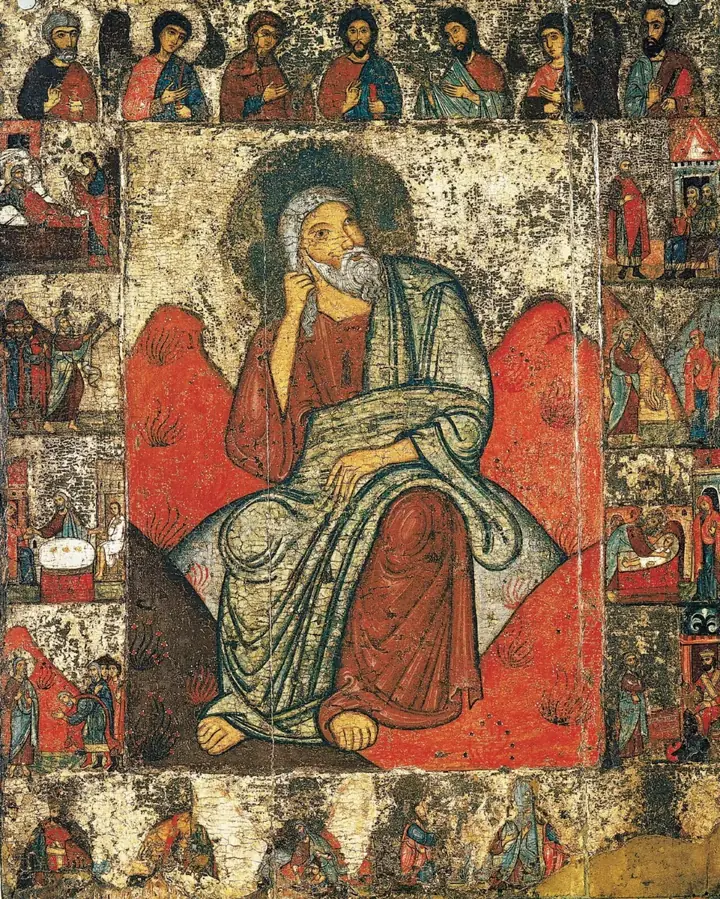
Elijah is one of the greatest prophets of the Old Testament. In the ninth century BC, in the kingdom of Israel, he stood alone against King Ahab and Queen Jezebel, who had brought in the worship of Baal. On Mount Carmel he challenged the prophets of Baal and called down fire from heaven. Discouraged, he met God at Horeb in "a still small voice," then was taken up to heaven in a chariot of fire. Carmelite friars and nuns regard him as their spiritual father. The Roman Martyrology commemorates him on July 20.
Who was the prophet Elijah?
His story is told in the first and second books of Kings (1 Kings 17 to 2 Kings 2). Elijah the Tishbite came from Gilead, east of the Jordan. His name, Eliyahu in Hebrew, means "My God is the Lord," and sums up his whole mission: to remind Israel, tempted by the fertility gods, that there is only one God. Clothed in a cloak of hair with a leather belt, solitary and fiery, he is the model of the prophet. Neither his birth nor his death is known, since the Bible says he was taken up to heaven.
The drought, the ravens and the widow of Zarephath
Elijah suddenly appeared before King Ahab: "As the Lord lives, there shall be no dew or rain these years except at my word" (1 Kings 17:1). Then he hid by the brook Cherith, where ravens brought him bread and meat morning and evening. When the brook dried up, God sent him to Zarephath, in pagan territory, to a widow who had only a handful of flour and a little oil. Elijah asked her to share: "The jar of flour shall not go empty, nor the jug of oil run dry." Later he brought her son back to life. Jesus would recall this story: God sent his prophet to a foreign woman (Luke 4:25-26).

Fire on Mount Carmel
In the third year, Elijah gathered all the people on Mount Carmel, facing the four hundred and fifty prophets of Baal: "How long will you straddle the issue? If the Lord is God, follow him; if Baal, follow him" (1 Kings 18:21). Each side prepared a bull on an altar without lighting the fire. The prophets of Baal cried out from morning to evening: nothing happened. Elijah had his altar drenched three times with water, then prayed simply. The fire of the Lord fell and consumed everything, even the water in the trench. The people fell on their faces: "The Lord is God!" Soon after, from the top of Carmel, Elijah's servant saw a small cloud rising from the sea, "as small as a man's hand," and the rain came at last.
The still small voice at Horeb
Threatened with death by Queen Jezebel, Elijah fled into the desert. Exhausted, he sat under a broom tree and prayed for death: "Enough, Lord!" An angel woke him twice: "Get up and eat, else the journey will be too long for you." Strengthened by this bread, he walked forty days and forty nights to Horeb, the mountain of God where Moses had received the Law.
There God passed by. There was a mighty wind, an earthquake, a fire, but the Lord was in none of them. Then came "a still small voice," the sound of a gentle breeze (1 Kings 19:12): Elijah hid his face in his cloak, for God was there. This page has become one of the most pondered in the Bible on silent prayer. God then sent Elijah back on mission and had him choose Elisha as his successor: Elijah threw his cloak over him, and Elisha left his oxen to follow him.
The chariot of fire
At the end of his mission, Elijah walked with Elisha toward the Jordan. He struck the water with his rolled-up cloak, and they crossed on dry ground. Elisha asked for a double share of his spirit. Then "a flaming chariot and flaming horses came between them, and Elijah went up to heaven in a whirlwind" (2 Kings 2:11). Elisha picked up his master's fallen cloak and carried on his work. Because Elijah had not died, his return was expected before the coming of the Messiah (Malachi 3:23).
Elijah in the New Testament
The angel announced that John the Baptist would go before the Lord "in the spirit and power of Elijah" (Luke 1:17), and Jesus said of John: "Elijah has already come." At the Transfiguration, on the mountain, Elijah and Moses appeared beside Jesus, the Law and the Prophets bearing witness to Christ. On the cross, when Jesus cried "Eli, Eli," some thought he was calling Elijah.
The father of Carmel
In the twelfth century, Latin hermits settled on Mount Carmel, near the "spring of Elijah," to live in prayer after his example. They were the origin of the Carmelite Order, which regards Elijah as its father and took his words as its motto: "I have been most zealous for the Lord, the God of hosts." The great Carmelite saints, Teresa of Avila, John of the Cross and Edith Stein, were nourished by his example of solitude and prayer.
Why do Catholics honor the prophet Elijah?
Elijah is a man of fire, able to defy a king, and at the same time fragile, collapsing with exhaustion and wishing to die. God does not judge him: he feeds him, lets him sleep, then reveals himself in silence. Christians pray with Elijah for courage in faith, for strength in discouragement and to learn to listen to God in silence.
To pray with him, read the prayer to the prophet Elijah, or follow the novena to the prophet Elijah, from July 11 to 19.
Where to pray to the prophet Elijah
- Haifa (Israel): the Stella Maris Monastery on Mount Carmel, mother house of the Carmelites, built over the cave of Elijah.
- Muhraqa (Israel): on a summit of Carmel, a Carmelite monastery marks the traditional site of Elijah's sacrifice against the prophets of Baal.
- Sinai (Egypt): near Saint Catherine's Monastery, a chapel of Saint Elijah marks the place where, by tradition, he met God.
- All over the world: every Carmel keeps a living memory of the prophet, celebrated solemnly on July 20.
Discover also
- Saint John the Baptist, who came "in the spirit and power of Elijah."
- Saint Teresa of Avila, reformer of Carmel.
- Saint Simon Stock, English Carmelite, linked to the tradition of the scapular.
- King David, king and prophet, author of the Psalms.
- Saint Malachi, the prophet who announced Elijah's return.


