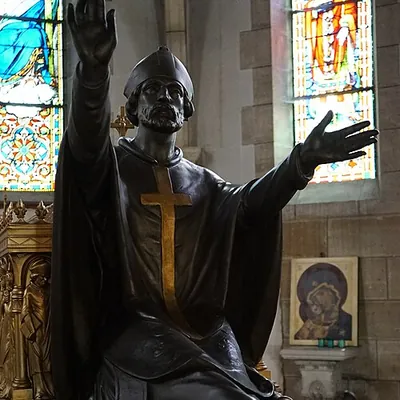
Saint Yon (Ionius or Aeonius in Latin) is a priest and martyr of the late 3rd century, honored in the south of the Île-de-France region. According to tradition, a disciple of Saint Denis of Paris, he evangelized the Hurepoix, in particular Châtres, present-day Arpajon, before being put to death around 290 on the hill that now bears his name, at Saint-Yon, in the Essonne. His feast day is August 5.
Who was Saint Yon?
Saint Yon belongs to the first missionaries of the Paris region. What we know of him comes from local traditions and late hagiographical accounts, which link him to Saint Denis, the first bishop of Paris. Historians cannot verify the details of his life: his date of birth, his origin and the exact circumstances of his death remain unknown. But his cult is very old and has taken root in the places that keep his memory, as shown by the name of the village of Saint-Yon, attested from the 12th century in the Latin form Sanctus Ionus, and by the Romanesque church dedicated to him.

A disciple of Saint Denis
In the 3rd century, Gaul still had few Christians outside the towns. According to tradition, Saint Denis, sent from Rome, founded the Church of Paris and gathered companions whom he sent to proclaim the Gospel in the countryside. Yon is said to have been one of them. He headed south, into the wooded and hilly region of the Hurepoix, between the Seine and the Beauce. At Châtres, present-day Arpajon, he is said to have gathered the first converts and built a church. This is why Arpajon honors him as a secondary patron of the town.
Martyrdom on the hill
Persecution finally reached the missionary. Tradition reports that Yon was put to death around 290 on a nearby hill, where the village of Saint-Yon now stands, above the valley of the Renarde. No reliable ancient account describes his torment: local tradition has above all kept the memory of the place. A church was later built there, and the village took the martyr's name. During the Revolution, the commune was for a time called "Yon", before recovering its present name in 1801.
Devotion and art
Saint Yon is the patron of the parish of Saint-Yon and the secondary patron of Arpajon. His cult remains mostly local, in the diocese of Évry-Corbeil-Essonnes. The church of Saint-Yon, built in the 12th century on an ancient hill fort, was restored in the 17th and 19th centuries and listed as a historic monument in 1948. In the basilica of Notre-Dame-de-Bonne-Garde at Longpont-sur-Orge, a fresco shows him beside Saint Denis, his master according to tradition. He can also be seen in the church of Saint-Clément in Arpajon.
His name had an unexpected destiny. In the 18th century, the Brothers of the Christian Schools, founded by Saint John Baptist de La Salle, had their main house at the manor of Saint-Yon, near Rouen. For this reason, they were long called the "Brothers of Saint-Yon".

What can we learn from Saint Yon?
Saint Yon is one of those almost anonymous missionaries who carried the Gospel into the countryside of Gaul. He left neither writings nor great works, but a living Church, and his name has remained attached to a hill and a village. He reminds us that the faith of our regions rests on the courage of humble witnesses. You can pray to him for priests and missionaries, for rural parishes, and for all who proclaim Christ where he is still little known.
To pray with him, see the prayer to Saint Yon and the novena to Saint Yon.
Where to pray to Saint Yon
- Saint-Yon (Essonne): the church of Saint-Yon, on top of the hill of his martyrdom according to tradition.
- Arpajon (Essonne): the former Châtres, of which he is the secondary patron, and the church of Saint-Clément.
- Longpont-sur-Orge (Essonne): the basilica of Notre-Dame-de-Bonne-Garde, where a fresco shows him with Saint Denis.
Discover also
- Saint John Baptist de La Salle, founder of the Brothers of the Christian Schools, known as the "Brothers of Saint-Yon".
- Saint Marcellus of Paris, another great figure of the early Church of Paris.
- Saint Genevieve, patron saint of Paris.