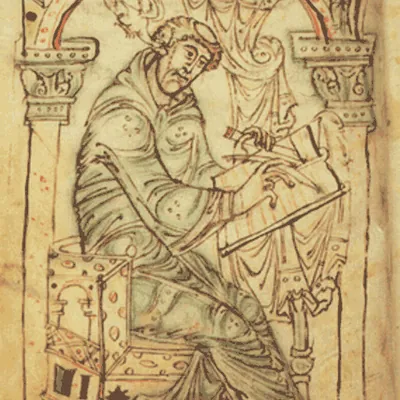
Saint Widrad (also called Waré, Guiré or Wideradus) was a powerful Burgundian lord of the 8th century who founded the Benedictine abbey of Flavigny, in Burgundy, in 719, and later became its abbot. He died on October 3, 747 and was buried in his abbey, where the monks honored him as a saint. His feast day is October 3.
Who was Saint Widrad?
Widrad is known above all through his wills, legal documents that are rare and precious for the Merovingian period, in which he gives his lands to monasteries. They reveal a great landowner of Burgundy, the son of a certain Corbo, who devoted his fortune to founding and endowing houses of prayer. Beyond that, almost nothing is known of his personal life. Historians even debate his status: some regard him as a lay abbot, that is, a lord administering the property of a monastery, others, like the Benedictine scholar Mabillon, as a true regular abbot. What is certain is that the monks of Flavigny venerated him as their holy founder and celebrated his feast on the day of his death.

A lord who gave his property to God
At the beginning of the 8th century, Frankish Gaul saw a flowering of monastic foundations. By giving land to monks, the great families secured prayer for their dead and the growth of Christian life in the countryside. Widrad took part in this movement with remarkable generosity. In his will, he declares that he built a monastery "with his own funds and at his own expense" at the place called Flavigny, and handed it over according to the rule to Abbot Magnoald and his monks, for them to possess forever. The monks of Flavigny followed the Rule of Saint Benedict.
The same will shows the extent of his gifts. Widrad also presents himself as abbot of the monastery of Saint Reine at Alise, the place where the young Burgundian saint was martyred, and leaves it many estates, such as Chichée, Ancy-le-Franc, Ravières and Savoisy. He gave the basilica of Saint-Andoche at Saulieu lands in the Auxois, the Avallonnais and the Nivernais: in gratitude, the monks of Saulieu regarded him as their founder.
A caring brother
Tradition says that Widrad founded two monasteries for his sisters: Saint-Andoche at Saulieu for one of them, named Decia, and Notre-Dame at Faverney, in 722, for the other, whose name history has not kept. These foundations say something about the man: his faith was not only a matter of property, but also of family. He wanted to offer his own a place where they could consecrate their lives to God.
The abbot of Flavigny
In 745, on the death of the first abbot, Magnoald, Widrad himself took charge of the abbey. That same year, the foundation charter of Flavigny was approved at the council of Autun. He drew up a second will at Autun, in 746 or 747. He died on October 3, 747, away from his monastery; his body was brought back to Flavigny and buried in the abbey he had founded.
Devotion and memory
The monks of Flavigny kept alive the memory of their founder. The old martyrology of the abbey records on October 3 the burial of "the blessed Widrard, abbot and founder of this place", and the calendar reported in the chronicle of Abbot Hugh of Flavigny names him "Saint Widrard, abbot of Flavigny". His office was celebrated as a feast of the abbey on the day of his death. In 1379, a document still obliged the abbot to give his monks a festive meal on October 3, the feast of their holy founder. The French calendar site Nominis also lists him on that date.
The abbey he founded went on to have a great history: in the 9th century it received the relics of Saint Reine, and Pope John VIII consecrated its church in 878. Sold during the Revolution, it now houses an aniseed sweet factory, but its Carolingian crypt can still be visited.

What can we learn from Saint Widrad?
Widrad left neither spiritual writings nor accounts of miracles. He left foundations. Rich and powerful, he understood that his property could serve something more lasting than his own glory: communities that would pray for centuries. You can pray to him to learn the Christian use of money, for the benefactors of the Church, and for families who pass on the faith.
To pray with him, see the prayer to Saint Widrad and the novena to Saint Widrad.
Where to pray to Saint Widrad
- Flavigny-sur-Ozerain (Côte-d'Or): the crypt of the abbey of Saint-Pierre, which he founded and where he was buried.
- Saulieu (Côte-d'Or): the basilica of Saint-Andoche, whose monks regarded him as their founder.
- Alise-Sainte-Reine (Côte-d'Or): the site of the monastery of Saint Reine, which he endowed with his lands.
- Faverney (Haute-Saône): the former abbey of Notre-Dame, founded according to tradition for one of his sisters.
Discover also
- Saint Reine, the martyr of Alise, whose relics were later venerated at Flavigny.
- Saint Benedict of Nursia, whose rule was followed by the monks of Flavigny.
- Saint Benedict of Aniane, the great reformer of Benedictine monasteries in the Carolingian era.