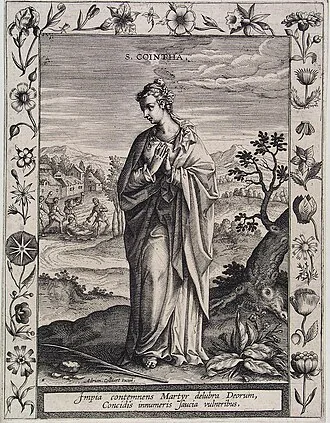
Saint Quinta (also called Cointha) was a martyr of Alexandria, in Egypt, who died in 249. An ordinary Christian, she refused to worship idols during an anti-Christian riot shortly before the persecution of Emperor Decius, and was put to death by the mob. Her martyrdom is reported by a first-hand witness, Bishop Saint Dionysius of Alexandria. Her feast day is February 8.
Who was Saint Quinta?
Of Saint Quinta we know almost nothing except her death. But what we do know is solid: the account comes from a letter by Dionysius, bishop of Alexandria at the time of the events, addressed to Fabius, bishop of Antioch, and copied by the historian Eusebius of Caesarea into his Ecclesiastical History. It is one of the most direct testimonies we have about the martyrs of the 3rd century. Dionysius says nothing of Quinta's age, family or occupation; he presents her only as "a believing woman". Her greatness lies entirely in her refusal to deny Christ.

The riot of Alexandria
In the middle of the 3rd century, Alexandria was one of the largest cities of the Roman Empire, and its Christian community was large. At the beginning of the year 249, Dionysius tells us, a man who called himself a soothsayer and poet stirred up the pagan crowd against the Christians. This was not yet a persecution ordered by the emperor: it was popular violence, which lasted about six months and came a year before the imperial edict.
The first victim was an old man named Metras. When he refused to blaspheme Christ, the mob beat him, wounded him cruelly and stoned him outside the city. Then it turned on a Christian woman: Quinta.
The martyrdom of Quinta
According to the account of Dionysius, handed down by Eusebius, Quinta was taken by force into a temple of the idols, and they tried to make her bow down. She turned away in disgust. They then tied her feet and dragged her through the whole city over the rough paving stones; she was scourged and dashed against millstones, then taken to the same place as Metras, where she was put to death.
The blood of the first martyrs, Dionysius adds, did not calm the crowd: the rioters fell upon the houses of the Christians, plundered them and killed others. Among them was the virgin Apollonia, whose martyrdom is told in the same letter. Many Christians of Alexandria, the bishop reports, accepted the loss of their goods with joy.
Cult and art
Saint Quinta is honored by the Catholic Church as a martyr, with a feast on February 8. She is also venerated by the Orthodox Churches. No particular shrine keeps her memory today, but she belongs to the great family of the martyrs of Alexandria, alongside Saint Metras and Saint Apollonia. Artists show her as a young woman being stoned, scourged, or tied by the feet and dragged behind a horse, in memory of the torment described by Dionysius.
What can we learn from Saint Quinta?
Saint Quinta was neither a bishop, nor a nun, nor a famous figure: she was an ordinary Christian, of whom history has kept only one gesture. Before the idols, she turned away. This refusal, which cost her her life, reminds us that faithfulness to Christ is often decided in a simple, decisive choice. You can pray to her for persecuted Christians, for those who suffer the violence of a crowd or a group, and for the courage not to deny your faith under pressure.
To pray with her, see the prayer to Saint Quinta and the novena to Saint Quinta.
Where to pray to Saint Quinta
- On February 8, in any church, in union with the Church that keeps her memory.
- Alexandria (Egypt): the city of her martyrdom, where a Christian community still lives.
Discover also
- Saint Dionysius of Alexandria, the bishop who recounted her martyrdom.
- Saint Apollonia, a virgin martyred at Alexandria during the same riot.
- Saint Fabian, pope and martyr in 250 under Emperor Decius.