Saint Polyeuctus was a Roman officer martyred at Melitene, in Lesser Armenia, in the third century. Won to the faith by the example of his friend Nearchus, he was put to death for refusing to sacrifice to the gods of the Empire. His cult, very old in the East, inspired one of the greatest churches of Constantinople and, many centuries later, a famous tragedy by the French playwright Pierre Corneille. The Catholic Church celebrates him on February 13.
Who was Saint Polyeuctus?
According to tradition, Polyeuctus was a wealthy officer of the Twelfth Roman Legion, the legion known as "Fulminata" (the Thundering Legion), stationed at Melitene, today's Malatya, in eastern Turkey. He died a martyr under Emperor Decius, in the middle of the third century. The date of January 10, 259, is often given, although it fits poorly with the reign of Decius, who died in 251.
The detailed account of his martyrdom has come down to us mainly through the Byzantine hagiographer Symeon Metaphrastes, who wrote in the tenth century, several hundred years after the events. That calls for caution about the details of the story. The antiquity of his cult, however, is solidly established, and that is the most reliable witness to the memory of a martyr whom the early Christians honored by name.
A soldier won by a friend
In the account of Symeon Metaphrastes, Polyeuctus is deeply moved by the zeal of his friend and fellow soldier Nearchus, who was already a Christian. Friendship opened the door to faith: Polyeuctus came to believe in turn. With the fervor of a new believer, he then openly attacked the official cult. He tore down the edict of Emperor Decius posted in the public square, which ordered everyone to honor the gods, and he smashed idols on his way. This spectacular act led to his arrest.
The tears of his family
The authorities had him tortured to make him give in. His wife, Pauline, and his father-in-law, Felix, a magistrate of the city, begged him in tears to offer sacrifice and save his life. The scene is one of the most moving in his story: the pressure did not come only from judges and executioners, but from the people he loved most. Polyeuctus refused and confessed his faith to the end. He was beheaded.
A baptism of blood
According to some traditions, Polyeuctus died before he had even received baptism with water. The Church has always taught that catechumens who die for Christ are baptized in their own blood. For this reason, Polyeuctus is often cited as an example of the "baptism of blood," the gift of one's life that unites a believer fully to the death and resurrection of Christ.
An ancient cult
Buried at Melitene, Polyeuctus was venerated there in a church dedicated to him, whose existence is attested as early as the fifth century. It was in this church that the parents of the monk Euthymius the Great came to pray for the birth of a son.
In Constantinople, the wealthy princess Anicia Juliana had a Church of Saint Polyeuctus built between 524 and 527. It was then the largest church in the capital. Its remains were identified thanks to an inscription in the Saraçhane district of Istanbul and have been excavated since the 1960s. Their sculptures, inspired by Persian art, are among the finest of the Byzantine period.
In the Byzantine Empire, people invoked Polyeuctus as the guarantor of oaths and treaties. A man who refused to break faith with God, even at the cost of his life, seemed the right witness for promises made before him.
From Melitene to Corneille
In 1642, Pierre Corneille drew from the martyrdom the tragedy Polyeucte martyr, one of the high points of French classical theater. He imagines a conflict between human love, that of Pauline for her husband and for Severus, and the call of grace, which in the end touches Pauline herself. The play later inspired operas by Donizetti (Poliuto) and Gounod, and an overture by Paul Dukas. For many English-speaking readers, this literary and musical tradition is the first way they meet the saint's name.
Why is Saint Polyeuctus the patron of oaths and treaties?
Saint Polyeuctus is not linked to a long list of modern patronages. In the Byzantine tradition, however, he was invoked as the protector of oaths and treaties. His fidelity, kept even through torture and the pleas of his own family, made him a natural patron for those who give their word. Today, Catholics can also pray to him for soldiers, for new converts and for anyone who must choose between conscience and the pressure of those around them.
What can we learn from Saint Polyeuctus?
Polyeuctus reminds us that faith can be born from the witness of a friend, and that it may ask us to give everything. His impulsive zeal, tearing down edicts and breaking statues, is not a model to copy in its actions. But his faithfulness until death, in spite of the tears of those he loved, remains an example for every believer who meets opposition close to home.
Symbols and how to recognize Saint Polyeuctus in art
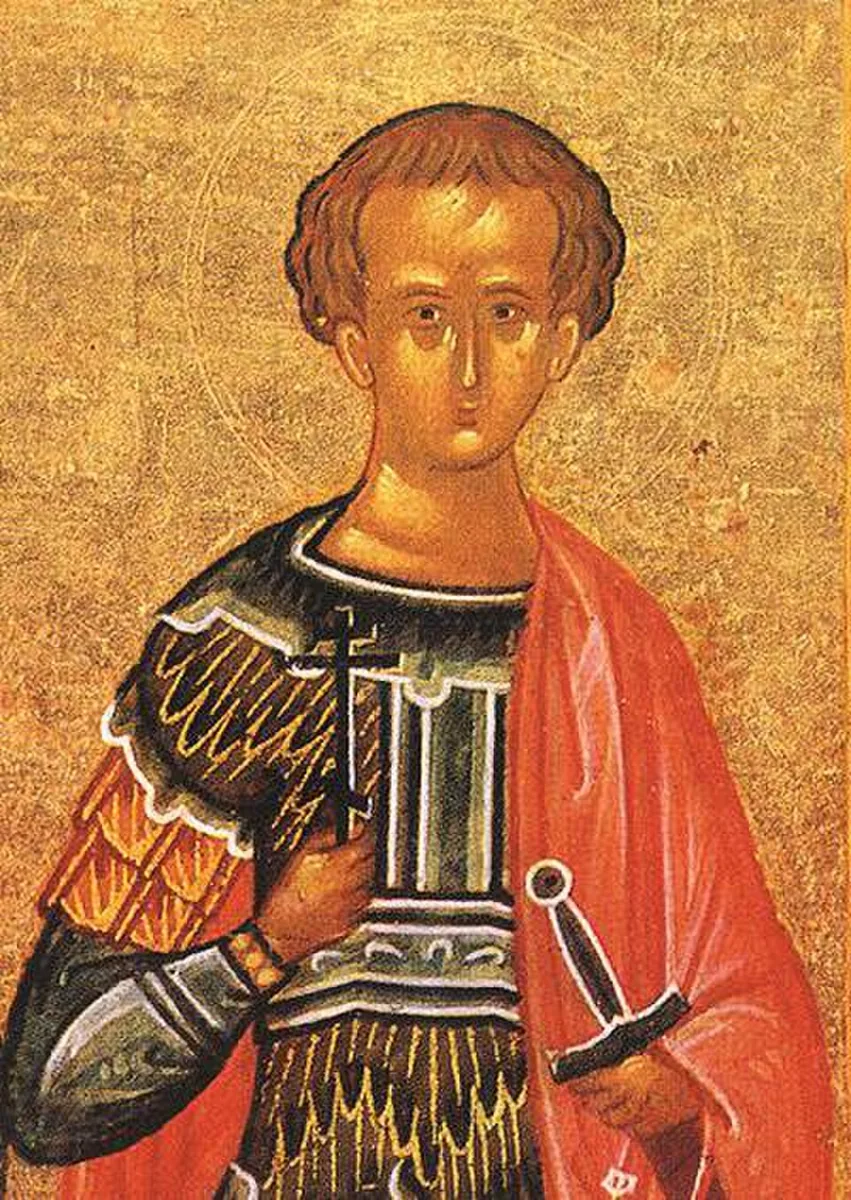
In Byzantine icons, Saint Polyeuctus appears as a young Roman soldier. He often wears military dress and holds a martyr's cross, the sign of those who gave their life for Christ. In Western art, his name is better known through illustrations of Corneille's tragedy than through religious paintings.
Where to pray to Saint Polyeuctus
- Malatya, Turkey: ancient Melitene, the place of his martyrdom.
- Istanbul, Turkey: the remains of the Church of Saint Polyeuctus at Saraçhane.
Wherever you are, you can also pray to him with the prayer to Saint Polyeuctus or the novena to Saint Polyeuctus, which ends on his feast, February 13.
Discover also
- Saint Sebastian, another Roman officer and martyr.
- Saint Maurice of Agaunum, leader of the Theban Legion.
- The Forty Martyrs of Sebaste, soldier martyrs of Asia Minor.
- Saint Demetrius of Thessalonica, great martyr venerated in Byzantium.
- Saint Victor of Marseille, soldier martyr in Gaul.