Saint Peter Thomas was a French Carmelite friar of the fourteenth century (c. 1305-1366). The son of a serf from Périgord, he became a master of theology in Paris, a preacher at the papal court of Avignon, a bishop, papal legate in the East and finally Latin Patriarch of Constantinople. He gave his life to peace among Christians and to the unity of the Church. He died at Famagusta, on the island of Cyprus, in January 1366. The Roman Martyrology commemorates him on January 6; the Carmelite Order and the Diocese of Périgueux celebrate him on January 8.
Who was Saint Peter Thomas?
Peter Thomas is a remarkable figure of the late Middle Ages: a man of very poor origins who moved among popes, kings and emperors without ever ceasing to live as a simple, prayerful Carmelite friar. He is known through a biography written in the months after his death by his friend and disciple Philip of Mézières, chancellor of the Kingdom of Cyprus, an eyewitness of his last years.
His life is inseparable from the great projects of his time: bringing the Latin Church and the Eastern Churches closer, defending Christians threatened by Ottoman expansion and, in the spirit of the age, reviving the crusade. This last aspect, with the violence that came with it, belongs to a historical context that must be looked at honestly. His holiness lies in his prayer, his poverty, his love for the Virgin Mary and his boundless dedication.

The serf's son who became a master
Peter was born around 1305 into a family so poor that at twelve he left home so as not to be a burden. At Monpazier he attended school, living on alms and teaching younger children. At Agen he met the Carmelites, friars who had come from Mount Carmel in the Holy Land, who looked to the prophet Elijah and lived under the protection of the Virgin Mary. He entered the order around 1325.
His superiors, struck by his intelligence, sent him to study and teach at Bordeaux, Albi, Agen, Cahors and then Paris, where he earned the degree of master of theology. His contemporaries admired his virtue as much as his learning. His love for the Virgin Mary was so ardent that her name was constantly on his lips.
Preacher in Avignon
In 1345 Peter was sent to Avignon, then the residence of the popes, as procurator of his order. He was noticed for his preaching, direct and burning. He dared to tell the truth before the cardinals and the pope, and he moved his listeners deeply.
Yet he went on living as a simple friar, rising at night to sing Matins and celebrating Mass each day very early. He said he received more light in celebrating the Eucharist than in all his studies.
Legate of peace and unity
From 1353, Popes Innocent VI and then Urban V entrusted him with ever more delicate missions, from Venice to Genoa, from Serbia to Hungary. In 1357 he went to Constantinople and received the Catholic profession of faith of Emperor John V Palaiologos, who hoped for help from the West against the Turks. Many of these efforts failed, but Peter never lost heart. On a pilgrimage to the Holy Land, he refused honors: "I come neither as nuncio nor as legate, but as a poor pilgrim friar."
Named legate for the East in 1359, he crossed the Mediterranean again and again: Smyrna, Rhodes, Cyprus, Crete. His idea of unity, marked by his time, sometimes led him to harsh methods toward dissenting Eastern Christians, which history cannot pass over in silence. In Cyprus, during an outbreak of plague in 1362, he organized Masses, processions and prayers of supplication, which, according to his biographer, Muslims and Jews frightened by the epidemic also joined.
Patriarch and last journey
With King Peter I of Cyprus and Philip of Mézières, he prepared an expedition intended to retake Jerusalem. Named Latin Patriarch of Constantinople in 1364, he organized the departure from Venice in 1365. The expedition took Alexandria in October, but the city was sacked, its people massacred, and then abandoned a few days later. Peter Thomas, who wanted to press on toward Jerusalem, was deeply saddened.
Back in Cyprus, he fell ill shortly after Christmas 1365. On his deathbed he asked his Carmelite brothers for forgiveness: "I have not helped you as I should have. Forgive me." He also said: "Life and death are the same to me: may the will of Jesus Christ my God be done." He died at Famagusta in the night of January 6 to 7, 1366. His body, laid out for six days in the Carmelite church, drew immense crowds, and healings were soon attributed to him.
Cult and relics
A process for his canonization opened as early as 1366 but did not reach a conclusion in the Middle Ages. In 1609 Pope Paul V confirmed his cult, and Urban VIII extended it to the Carmelites and to the Dioceses of Sarlat and Périgueux. His relics have been lost: Famagusta was taken by the Ottomans in 1571, and searches in the ruins of the Carmelite church in the early twentieth century found nothing. A relic of the True Cross that he left to Philip of Mézières is still kept in Venice, at the Scuola Grande of San Giovanni Evangelista.
Why is Saint Peter Thomas a patron of Christian unity?
Saint Peter Thomas has no official patronage. But his whole life as a legate was spent trying to reconcile the Churches of East and West, so he is naturally invoked for Christian unity, for peace in the Mediterranean and the Middle East, and for diplomats and peacemakers. A preacher and theologian himself, and once a poor student living on alms, he can also be prayed to for preachers and for students without means.
Symbols and how to recognize Saint Peter Thomas in art
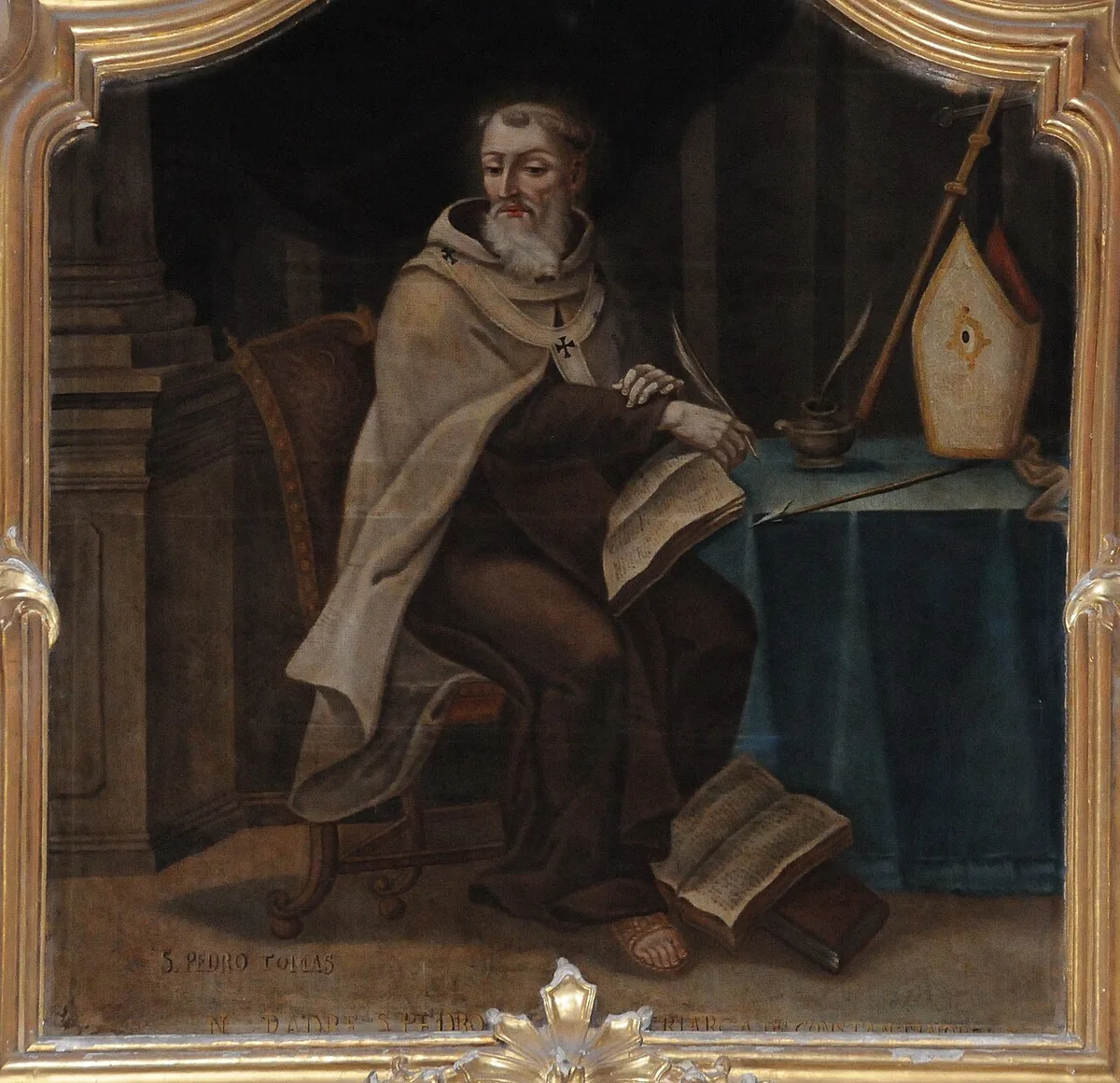
He is shown in the Carmelite habit, often with the insignia of a patriarch, and sometimes praying before the Virgin Mary, a sign of his great Marian devotion.
Where to pray to Saint Peter Thomas
- Salles-de-Belvès (Dordogne, France): the traditional place of his birth and center of his cult in Périgord.
- Carmelite communities: his memorial is celebrated on January 8 throughout the Carmelite family.
- Venice: the Scuola Grande of San Giovanni Evangelista, which keeps his relic of the True Cross.
- Famagusta (Cyprus): the ruins of the Carmelite church where he was buried.
To pray with him, see the prayer to Saint Peter Thomas and the novena to Saint Peter Thomas.
Discover also
- Saint Simon Stock, another great Carmelite figure of the Middle Ages.
- Saint Teresa of Avila, reformer of Carmel.
- Saint John of the Cross, Carmelite and Doctor of the Church.
- Saint Bridget of Sweden, his contemporary, who also worked for the return of the pope to Rome and for peace.
- Saint Catherine of Siena, another great figure of the fourteenth-century Church.