Saint Paschal I was pope from 817 to 824, in the age of the Carolingian Empire. His pontificate, full of contrasts, combined active diplomacy with the Frankish emperors, a warm welcome in Rome for Greek monks driven out by iconoclasm, and a style of government his contemporaries found harsh. Above all, he left Rome some of its most beautiful mosaics, still visible today. The Roman Martyrology mentions him on February 11.
Who was Saint Paschal I?
Paschal was a Roman, but almost nothing is known of his family, which was probably of modest origin. Educated at the Lateran school, he was ordained a priest by Pope Leo III. He made his career in the papal administration and became abbot of the monastery of Saint Stephen, near Saint Peter's Basilica.
On January 24, 817, the day after the sudden death of Pope Stephen IV, he was elected pope. He was consecrated the very next day, probably to forestall any intervention by Emperor Louis the Pious.
The builder pope
In seven years, Paschal rebuilt three major churches in Rome: Santa Prassede (Saint Praxedes), Santa Cecilia in Trastevere and Santa Maria in Domnica. He also undertook works at Saint Mary Major and Saint Peter's.
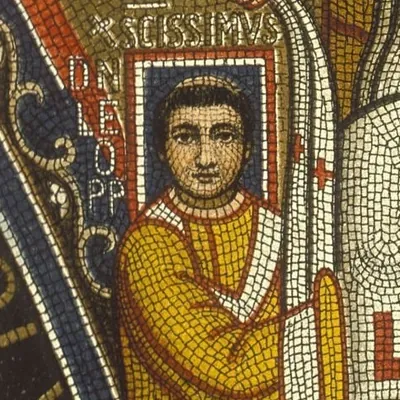
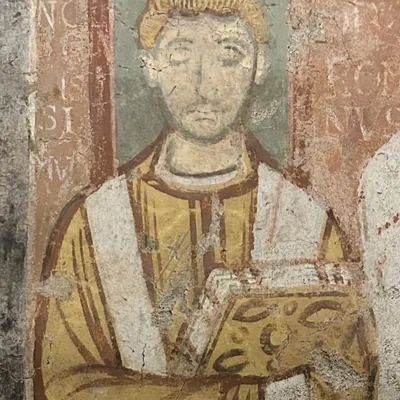
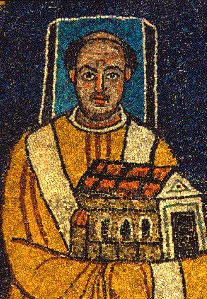
In the apses of his churches, the pope had himself portrayed holding a model of the building, his head surrounded by a square halo. This square nimbus was the sign that the person was still alive when the work was made. His monogram also appears in the mosaics.
Pilgrims to Rome can still admire these works today, more than twelve centuries later. Santa Prassede, a short walk from Saint Mary Major, is often overlooked by visitors in a hurry, yet its small Chapel of San Zeno, entirely covered in gold mosaics, has long been nicknamed the "Garden of Paradise." It is one of the best places to pray quietly in the heart of the city.
The relics of the martyrs
This building program grew out of an intense devotion to the martyrs. Paschal had many relics transferred from the catacombs, then under threat, into the churches of the city, where they could be honored and protected.
Roman tradition remembers in particular that he found the body of Saint Cecilia and had it placed in the basilica that bears her name in Trastevere. For lovers of sacred music, whose patron Cecilia is, this is one of the treasures of Rome.

Between Franks, Byzantines and Romans
With the Carolingians, Paschal obtained confirmation of the papal territories, listed for the first time, and began the custom by which the emperor was crowned in Rome by the pope.
Toward Byzantium, where Emperor Leo V had revived the campaign against holy images, he refused to receive the imperial embassy. Near Santa Prassede he founded a monastery for the Greek monks who had taken refuge in Rome, so that they could continue to pray and venerate the icons freely.
A contested authority
In Rome itself, part of the aristocracy challenged his authority and sought the support of Lothair. Two high officials of the Lateran who favored the Franks were blinded and then beheaded. Suspected of involvement, Paschal denied any complicity by an oath before a synod of bishops.
Historians describe him as an authoritarian pontiff, little loved by the people of Rome. When he died in 824, unrest prevented his burial at Saint Peter's. He was laid to rest only after the installation of his successor, Eugene II, in Santa Prassede.
What can we learn from Saint Paschal I?
Paschal I has no official patronage, and his life invites an honest reading. The Church honors in him a shepherd who loved the beauty of the liturgy, protected the relics of the martyrs and welcomed persecuted Christians, without hiding the shadows of his government. He reminds us that the Church's saints are not always flawless rulers, and that holiness and beauty can grow even in troubled times.
He can be a companion for:
- artists, architects and all who serve the beauty of churches;
- those who care for the memory of the martyrs;
- Christians who welcome refugees persecuted for their faith.
His cult has remained discreet. Cardinal Baronius added him to the calendar in the 16th century on May 14. He was removed from it in 1963 and remains in the Roman Martyrology on February 11.
To pray with him, see the prayer to Saint Paschal I and the novena to Saint Paschal I.
Symbols and how to recognize Saint Paschal I in art
Paschal I is one of the few early popes whose portrait was made during his lifetime. In the apse mosaics of Santa Prassede, Santa Cecilia and Santa Maria in Domnica, he can be recognized by:
- the square halo, the sign of a living person;
- the model of the church he holds in his hands, as its donor;
- his monogram, set into the mosaics.
At Santa Maria in Domnica, he is shown kneeling at the feet of the Virgin Mary.

Where to pray to Saint Paschal I
- Rome: the Basilica of Santa Prassede, near Saint Mary Major, where he is buried and portrayed in the apse mosaic.
- Rome: the Basilica of Santa Cecilia in Trastevere, which he rebuilt.
- Rome: Santa Maria in Domnica, on the Caelian Hill, whose apse shows him at the feet of the Virgin.
Discover also
- Saint Cecilia, whose relics he had transferred to Trastevere.
- Saint Leo III, the pope who ordained him a priest and crowned Charlemagne.
- Saint Benedict of Aniane, monastic reformer under Louis the Pious in the same period.
- Saint Leo IV, another builder pope of the 9th century.