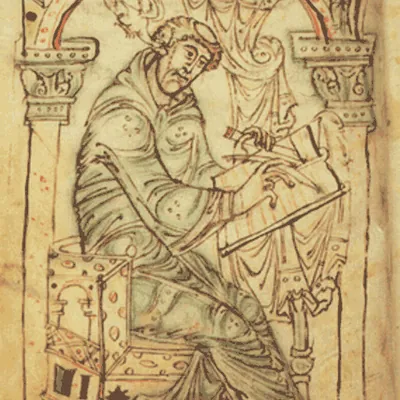
Saint Nothhelm (also spelled Nothelm) was an Anglo-Saxon priest of London who became the tenth Archbishop of Canterbury, from 735 until his death on October 17, 739. A friend and collaborator of Saint Bede the Venerable, he went to Rome to look for documents for the Ecclesiastical History of the English People. As archbishop, he reorganized the dioceses of Mercia. His feast day is October 17.
Who was Saint Nothhelm?
Nothhelm belongs to the golden age of the Anglo-Saxon Church, the age of Bede at Jarrow and of Boniface in Germany. We know him from solid sources: the preface of Bede's Ecclesiastical History, which names him among its informants, the correspondence of Saint Boniface, the lists of bishops and the acts of the synods of his time. On the other hand, nothing is known of his birth and youth. Before becoming archbishop, he was archpriest of the church of Saint Paul in London. His episcopate was short, barely four years, but he left the mark of a learned shepherd, attentive to the history of the Church and to the organization of dioceses.

Bede's researcher
At the beginning of the 8th century, Bede the Venerable was preparing, in his monastery at Jarrow, a history of the Church in England since the arrival of Saint Augustine in 597. For the kingdom of Kent and the neighboring regions, he relied on Abbot Albinus, of the monastery of Saint Augustine in Canterbury, and on Nothhelm. Nothhelm made the journey to Rome. With the pope's permission, he consulted the archives of the Roman Church and brought back copies of the letters of Saint Gregory the Great concerning Augustine's mission. Thanks to him, these precious documents appear in Bede's work and have come down to us.
The link between the two men did not end there. Nothhelm asked Bede about difficult passages in the Books of Kings, and the monk of Jarrow answered him with a short treatise, the Thirty Questions on the Book of Kings, which he dedicated to him. Bede may also have written for him another small work on eight biblical questions.
Archbishop of Canterbury
In 735, Nothhelm became Archbishop of Canterbury, the principal see of the Church in England. His appointment may have owed much to King Æthelbald of Mercia, one of whose counselors he was, at a time when Mercia was becoming the most powerful kingdom in the south of the island. The following year, Pope Gregory III sent him the pallium. In 736 or 737, he gathered a synod of nine bishops to settle a dispute over the ownership of a monastery, with no king presiding, which was unusual. In 737, he reorganized the dioceses of Mercia: he consecrated Witta as bishop of Lichfield and Torhthelm as bishop of Leicester, a see that then found a lasting existence. He also consecrated the bishops of Hereford, Sherborne and Elmham.
During his episcopate, Saint Boniface, the apostle of Germany, wrote to him to ask for a copy of Pope Gregory the Great's answers to Saint Augustine's questions, the Libellus responsionum, which he needed for his mission, as well as the exact date of the arrival of the first Roman missionaries in England. Some historians have suspected Nothhelm of fabricating this text; this theory has been refuted, even if the authenticity of the document is still debated.
Death and devotion
Nothhelm died on October 17, 739, and was buried in Canterbury Cathedral. He was afterward honored as a saint, with a feast on October 17. His cult has remained modest and local. A verse eulogy of Nothhelm has been preserved in a 16th-century manuscript in the library of Lambeth Palace, in London. No particular iconographic tradition has become attached to him.

What can we learn from Saint Nothhelm?
Saint Nothhelm is a saint of discreet service. Before he was archbishop, he put his time and knowledge at the service of another, Bede, so that the history of the Church would be handed down accurately. As archbishop, he set out to give Christians shepherds and well-organized dioceses. You can pray to him for historians, archivists and researchers, for those who work behind the scenes in the service of a shared work, and for bishops charged with organizing the Church.
To pray with him, see the prayer to Saint Nothhelm and the novena to Saint Nothhelm.
Where to pray to Saint Nothhelm
- Canterbury Cathedral (Kent, England): the see of which he was archbishop and the place of his burial.
- London: the city where he served as archpriest of the church of Saint Paul.
- Jarrow (England): the monastery of Bede, with whom he worked.
Discover also
- Saint Bede the Venerable, the historian he helped and who dedicated a treatise to him.
- Saint Boniface of Mainz, the apostle of Germany, who wrote to him.
- Saint Augustine of Canterbury, first Archbishop of Canterbury, whose exchanges with the pope he recovered.
- Saint Theodore of Tarsus, another great Archbishop of Canterbury and organizer of the English Church.