Saint Nabor was a Christian soldier who died a martyr with his companion Saint Felix at Lodi, near Milan, in the early 4th century, during the great persecution of Diocletian. Venerated in Milan from the time of Saint Ambrose, the two martyrs are celebrated together on July 12. In Lorraine, the name of Nabor is linked to the town of Saint-Avold, which grew up around an abbey that received his relics in the 8th century.
Who was Saint Nabor?
Nabor is one of those military martyrs of the early centuries whose story has come down to us only in summary form. Tradition presents him as a legionary from Mauretania, in North Africa, serving with his friend Felix in the imperial army. When the persecution broke out, the two soldiers refused to deny Christ and were executed at Lodi, the ancient Laus Pompeia, around 304. The more detailed accounts of their passion are late and do not allow us to reconstruct their lives with certainty. The most solid fact is the antiquity of their cult in Milan, attested in the 4th century by Saint Ambrose himself.

Soldiers faithful to Christ
At the beginning of the 4th century, Emperor Diocletian and his colleagues launched against the Christians the most violent persecution in the history of the Empire. In the army, soldiers had to sacrifice to the gods; those who refused risked death. It is in this context that tradition places the martyrdom of Nabor and Felix. According to the accounts, they were arrested, questioned, then executed at Lodi, some thirty kilometers from Milan. Their witness joins that of other Christian soldiers of the same period, such as Saint Maurice and his companions or Saint Sebastian: men used to discipline and obedience, who recognized that there was a higher obedience.
The cult in Milan
The bodies of Nabor and Felix were taken to Milan, where a basilica was dedicated to them. It held an important place in the life of the Church of Milan: it was there, according to Saint Ambrose's own account, that the bishop had the bodies of the martyrs Gervasius and Protasius brought to light in 386. A hymn attributed to Ambrose celebrates, together with Saint Victor, the martyrs Nabor and Felix who came from Africa. The Roman Martyrology commemorates Saints Nabor and Felix on July 12. They are traditionally invoked for the illnesses of children.
Saint Nabor in Lorraine and Alsace
In the 8th century, Saint Chrodegang, bishop of Metz and a great reformer of the Frankish Church, brought several holy bodies from Rome for the abbeys of his diocese. In 765, he entrusted relics of Saint Nabor to the Benedictine abbey founded on the site of present-day Saint-Avold. The abbey took the name of the martyr, and the town that developed around it was first called Saint-Nabor; this name later changed into Saint-Avold, but its inhabitants are still called Naboriens. August 24, the date the relics arrived, has remained a day of pilgrimage.
One uncertainty should be noted: the relics of Saint-Avold came from Rome and not from Milan, and another martyr named Nabor is known in Rome. The exact identity of the saint venerated in Lorraine is therefore debated; local tradition identifies him with the companion of Felix.
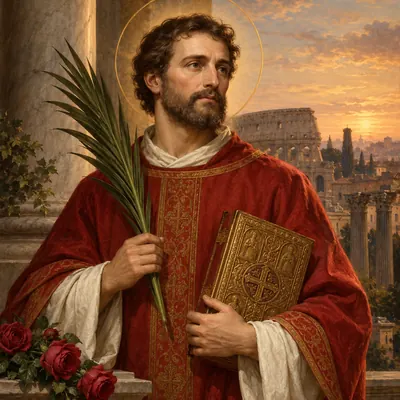
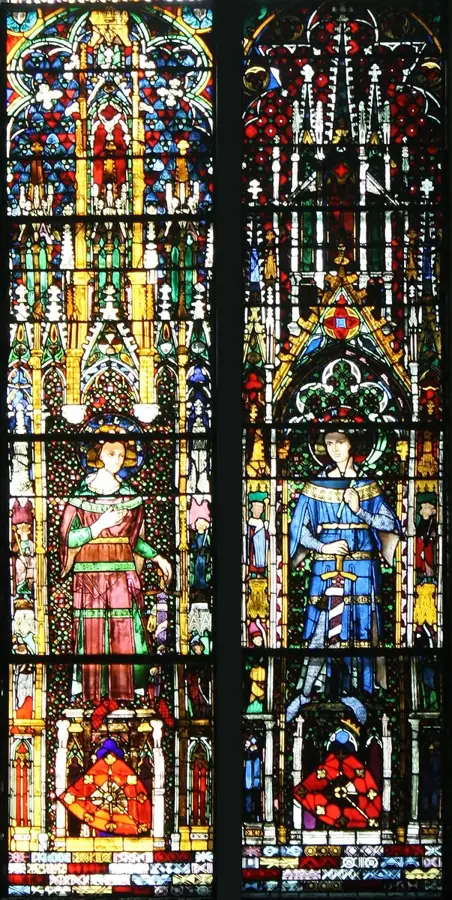
Other places received relics, such as the church of Saint-Nabor in Colombey. In Alsace, a legend tells that a camel, sent in the 13th century by Hugh, Count of Burgundy, was to carry part of the relics as far as possible; it stopped at the village that now bears the name of Saint-Nabor, before halting at the monastery of Niedermunster, at the foot of Mont Sainte-Odile. Saint Nabor is shown as a Roman soldier, with a spear or a javelin.
What can we learn from Saint Nabor?
Saint Nabor is a witness to courage. As a soldier, he knew the value of being faithful to an oath; as a Christian, he chose to remain faithful to Christ to the end. His friendship with Felix reminds us that we do not bear witness alone: faith is lived and defended together. You can pray to him for soldiers and police officers, for persecuted Christians, for sick children, and for all who must choose between the easy way and their conscience.
Where to pray to Saint Nabor
- Saint-Avold (Moselle): the abbey church of Saint-Nabor, which received his relics in 765 and where a large statue depicts him.
- Milan and Lodi (Italy): the cities of his martyrdom and of his first cult, with Saint Felix.
- Saint-Nabor (Bas-Rhin), at the foot of Mont Sainte-Odile: a village that bears his name.
- Colombey, in Lorraine: the church of Saint-Nabor, which received relics of the saint.
Discover also
- Saint Ambrose of Milan, who celebrated the martyrs of his Church.
- Saint Chrodegang of Metz, who brought his relics to Lorraine.
- Saint Maurice of Agaunum, another soldier martyr of the same period.
- Saint Angilram of Metz, bishop of Metz, who was a monk at the abbey of Saint-Avold.