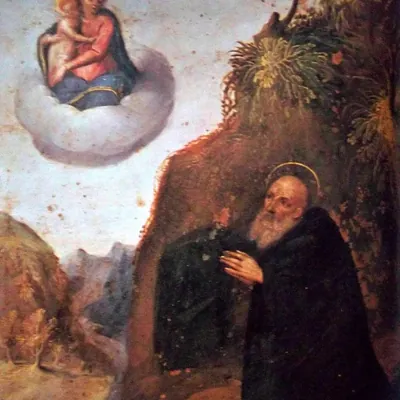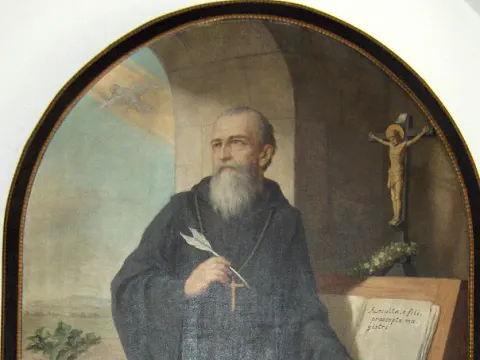
Saint Menoux, also called Menulphus or Menou, was a 6th-century hermit who came from the British Isles, probably from Ireland. According to tradition, after a stay in Brittany with Saint Corentin and a pilgrimage to Rome, he stopped in the Bourbonnais, on the banks of the river Ours, where he lived and died. His tomb is venerated in the church of the village that bears his name, Saint-Menoux, in the Allier department of France. His feast day is July 12.
Who was Saint Menoux?
Saint Menoux belongs to the great family of Celtic monks and hermits who traveled across Europe in the first centuries of the Middle Ages. His life is known only from late accounts, in which the memory of a real man is mixed with legend. Neither the date of his birth nor that of his death is known, and even his origin remains uncertain: tradition makes him the son of an Irish king, while other authors have him come from England, Scotland or Britain. What is certain is the age of his cult around his tomb, in the diocese of Bourges and later of Moulins, and the popular devotion that still surrounds him today.

A pilgrim from the islands
According to tradition, Menoux left his country to become a pilgrim, like many Irish monks who gave up their homeland for love of Christ. He crossed Britain and reached Armorica, where he settled in Quimper with Saint Corentin. The accounts say that Corentin wanted to entrust him with the office of bishop, and that he refused. Other authors claim instead that he succeeded Corentin in the see of Quimper, but the oldest records of the region do not mention him: it is wiser to remain cautious. Menoux then left for Rome, to the tomb of the apostles, and tradition credits him with many miracles along the way.
The hermit of the Ours
On his way home, Menoux stopped to rest on the banks of the Ours, a small river in the Bourbonnais, at a place then called Mailly-sur-Rose. He decided to stay. He lived there in prayer and meditation, serving the poor and the sick. The local people saw him as a man of God; they came to him for advice and healing.
A beautiful tradition tells that he took under his protection a simple-minded man of the village, named Blaise, whom everyone mocked. Unable to pronounce the name Menulphus properly, Blaise called him "Menoux," and the name stuck. When the saint died, Blaise would not leave his friend: he spent his days and nights on his grave, and had even made an opening in the coffin to stay close to him. The parish priest finally had a sarcophagus made with an opening. Popular tradition also credits him with the legend of the grass snake, which is said to explain the name of the nearby village of Couleuvre.
The tomb and the "débredinoire"
The miracles attributed to the saint drew crowds to his grave. Around the year 1000, the bishop of Bourges had his remains moved and a church built over them: the village then took the name Saint-Menoux. A Benedictine abbey grew up there, which was destroyed during the Revolution. The present Romanesque church keeps, in the apse of the choir, the saint's Merovingian sarcophagus, which still contains his relics.
This sarcophagus has an opening called the "débredinoire": according to a custom that is still alive, people put their head into it to be "débrediné," that is, cured of "bredinerie," a Bourbonnais word for foolishness or troubles of the mind. Such openings, called fenestellae, once allowed pilgrims to come close to the relics. Even today, families bring children or relatives suffering from mental illness, and visitors come to ask for peace of mind.

Devotion and memory in Brittany
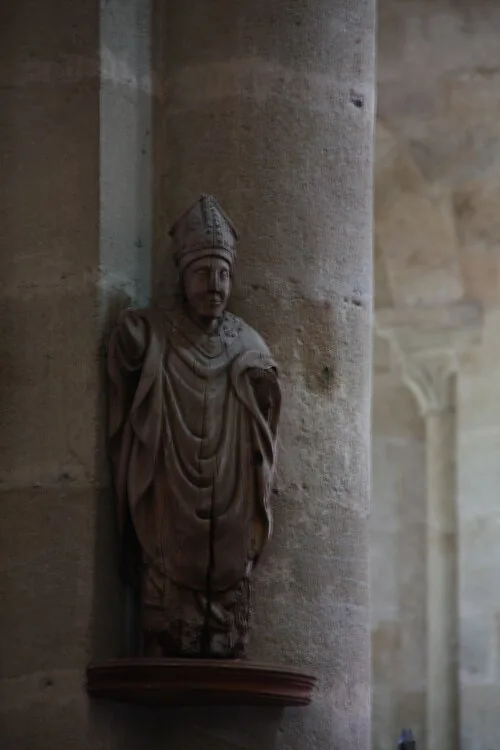
The cult of Saint Menoux spread through the old diocese of Bourges. In Brittany, he is celebrated on July 12 in the calendar of Breton saints, but he is little honored there, probably because he died far from the peninsula. A few place names seem to keep his memory, such as Pont-Menou in Plestin-les-Grèves, Le Vau-Meno in Saint-Brieuc or Kermeno in Bignan; other connections remain uncertain. In the church of Saint-Menoux, statues and stained-glass windows show him as a bishop or a pilgrim.
What can we learn from Saint Menoux?
Saint Menoux is the friend of the little ones. Tradition remembers above all his tenderness for a man everyone mocked, and the faithfulness of this simple friend who would not leave him. You can pray to him for people with mental illness or intellectual disabilities, for their families, for those who are rejected or ridiculed, and for all pilgrims. His life reminds us that holiness can take root in a quiet village by a river, in prayer and kindness.
To pray with him, see the prayer to Saint Menoux and the novena to Saint Menoux.
Where to pray to Saint Menoux
- Saint-Menoux (Allier, France): the Romanesque church that houses his sarcophagus and the débredinoire.
- Quimper (Finistère): the town where, according to tradition, he lived with Saint Corentin.
- At home: praying for someone who suffers in mind.
Discover also
- Saint Corentin, first bishop of Quimper, with whom he is said to have lived.
- Saint Columbanus, another great Irish pilgrim on the continent.
- Saint Ursinus of Bourges, first bishop of the diocese where his cult developed.