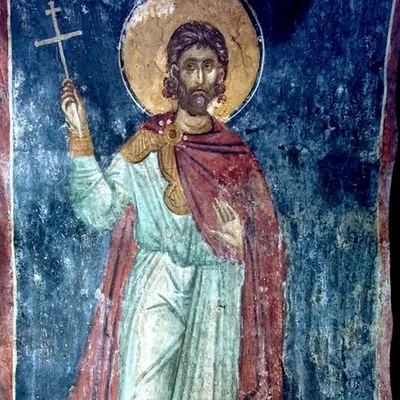
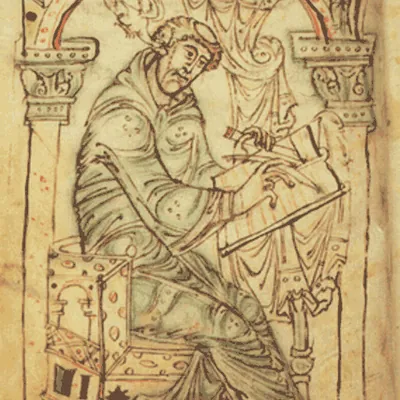
Saint Meneleus (Ménélé or Ménélée in French) was a monk of the 7th and early 8th centuries. Born around 654-660 near Précigné, in present-day Sarthe, he ran away on the eve of his wedding to give himself to God, lived seven years at the monastery of Saint-Chaffre in Auvergne, then restored the ruined abbey of Menat, in Puy-de-Dôme, where he became abbot. He died there around 720. His feast day is July 22.
Who was Saint Meneleus?
Meneleus is known by many names: Ménélée, Ménelé, Méléré, Ménéré, or even Mouvier. His life has come down to us through a hagiographical account, a manuscript of which was kept in the library of Cluny, and through the tradition of the abbey of Menat. The account follows a pattern found in several saints of the early Middle Ages: a young nobleman promised in marriage chooses monastic life, goes far away, then founds or restores a monastery. Not every detail can be verified, but the memory of Meneleus as the restorer of Menat is firmly rooted: the abbey bore his name for centuries. He is honored by the Catholic Church, and also by the Orthodox Church.

The bridegroom who ran away
According to the account, Meneleus was the son of a powerful lord, Amanulf. From childhood he showed great piety and liked to withdraw to pray, especially in the chapel of Saint-Martin at Précigné. He wanted to give himself to God. But his father saw him as his heir: he involved him in running the estate and looked for a wife of his rank. He found her in Sensa, daughter of a lord named Barontus, who lived at Nantilly, near Saumur.
On the eve of the wedding, Meneleus secretly left the house at Les Parillés. Two young servants went with him, Savinian and Constantius. This departure was no whim: it was the long-pondered choice of a life given entirely to God, at the price of a painful break with his family.
Seven years at Saint-Chaffre
The three runaways reached Auvergne. There they met a monk named Theofrid, also called Saint Chaffre, and followed him to his monastery of Calminiac, in the Velay, which would later take the name of Saint-Chaffre, at Le Monastier-sur-Gazeille. Meneleus stayed there seven years. It was there that he learned monastic life: the prayer of the hours, work, obedience and fraternal life.
The restorer of Menat
Following a vision, Meneleus went to settle at Menat, in the Sioule valley, where there was an old monastery, then in ruins. With Savinian, he set about rebuilding it. The work succeeded so well that Menat flourished again, and Meneleus was made its abbot. He probably died on July 22, 720, and Savinian succeeded him at the head of the community. Later the abbey would be attached to Cluny and become one of the centers of monastic reform in Auvergne.
Devotion and art
The abbey of Menat bears the name of Saint Meneleus. In its church, which became a parish church in 1802, a Romanesque capital hollowed out to serve as a baptismal font tells his legend: on the left, the young Meneleus pushes away the wedding ring offered to him by Barontus, accompanied by his daughter Sensa; on the right appears Saint Theofrid, abbot of Saint-Chaffre. A statue of the saint is also venerated there.
His cult was also kept alive in his native region. On August 23, 1712, on the initiative of the Marquis de Torcy, lord of Sablé, relics of Saint Meneleus and Saint Savinian were received at Précigné. More than fifty clergy took part in the procession, and the consecration of the church the next day was followed by three days of Masses, processions and preaching. Saint Meneleus is celebrated on July 22.

What can we learn from Saint Meneleus?
Meneleus chose God at the very moment when everything seemed settled for him. He had to leave, to be trained at length by a master, then to rebuild what lay in ruins. His life speaks to young people discerning their vocation, to families who must let a child follow his own path, and to all who have to restore an abandoned work. He was not alone: his friend Savinian shared his flight, his training and his labor, before taking over from him.
To pray with him, see the prayer to Saint Meneleus and the novena to Saint Meneleus.
Where to pray to Saint Meneleus
- Menat (Puy-de-Dôme): the former abbey of Saint-Ménélée, whose church holds his capital and his statue.
- Précigné (Sarthe): his home parish, which received his relics in 1712.
- Le Monastier-sur-Gazeille (Haute-Loire): the abbey church of Saint-Chaffre, heir to the monastery where he was trained.
Discover also
- Saint Carilefus (Calais), an Auvergne monk who also passed through Menat, a century earlier.
- Saint Martin of Tours, patron of the chapel at Précigné where he loved to pray.
- Saint Benedict of Nursia, father of the monks of the West.