Saint John Cantius, also called John of Kanty (in Polish, Jan Kanty), was a priest and professor of theology at the University of Kraków in the fifteenth century. Born in Kęty around 1390 and died in Kraków on Christmas Eve 1473, he joined teaching, prayer and boundless charity toward the poor throughout his life. Patron saint of Poland, of students and of teachers, he was canonized in 1767. His feast day is December 23.
Who was Saint John Cantius?
John was born around 1390 in Kęty, a small town between Kraków and Silesia, to parents named Stanislaus and Anne. The name "Cantius" is the Latin form of "of Kęty," his hometown. Poland was then living a time of growth under the Jagiellonian dynasty, after its union with Lithuania.
The University of Kraków, founded in 1364, had just been restored in 1400 thanks to Queen Saint Hedwig (Jadwiga) of Poland. John would become one of its students, then one of its most respected teachers.
What we know of him comes from the university archives, from testimonies gathered for his beatification and from edifying stories handed down by his biographers. Some episodes of his life have the features of legend, but his reputation for kindness and rigor is attested very early.
The professor of Kraków
John studied philosophy and then theology at the University of Kraków. After his ordination, he first taught at the monastic school of the Canons of the Holy Sepulchre at Miechów, before returning to the university, where he taught for decades.
He copied many manuscripts by hand, several of which are still kept at the Jagiellonian Library. He lived very simply in the Collegium Maius, the building where the masters lived.
Tradition says he had two Latin lines written on the wall of his room: "Beware of wounding, for it is hard to make peace; beware of slander, for it is painful to repair." His colleagues and students admired his integrity, his humility and his refusal of all gossip.
Parish priest of Olkusz
Around 1439, he was appointed parish priest of Olkusz, a small mining town northwest of Kraków. He took his duties very seriously: he preached, visited his people and helped the poor. But the responsibility for souls weighed heavily on him, and he felt he was not equal to it. After a few years, he obtained permission to return to the university, where he was convinced he could serve the Church better.
The charity of a scholar
John gave away almost everything he had. His biographers tell that he sometimes came home barefoot, having given away his shoes, and that his long cassock hid what he lacked. One legend, close to the story of Saint Martin, says he gave his cloak to a beggar shivering with cold.
Another story tells that he was attacked by robbers on the road to Rome and told them he had nothing left. Then, remembering a few coins sewn into his clothes, he ran after them to give them these as well. The robbers, ashamed, gave everything back.
He made the pilgrimage to Jerusalem and went several times to Rome on foot. He led an austere life: he slept little, gave up meat and spent long hours in prayer, especially before the Passion of Christ. He died on December 24, 1473, at over eighty years of age. His body was laid in the church of Saint Anne, the university church, and his tomb at once became a place of pilgrimage.
Why is Saint John Cantius the patron saint of students?
John spent most of his life at the university, as a student and then as a teacher, and never separated study from prayer and from service to the poor. For this reason he is the patron saint of students, teachers and Polish universities, and one of the patrons of Poland and of Kraków. Many young Poles entrust their exams to him. He is also invoked by those who want to learn not to wound others with their words.
Polish immigrants carried his devotion to North America. In Chicago, the church of Saint John Cantius, built by Polish Catholics, is today known for its beautiful liturgy and sacred music.
Symbols and how to recognize Saint John Cantius in art
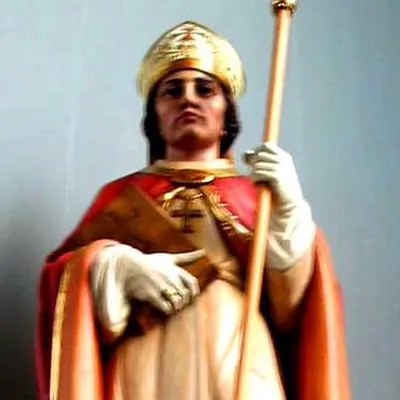
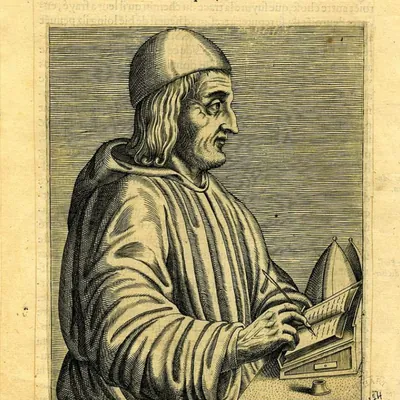
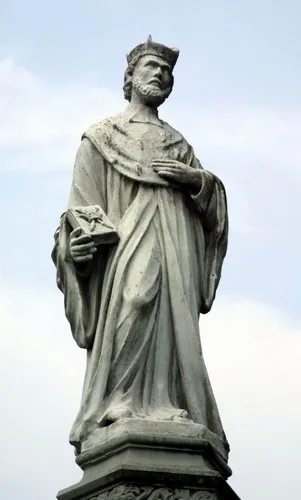
Saint John Cantius is shown as a priest and professor, wearing the academic gown and a biretta. He is often depicted giving his cloak to a poor man, in memory of his charity, or with a book, the sign of his teaching.
Where to pray to Saint John Cantius
- Kraków: Saint Anne's Church, the church of the Jagiellonian University, a masterpiece of Polish Baroque rebuilt between about 1689 and 1703 after his beatification. His mausoleum, by the stucco artist Baldassare Fontana, shows his sarcophagus carried by four allegorical figures representing the faculties of the old university: theology, philosophy, law and medicine. The Collegium Maius, where he lived and taught, is a few steps away.
- Kęty: his hometown, about fifty kilometers southwest of Kraków, where a church is dedicated to him.
- Olkusz: the basilica of Saint Andrew, the church where he was parish priest.
To pray with him, use the prayer to Saint John Cantius or the novena to Saint John Cantius.
Discover also
- Saint Hedwig of Poland, the queen who restored the University of Kraków.
- Saint Martin of Tours, whose sharing of his cloak he imitated.
- Saint Stanislaus Kostka, another patron saint of Polish youth.
- Saint Thomas Aquinas, model of theologians and patron of Catholic universities.
- Saint John Paul II, a former student of the University of Kraków.