Saint Gobrian (Gobrien in French) was a bishop of Vannes at the beginning of the 8th century. Born around 660 in the Vannes country of Brittany and trained at the abbey of Saint-Gildas de Rhuys, he was elected bishop of Vannes, then withdrew at the end of his life to a hermitage on the Oust, near Josselin, where he died in 725. Bretons invoked him against "St. Anthony's fire". His feast day is November 10.
Who was Saint Gobrian?
Gobrian belongs to the long list of holy Breton bishops of the early Middle Ages, whose memory has been kept mainly in chapels, fountains and statues. Written sources on his life are rare and late: the main one is the Gallia Christiana, the great reference work on the dioceses of France, which counts him among the early bishops of Vannes and gives the date of his death. The rest comes from local tradition, which made him a healing saint. The episcopal lists themselves differ: some place him nineteenth among the bishops of Vannes, others eleventh. His figure nevertheless remains very much alive in the Morbihan, where several places of worship bear his name.

A monk of Rhuys who became bishop
Young Gobrian was trained at the abbey of Saint-Gildas de Rhuys, founded in the 6th century by Saint Gildas on the peninsula that closes the Gulf of Morbihan. There he learned prayer, the study of Scripture and the discipline of monastic life. Ordained a priest at Vannes, he became known for his piety. On the death of Bishop Morvan, the clergy and people chose him as his successor. He governed the diocese of Vannes at the beginning of the 8th century, at a time when Brittany still lived largely on the margins of the Frankish kingdom.
The healer of St. Anthony's fire
Tradition credits Gobrian with many healings, especially of people suffering from the "mal des ardents", also called "sacred fire" or St. Anthony's fire. This terrible disease, now known to be caused by ergot, a fungus that contaminates rye, caused violent burning in the limbs and could lead to gangrene. In the Middle Ages it struck whole villages, and people turned to healing saints. Gobrian became one of them in Brittany. A popular tradition even says that people placed a handful of nails on his tomb to obtain healing as the metal rusted.
The hermit of the Oust
At the end of his life, Gobrian left his office to withdraw into solitude. He settled on the bank of the Oust, not far from Josselin, and there, according to tradition, built a wooden oratory around 717. He lived there in prayer until his death on November 3, 725, according to the Gallia Christiana. His body was laid to rest on the spot. In the 11th century, a chapel in the shape of a Latin cross replaced the oratory; it was enlarged in the 14th and again in the 16th century, and it is this chapel that can be visited today at Saint-Servant.
Devotion and art
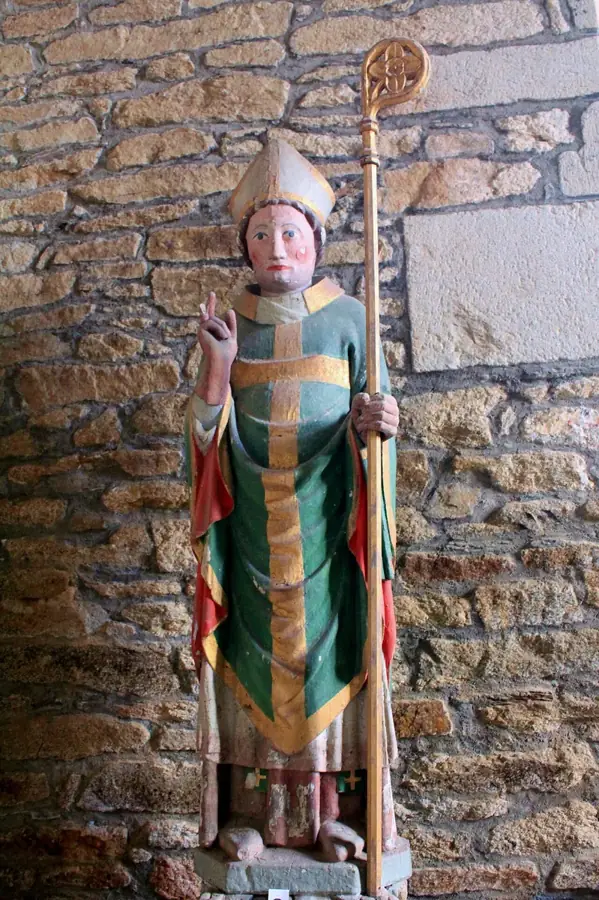
The calendar of Breton saints celebrates Saint Gobrian on November 10. Several buildings are dedicated to him: the church of Morieux, in the Côtes-d'Armor, the church of Rohan and the chapel of Saint-Gobrien at Camors, in the Morbihan, as well as a now ruined chapel at Kerleguen, in Grand-Champ. Fountains bear his name at Saint-Servant, Mesquer and Saint-Servan. He is shown as a bishop, mitre on his head and crozier in hand, as in the polychrome wooden statuettes of Saint-Servant (16th century) and Camors (17th century). The pardon (traditional Breton religious festival) of the chapel at Saint-Servant is celebrated on the first weekend of July.

What can we learn from Saint Gobrian?
Gobrian unites the great vocations of Christian Brittany: monk, bishop and hermit. He served his people as a pastor, then chose solitude to end his life in prayer. Popular memory has above all kept his compassion for the sick. You can pray to him for the sick, especially those suffering from skin diseases or burning pain, for the diocese of Vannes, and for those who, at the end of their working life, seek to give more room to God.
To pray with him, see the prayer to Saint Gobrian and the novena to Saint Gobrian.
Where to pray to Saint Gobrian
- Saint-Servant (Morbihan): the chapel of Saint-Gobrien, near the Oust, where his body was laid, and the Saint-Gobrien fountain in the same municipality.
- Camors (Morbihan): the chapel of Saint-Gobrien and its 17th-century statue.
- Rohan (Morbihan) and Morieux (Côtes-d'Armor): churches dedicated to him.
- Mesquer (Loire-Atlantique) and Saint-Servan (Ille-et-Vilaine): fountains that bear his name.
Discover also
- Saint Gildas the Wise, founder of the abbey of Rhuys where Gobrian was trained.
- Saint Paternus of Vannes, first bishop of Vannes.
- Saint Meriadoc of Vannes, another bishop of Vannes who also lived as a hermit.