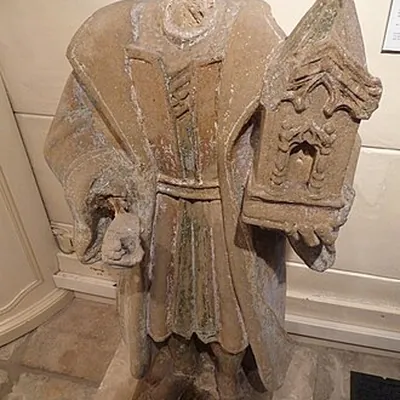
Saint Eustace White was an English Catholic priest, martyred under the reign of Elizabeth I. Born in 1559 at Louth, in Lincolnshire, and converted to Catholicism against his father's will, he was ordained a priest on the Continent and returned to England in 1588 to exercise his ministry in secret. Arrested in Dorset in 1591 and tortured in London, he was hanged, drawn and quartered at Tyburn on December 10, 1591. He is one of the Forty Martyrs of England and Wales canonized in 1970. His feast day is December 10.
Who was Saint Eustace White?
Eustace White lived at a time when the Catholic religion was outlawed in England. Since the break with Rome and the establishment of the Church of England, celebrating Mass, being a Catholic priest ordained abroad or harboring a priest had become a crime punishable by death, treated as high treason. Yet hundreds of young Englishmen went to train in the English colleges opened on the Continent, at Douai, Reims or Rome, then returned in secret to support the Catholics of their country. Eustace White was one of them. His life was short, and the sources about it are mainly the accounts of the martyrs gathered by English Catholic historians, but it bears witness to a stubborn faithfulness in the midst of persecution.

A convert disowned by his father
Eustace White grew up in Louth, a small town in Lincolnshire, in a family attached to the established religion. As a young man, he discovered the Catholic faith and converted. This choice cost him dearly: his father disowned him. Eustace did not go back on his decision. He even decided to go further and become a priest, which, for an Englishman of his time, meant going abroad and accepting that one day he would return at the risk of his life.
A hidden priest in England
After his studies, Eustace White was ordained a priest, probably at the English College in Rome, in 1588. That same year, he went back to England. The moment was particularly dangerous: Spain had launched its Armada against the kingdom, and English Catholics were suspected of being traitors in the enemy's service. For about three years, Eustace exercised his ministry in secret, mainly in the west of the country: he celebrated Mass in friendly houses, heard confessions, baptized and encouraged the families who had remained faithful.
Arrest and torture
In 1591, in Dorset, a friendly conversation with a man traveling with him gave him away: the man realized he was a priest and denounced him. Once arrested, Eustace defended his faith confidently before the local authorities. But he was sent to London, where he was tortured several times to extract the names of the Catholics who had sheltered him. He betrayed no one.
In early December 1591, he was tried with other priests, Edmund Gennings and Polydore Plasden, and several laymen accused of having helped them. All were condemned. On December 10, 1591, Eustace White was taken to Tyburn, the usual place of execution in London, to be hanged, drawn and quartered, the punishment for traitors. On the same day, his companions were put to death in London. Historians refer to them as the London martyrs of 1591.
Devotion
Eustace White was beatified in 1929 by Pope Pius XI, then canonized on October 25, 1970 by Pope Paul VI, with the Forty Martyrs of England and Wales, who died for their faith between 1535 and 1679. The Church celebrates him on December 10, the day of his death; he is also honored on October 25 together with all forty martyrs. The place of his martyrdom, Tyburn, near today's Marble Arch, is now a place of prayer for the English martyrs.

What can we learn from Saint Eustace White?
Eustace White lost everything for Christ: his father's affection, his security, his freedom, and then his life. He reminds us that faith can demand painful choices, even within the family, and that faithfulness is also lived in the courageous silence of one who refuses to betray his brothers. You can pray to him for persecuted Christians, for converts rejected by their loved ones, for priests who serve in difficult conditions, and for Christian unity.
To pray with him, see the prayer to Saint Eustace White and the novena to Saint Eustace White.
Where to pray to Saint Eustace White
- London: Tyburn Convent, near Marble Arch, shrine of the martyrs executed at Tyburn.
- Louth (Lincolnshire): his hometown.
- Rome: the English College, where he was probably ordained and where the memory of its martyred former students is venerated.
Discover also
- Saint Polydore Plasden, a priest tried and martyred with him in December 1591.
- Saint Edmund Gennings, another priest martyred on the same day.
- Saint Edmund Campion, Jesuit martyred at Tyburn ten years earlier.
- Saint Henry Walpole, another priest martyr of the Elizabethan era.