Saint Canice, in Irish Cainnech and known in Scotland as Kenneth, was a sixth-century Irish monk, a friend of Saint Columba of Iona, a missionary in Scotland and the founder of the monastery of Aghaboe, in present-day County Laois. The city of Kilkenny, "the church of Canice," is named after him. Counted among the "Twelve Apostles of Ireland," he is believed to have died around 599-600. His feast day is October 11.
Who was Saint Canice?
Canice is one of the great figures of Irish monasticism, from the golden age when the monasteries of Ireland trained saints and missionaries for the whole of Europe. We know his life through a medieval Latin Life, full of miracles, and through several mentions in the Life of Saint Columba written at the end of the seventh century by Saint Adomnán, abbot of Iona, which is an older and more reliable source. The details of his biography (dates, journeys and teachers) vary from one source to another and should be received with caution.
He is the patron saint of the Diocese of Ossory and of the city of Kilkenny, and several places in Ireland and Scotland bear his name, such as the island of Inchkenneth in Scotland.

A student in the schools of the Irish saints
The son of a bard, Canice grew up in a world where words and memory mattered greatly. According to his Life, he went to Wales as a young man to be trained in monastic life, then returned to Ireland.
He attended the great monastic schools of his day: Clonard, where Saint Finnian trained the men tradition would call the "Twelve Apostles of Ireland," then Glasnevin, near Dublin, under Saint Mobhi. There he came to know Saint Columba, Saint Comgall of Bangor and Saint Kieran of Clonmacnoise, among others. These monastic friendships would mark his whole life.
With Columba in Scotland
When Columba founded the monastery of Iona in 563, Canice joined him in Scotland for a time. Adomnán mentions him several times in the Life of Saint Columba.
He tells, for example, that one day when Columba was at sea in a violent storm, he declared that Cainnech, then in Ireland, was praying for him. And indeed the saint, warned inwardly, had hurried away from his meal with only one shoe on, to run to the church and pray for his friend. Adomnán also reports that Cainnech once forgot his staff on Iona and miraculously found it again on the other side of the sea. These stories reveal the deep spiritual friendship that united the two men.
Tradition also credits Canice with missionary work in Scotland among the Picts, and with founding several churches. One tradition, which is disputed, even links his name to an early Christian settlement on the site of St Andrews. He is also said to have lived as a hermit on an island.
Aghaboe and Kilkenny
Back in Ireland, Canice founded the monastery of Aghaboe, in Irish Achadh Bhó, "the field of the cow," in the kingdom of Ossory. The monastery became an important religious center and long remained the main seat of the Church in Ossory. Canice led a life of prayer, work and study there. A commentary on the Gospels called the Glass Chainnigh, "the chain of Canice," is attributed to him and is said to have been kept and studied for a long time.
He is also said to have founded, or inspired, a church on the site of present-day Kilkenny, in Irish Cill Chainnigh. In the Middle Ages, the seat of the Diocese of Ossory moved from Aghaboe to Kilkenny, and a great Gothic cathedral was built in his honor in the thirteenth century, next to an older round tower. Saint Canice's Cathedral now belongs to the Church of Ireland (Anglican), while the Catholic cathedral of Kilkenny is dedicated to the Virgin Mary.
Death and cult
Canice died at a great age, around 599 or 600, and was buried at Aghaboe. Churches are dedicated to him in Ireland and Scotland, and as far away as Australia and New Zealand, where Irish emigrants brought his cult. The Orthodox Churches, which venerate the saints of early Ireland, also keep his feast.
Why is Saint Canice the patron saint of Kilkenny?
Kilkenny takes its very name from him, and the medieval Diocese of Ossory, whose seat moved from his monastery of Aghaboe to Kilkenny, kept him as its patron. He remains the patron saint of the Catholic Diocese of Ossory. Tradition also invokes him for shipwrecked sailors, in memory of the stories of sea crossings and storms linked to his life.
Canice is above all a saint of friendship in Christ. His prayer for Columba in the middle of a storm shows the power of the communion of saints: to pray for an absent friend is already to support him. You can pray to him for your friends, for those who travel by sea, for students and for Ireland. See the prayer to Saint Canice and the novena to Saint Canice.
Symbols and how to recognize Saint Canice in art
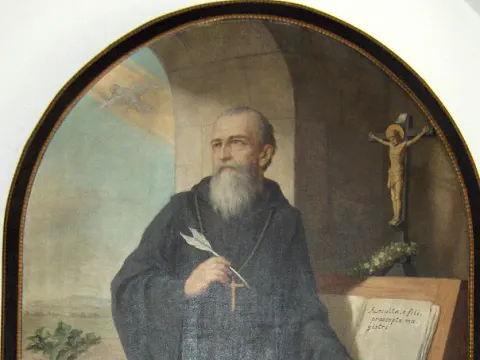
Saint Canice is shown as an Irish monk, often bearded, as in the carved head in Kilkenny. In Kilkenny, the cathedral that bears his name, with its round tower beside it, has itself become the most familiar image associated with him.
Where to pray to Saint Canice
- Kilkenny (Ireland): Saint Canice's Cathedral, a Gothic building with a round tower, now Anglican, which bears his name.
- Kilkenny: the Catholic Cathedral of Saint Mary, seat of the Diocese of Ossory, of which he is the patron.
- Aghaboe (County Laois): the ruins of the abbey, on the site of his monastery and his tomb.
- Inchkenneth (Scotland): the small island that bears his name, near the Isle of Mull.
Discover also
- Saint Columba of Iona, his friend, founder of Iona.
- Saint Adomnán of Iona, who recorded several episodes of his life.
- Saint Kieran of Clonmacnoise, his fellow student at Clonard.
- Saint Columban, another great Irish monk of the sixth century.
- Saint Kentigern (Mungo) of Glasgow, who evangelized Scotland in the same period.