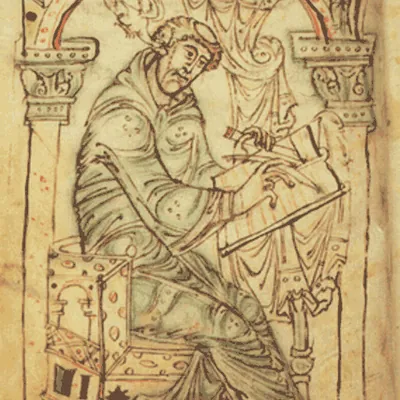
Saint Bilhild (also spelled Bilihilt, Bilhildis or Bilehild) was a Frankish noblewoman of the 7th and early 8th centuries, founder and first abbess of the monastery of Altmünster, in Mainz, Germany. She died on November 27, 734. Her life is known only through accounts written several centuries later, but her relics are still venerated in Mainz. Her feast day is November 27.
Who was Saint Bilhild?
Bilhild lived at the time when the Christian faith was taking root in the Main valley and the Rhineland, a few years before the great mission of Saint Boniface. Historians urge caution: the Lives of the saint date from after 1060, there are five different versions, and solid evidence of her cult goes back only to the 12th century. A Mainz charter concerning her turned out to be a medieval forgery. The accounts also follow a common pattern in Frankish hagiography: a pious young girl, married against her will, who flees to found a monastery. Yet the Roman Martyrology commemorates her, and her existence as founder of Altmünster is not called into question.
A young girl married against her will
According to her Life, Bilhild was born into a noble family at Hocheim. The place is debated: tradition identifies it with Veitshöchheim, on the Main, near Würzburg, but some historians think rather of Hochheim am Main, not far from Mainz. Brought up in the Christian faith, she wished to consecrate her life to Christ. Her parents nevertheless gave her in marriage to a Frankish duke named Hetan, still a pagan, who is sometimes identified with Hedan I, duke of Thuringia. She is said to have wanted to convert him, without success.
The flight to Mainz
When her husband left for war, Bilhild seized the chance to live according to her vocation. She went down the Main by boat to Mainz, where her uncle Rigibert was bishop. There she gave herself entirely to the service of God and to works of charity, renouncing the honors and pleasures of her rank. When her husband died, she asked the bishop for permission to found a religious community. She sold her property at Veitshöchheim and, with her fortune, founded the monastery of Altmünster, in Mainz, of which she became the first abbess.
An older document, however, casts doubt on this account: according to the Benedictine scholar Jean Mabillon, a 9th-century calendar of Fulda, now lost, called her a "virgin". It is therefore possible that she was never married, and that the story of the forced marriage was added by the hagiographers.
Death and cult
Bilhild died on November 27, 734, and was buried in the church of her abbey. According to tradition, a sweet fragrance soon rose from her tomb, and many miracles were reported there. The monastery of Altmünster kept her memory for centuries; from the 15th century, a cloth presented as the veil that had covered the face of Christ was also venerated there, which tradition said had been given to the saint by a queen.
Her main relics are now kept in the church of Saint Emmeram in Mainz. Her skull was examined scientifically in 1991, and the study concluded that it was authentic. A 16th-century Mainz missal contains a Mass for her feast. A statue of the saint stands in a square in Mainz. Her liturgical memorial is celebrated on November 27, especially in the diocese of Mainz.

What can we learn from Saint Bilhild?
Whether we follow the account of her Life or the hypothesis of a consecrated virgin, Saint Bilhild appears as a woman who put her fortune and her life at the service of God and the poor, and who founded a community where women prayed for centuries. Her story, as tradition has handed it down, also speaks to people living through difficult family situations who are looking for ways to stay faithful to their faith. You can pray to her for consecrated women, for wives who carry the faith alone in their homes, and for those who want to make their wealth an instrument of charity.
To pray with her, see the prayer to Saint Bilhild and the novena to Saint Bilhild.
Where to pray to Saint Bilhild
- Mainz (Germany): the church of Saint Emmeram, where her main relics are kept.
- Mainz: the statue of the saint in a square of the city, and the area of the former monastery of Altmünster.
- Veitshöchheim (Bavaria): the traditional place of her birth.
Discover also
- Saint Boniface, the apostle of Germany, archbishop of Mainz shortly after her death.
- Saint Kilian of Würzburg, martyr of Würzburg, the city where she was brought up.
- Saint Radegund, a Frankish queen who became a nun, whose story inspired Bilhild's hagiographers.
- Saint Lioba, another 8th-century abbess in Franconia, at Tauberbischofsheim.