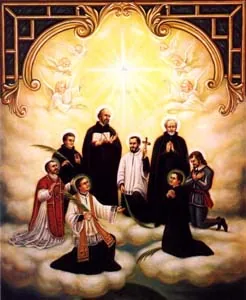
Saint Anthony Daniel (Antoine Daniel) was a French Jesuit priest, born in Dieppe in 1601 and killed on July 4, 1648, during the attack on the Huron village of Teanaustayé, in present-day Ontario, Canada. A missionary among the Huron-Wendat people for fourteen years, he was the first Jesuit of the Huron mission to die a martyr. Canonized in 1930 with the other North American Martyrs, he is honored on October 19 with Saint John de Brébeuf, Saint Isaac Jogues and their companions, and on September 26 in Canada.
Who was Saint Anthony Daniel?
Anthony Daniel is one of the eight martyrs of New France, six Jesuits and two lay helpers (called donnés) who died between 1642 and 1649. He is less famous than John de Brébeuf or Isaac Jogues, yet he is an endearing figure: a patient missionary, devoted to children, who learned the Huron language well enough to translate prayers into it, and who died protecting his people.
The account of his death comes to us from the Jesuit Relations, the yearly reports sent from the missions to France, and especially from Father Paul Ragueneau, superior of the mission, who gathered the testimony of Wendat survivors.
From Dieppe to New France
Born into a family of Dieppe, a port that looked toward the Americas, Anthony Daniel began studying law before entering the Society of Jesus at twenty. As a teacher at the college of Rouen, he met a young Native American who had been sent to France to be educated, and he prepared him for baptism. That encounter deepened his desire to go to the missions. After his theology at the Collège de Clermont in Paris, he sailed for New France in 1632.
His first posting was on Cape Breton Island, in today's Nova Scotia. The next year, in Quebec, he joined John de Brébeuf, who taught him the Huron language. In 1634 they traveled together by canoe up the St. Lawrence and the Ottawa rivers, an exhausting journey of several weeks, to the land of the Huron-Wendat, south of Georgian Bay.
Missionary among the Hurons
In Huronia, Anthony Daniel shared the life of the villages and learned their customs. With his fellow Jesuits he worked on a grammar and a dictionary of the language. He composed hymns and translated the Our Father and the Creed into Huron, and taught the children to sing them. Between 1636 and 1638 he directed a seminary for young Hurons in Quebec, then returned to the missions, which he preferred.
For ten years he served several villages, above all Teanaustayé, which the Jesuits called Saint-Joseph, one of the largest towns of the Huron confederacy. The mission went through terrible trials: epidemics brought from Europe that devastated the villages, distrust from those who blamed the "Black Robes" for them, and war with the Iroquois, which grew fiercer in the 1640s.
The good shepherd of Teanaustayé
In early July 1648, Anthony Daniel returned to Teanaustayé after a retreat at Sainte-Marie, the center of the mission. On the morning of July 4, he had just celebrated Mass when the village, left without many of its warriors, was attacked by the Iroquois. He hurriedly baptized those who asked for it, gave absolution, then urged his people to flee. To give them time to escape, he walked out of the chapel, still wearing his vestments according to some accounts, and went alone toward the attackers.
At first taken aback, the Iroquois shot him with arrows, then killed him with a musket shot. They threw his body into the burning chapel. Many Wendat were able to escape thanks to his sacrifice. Anthony Daniel was forty-seven. A year later, in March 1649, John de Brébeuf and Gabriel Lalemant were put to death in turn.
Devotion and canonization
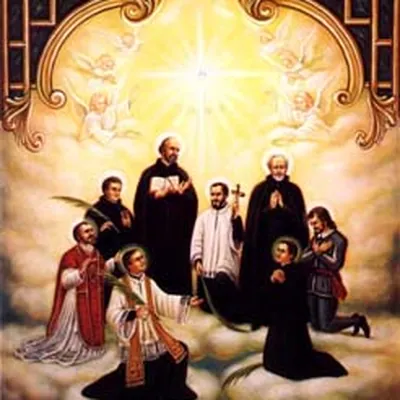
His companions immediately regarded Anthony Daniel as a martyr, and accounts relate that he appeared to Father Chaumonot. He was beatified in 1925 and canonized on June 29, 1930, by Pope Pius XI, together with John de Brébeuf, Isaac Jogues, Gabriel Lalemant, Charles Garnier, Noël Chabanel, René Goupil and John de La Lande.
The universal Church, including the United States, celebrates them on October 19. In Canada they are celebrated on September 26 and are secondary patrons of the country.
Why is Saint Anthony Daniel a patron of Canada?
With the other North American Martyrs, Anthony Daniel shares the title of secondary patron of Canada. These missionaries gave their lives in the land that would become Canada, and the Church there honors them as founders in faith. Anthony Daniel is also a natural intercessor for missionaries, catechists and teachers, for Indigenous peoples, and for all who risk their lives to protect others.
He is the image of the good shepherd who lays down his life for his sheep. He spent years learning a language, serving patiently and teaching children, and he died placing himself between his people and those who wanted to kill them. To pray with him, see the prayer to Saint Anthony Daniel and the novena to Saint Anthony Daniel.
Symbols and how to recognize Saint Anthony Daniel in art
- The black Jesuit cassock, which earned the missionaries the name "Black Robes."
- Priestly vestments and arrows, recalling his death on leaving the chapel at Teanaustayé.
- The cross, often shared with his companions in group paintings of the North American Martyrs.
- A palm, the traditional sign of martyrdom.
Where to pray to Saint Anthony Daniel
- Midland, Ontario: the Martyrs' Shrine, near the site of Sainte-Marie among the Hurons, the great place of pilgrimage for the Canadian Martyrs.
- Auriesville, New York: the National Shrine of the North American Martyrs, where all eight martyrs are honored.
- Quebec City: the Cathedral-Basilica of Notre-Dame de Québec, which keeps relics of the martyrs.
- Thetford Mines, Quebec: the parish dedicated to him.
- Dieppe, France: his hometown in Normandy.
Discover also
- Saint John de Brébeuf, his teacher in the Huron language and companion in mission.
- Saint Isaac Jogues, martyr of the same mission.
- Saint Charles Garnier, Jesuit martyred in Huronia in 1649.
- Saint Gabriel Lalemant, put to death with John de Brébeuf.
- Saint René Goupil, lay helper and first of the North American Martyrs.