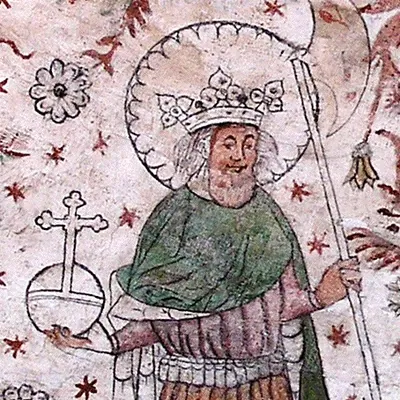
Saint Aderald was a priest from Champagne at the end of the 10th century, canon and archdeacon of Troyes. Known for his charity toward the poor and the sick, he made the pilgrimage to Jerusalem and brought back a stone from the Holy Sepulchre, for which he founded a priory near Troyes, at Samblières, present-day Villacerf. He died there in 1004. His feast day is October 20.
Who was Saint Aderald?
Aderald belongs to the generation of clerics who, around the year 1000, combined service in a cathedral, care for the poor and the longing for Jerusalem. What we know of him comes mainly from the historians of the diocese of Troyes: a Life published in 1633 by the Jesuit Étienne Binet, then the Lives of the Saints of the Diocese of Troyes by Abbé Defer, in the 19th century, which take up older traditions. These accounts are late and sometimes imprecise. Yet they draw a consistent figure: an educated priest, close to the weakest, whom the people of the region came to see in the hope of healing, and whose cult lasted until the Revolution.

A cleric of the cathedral of Troyes
Aderald was born around the middle of the 10th century. His parents, Walon and Odrade, were fervent Christians, well instructed in their faith: they entrusted him very early to religious to be educated. The young man developed a passion for Holy Scripture and the lives of the saints. He entered the service of the bishop of Troyes, Manasses, as an acolyte, that is, a cleric who assists at the altar. Little by little, this life devoted to the liturgy and to study led him toward the priesthood.
The priest of the poor and the sick
Once a priest, Aderald stood out for his attention to the weakest. Historians of charity in the Middle Ages have counted him among those who spent themselves for the poor and the sick. His reputation spread throughout the region, which embarrassed him: he did not seek fame. Yet people flocked to him, not only to receive help, but also in the hope of being healed. He became a canon of the cathedral chapter, then archdeacon, an important office that placed him alongside the bishop in governing the diocese.
The pilgrim of the Holy Sepulchre
While he was canon and archdeacon, Aderald undertook the long journey to Jerusalem, at a time when pilgrimage to the Holy Land was a rare and dangerous adventure. He came back with a fragment of stone from the Holy Sepulchre, the tomb of Christ. To shelter it and to live there in prayer, he founded a priory in a small village near Troyes, Samblières. The place soon took the name of Saint-Sépulcre, which it kept for centuries before becoming Villacerf in the 17th century. The priory later depended on the great Cluniac priory of La Charité-sur-Loire.
Aderald withdrew there and died on October 20, 1004, only a few years after the foundation. According to his wish, he was buried in the priory church.
Devotion, relics and art
Aderald's tomb was venerated for several centuries. One of his ribs was given by the prior to the chapter of the cathedral of Saint-Pierre in Troyes. When the priory church fell into ruin at the end of the 17th century, the objects of worship were moved to the parish church; his relics were in turn sheltered there at the beginning of the Revolution, in 1791. They did not escape the Terror, however: they were desecrated, and the saint's bones were thrown into a common grave.
Saint Aderald is celebrated on October 20. He is among the saints formerly invoked for the sick and those who care for them. No well-established iconography of him is known.

What can we learn from Saint Aderald?
Saint Aderald managed to hold together what sometimes seems separate: prayer and study, the government of a diocese and care for the poor, the longing for Jerusalem and rootedness in his own land. Back from the tomb of Christ, he wanted that mystery to be present close to home, so that others could pray there. You can pray to him for the sick and those who care for them, for pilgrims, for priests and for the diocese of Troyes.
Where to pray to Saint Aderald
- Villacerf (Aube): the former village of Saint-Sépulcre, where he founded his priory and died.
- Cathedral of Saint-Pierre-et-Saint-Paul in Troyes: the church where he was canon and archdeacon.
Discover also
- Saint Lupus of Troyes, the great bishop of Troyes in the 5th century.
- Saint Prudentius of Troyes, bishop of Troyes in the 9th century.
- Saint Odilo of Cluny, abbot of Cluny in the same period, around the year 1000.