All Souls' Day
In 2026, All Souls' Day falls on Monday, November 2, 2026, the day after All Saints' Day. The plenary indulgence for the dead can be gained from November 1 to 8.
- Date
- November 2, the day after All Saints' Day. Saints of November 2
- Liturgical season
- Ordinary Time
- Upcoming dates
- Monday, November 2, 2026, Tuesday, November 2, 2027, Thursday, November 2, 2028, Friday, November 2, 2029, Saturday, November 2, 2030
What is celebrated?
On November 2, the Church prays for all the faithful departed. All Saints' Day, the day before, celebrates the saints who are with God; All Souls' Day entrusts to his mercy those who have died and who may still need to be purified.
The commemoration was set on the day after All Saints by Saint Odilo, abbot of Cluny, around 998, for all the monasteries of his order. The practice then spread to the whole Church.

Traditions and customs
In France, families often decorate graves on All Saints' Day itself, a public holiday, especially with chrysanthemums. Priests may celebrate three Masses on this day, a permission granted by Benedict XV in 1915, during the Great War.
November is the month of the Holy Souls. Having a Mass offered for a loved one, praying the rosary or visiting a cemetery are the most common practices.
Saint Odilo and the origin of November 2
Praying for the dead is as old as the Church. Inscriptions in the catacombs ask peace for the departed, and Saint Monica, dying, asked her son Augustine: "Remember me at the altar of the Lord, wherever you may be" (Confessions, IX, 11).
The date of November 2 comes from the abbey of Cluny. Around the year 1000, its abbot, Saint Odilo, ordered all the monasteries of his order to celebrate, on the day after All Saints, the Office and Mass for all the faithful departed. The custom spread across the West, and Rome adopted it in the 14th century. In 1915, in the middle of the First World War, Pope Benedict XV allowed every priest to celebrate three Masses that day.
Why pray for the dead?
The Bible already records that Judas Maccabeus had a sacrifice offered for his fallen soldiers, "that they might be delivered from their sin" (2 Maccabees 12:46). The Church believes that those who die in God's friendship but are still imperfectly purified undergo a purification before entering the joy of heaven: this is what she calls purgatory (Catechism of the Catholic Church, 1030-1032).
The prayer of the living helps them. It is not a gloomy practice: it is an act of trust in God's mercy and of faithfulness to those we have loved. Jesus said to Martha, before her brother's tomb: "I am the resurrection and the life" (John 11:25).
What to do on All Souls' Day
The most traditional gesture is to have a Mass offered for a loved one. You do not buy a Mass: you make an offering to the parish, usually a modest suggested amount, and no one is turned away for lack of means. Many parishes also celebrate a Mass on November 2 where the names of those who died during the year are read, or keep a Book of the Dead open all month.
You can also visit and bless the graves, pray a decade of the Rosary at the cemetery, or light a candle. On November 2, a plenary indulgence applicable to the dead is granted to those who visit a church and pray the Our Father and the Creed; from November 1 to 8, to those who visit a cemetery and pray for the dead, under the usual conditions (confession, Communion and prayer for the Pope's intentions). The whole month of November is traditionally dedicated to the holy souls.
Prayers for the dead: Eternal Rest and De Profundis
The Eternal Rest prayer ends every prayer for the dead. The De Profundis, Psalm 130 (129), has been the prayer for the dead of the Latin Church since the Middle Ages.
Eternal rest grant unto them, O Lord,
and let perpetual light shine upon them.
May they rest in peace. Amen.
Out of the depths I cry to you, O Lord;
Lord, hear my voice.
Let your ears be attentive
to the voice of my pleading.
If you, O Lord, should mark our guilt,
Lord, who could stand?
But with you is found forgiveness,
that you may be revered.
I hope in the Lord, my soul hopes in his word;
my soul waits for the Lord
more than watchmen wait for the dawn.
O Israel, hope in the Lord,
for with the Lord there is mercy
and fullness of redemption.
It is he who will redeem Israel
from all its iniquities.
Eternal Rest: traditional prayer of the Church. De Profundis: Saintspedia translation of the Latin psalm, ended with the Eternal Rest.
Prayers, novenas and saints for this feast
- Prayer for the dead and in times of grief : the saints to invoke
- Novena to Saint Odilo : the abbot of Cluny behind November 2
- Prayer to Saint Gertrude for the dead
- Prayer to Saint Nicholas of Tolentino : patron of the holy souls
- Prayer for the dying
- All Saints' Day : November 1
Saints related to this feast
-
 January 1
Saint Odilo of Cluny
fifth abbot of Cluny, promoter of the Peace of God and founder of the commemoration of All Souls
-
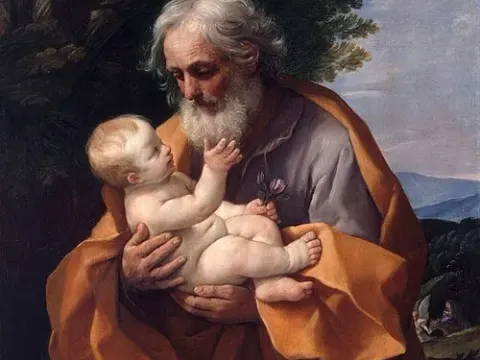 March 19
Saint Joseph
husband of the Virgin Mary, foster father of Jesus and patron of the universal Church
-
 September 10
Saint Nicholas of Tolentino
Italian friar of the Order of Hermits of Saint Augustine, preacher and confessor in Tolentino, patron of the holy souls in purgatory
-
 August 27
Saint Monica, Mother of Saint Augustine
mother of Saint Augustine, model for mothers who pray for children who have drifted from the faith
Frequently asked questions
What is the difference between All Saints' Day and All Souls' Day?
All Saints' Day, November 1, celebrates all the saints. On November 2, we pray for all the faithful departed.
Is All Souls' Day a holy day of obligation?
No. In France, only November 1 is a public holiday, which is why many families go to the cemetery on All Saints' Day.
What prayer can you say for someone who has died?
"Eternal rest grant unto him (her), O Lord, and let perpetual light shine upon him (her). May he (she) rest in peace. Amen."
What day is All Souls' Day in 2026?
Monday, November 2, 2026, the day after All Saints' Day, which falls on a Sunday this year.
How do you gain the plenary indulgence for the dead?
On November 2, by visiting a church and praying the Our Father and the Creed; from November 1 to 8, by visiting a cemetery and praying for the dead. You must also go to confession, receive Communion and pray for the Pope's intentions. The indulgence can only be applied to the dead.
What is purgatory?
In Catholic faith, it is the purification of those who die in God's friendship but are not yet fully purified. The prayers of the living, and above all the Mass, help them (Catechism, 1030-1032).
Other Christian feasts
- Easter
- Pentecost
- Ascension
- Ash Wednesday
- Palm Sunday
- Good Friday
- All Saints' Day
- Assumption
- Christmas
- Epiphany
- Candlemas
- Annunciation
- Immaculate Conception
- Corpus Christi
- Christ the King
- Holy Thursday
- Baptism of the Lord
- Divine Mercy Sunday
- Holy Trinity
- Sacred Heart of Jesus
- Transfiguration
- Exaltation of the Holy Cross
- Easter Monday
- Whit Monday
- Shrove Tuesday (Mardi Gras)
- Holy Saturday
- Nativity of the Blessed Virgin Mary
- Feast of the Holy Family
- The Visitation
- Holy Innocents