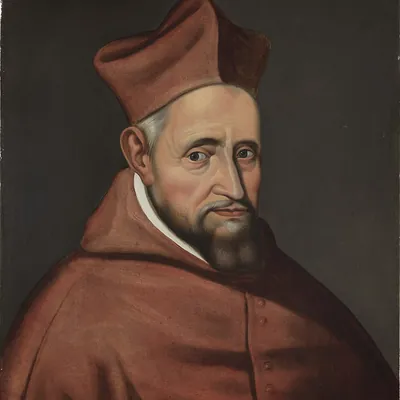
Saint Rouin (Rodingus, in Latin Chrodingus or Chraudingus) was a 7th-century monk and hermit, honored as the founder of the monastery that would become the abbey of Beaulieu-en-Argonne, in the Meuse region of eastern France. Abbot of Tholey according to the oldest texts, he is said to have brought relics of Saint Maurice to the Argonne and to have ended his days in a hermitage in the forest. His Life, written four centuries after his death, mixes memories and legends. His feast day is September 17.
Who was Saint Rouin?
The name Rouin is the popular form of a Germanic name, Chrodingus or Chraudingus, also rendered as Rodingus. He first appears in the Deeds of the Bishops of Verdun, written in the second half of the 9th century. He was probably a nobleman of Austrasia who became abbot of Tholey, in present-day Saarland, then founder of a monastery in the Argonne forest.
In the 11th century, Blessed Richard, abbot of Saint-Vanne in Verdun, wrote a Life of Rouin. He made him a monk from Ireland and enriched his account with many miracles. This Life follows the customs of medieval hagiography: it seeks to edify and to glorify the founder of an abbey more than to trace an exact biography. Even the dates remain uncertain. Still, one can recognize in it the figure of a real monk, whose memory has stayed alive throughout the Argonne.

A monk in the Argonne forest
According to the Life, Rouin left Tholey to lead a more solitary life in the Argonne. The bishop of Verdun, Paul, welcomed him into his diocese. But the forest of Vasloge belonged to a rich lord, Austresius, who lived at Autrécourt. He ordered the monks to leave; when they refused, he sent men who whipped them and drove them away. The account adds that misfortunes later struck his family.
Rouin then set out for Rome, but, according to the Life, the Holy Spirit asked him to return to the Argonne. On the way, at Resson, overcome by thirst, he planted his staff in the ground and a spring gushed out. Being poor, he found in this fountain the gold that allowed him to buy the estate and build a church there. A widow healed at Hargeville left him her inheritance. Austresius himself finally changed his attitude: he gave back the place from which he had driven him, and his sister Bona, healed by the saint, gave him her estate of Bonne.
The founder of Beaulieu
On these lands rose a monastery dedicated to the Savior, to Saint Maurice and his companions. The Life credits it with twenty-one altars, a figure that mainly shows how important the foundation had become in the eyes of the biographer. Vocations flowed in. Rouin went to Rome again to obtain approval for his foundation. On the way back, he passed through the abbey of Saint-Maurice d'Agaune, in the Valais, where he received a bone of the martyr. The Deeds of the Bishops of Verdun also keep this memory: Rouin brought relics of Saint Maurice to the monastery of Vasloge, which would become the abbey of Beaulieu-en-Argonne.
The Life also reports that King Childeric took the monastery under his protection and exempted it from all obligations. Donations, according to the account, were many.
The hermit and his death
At the end of his life, Rouin left the leadership of the monastery and withdrew, with a single companion, to a hidden place in the forest, at the foot of three hills. He continued, however, to join in the Mass. Feeling his strength fail, he sent word to the monk Stephen. The brothers hurried to him, but he refused to be carried back to the monastery. He asked for viaticum, received it on his knees, raised his hands to heaven while the monks sang, and died among them, on a September 17. The Petits Bollandistes place this death in 680.

Devotion and memory
Saint Rouin is celebrated on September 17. The site of his hermitage, northwest of the village of Beaulieu-en-Argonne, has remained a place of pilgrimage. An oratory was built there in the 17th century; between 1954 and 1961 it was replaced by a modern chapel, listed as a historic monument in 1998, which still draws pilgrims and walkers. A Saint-Rouin fountain also recalls, in the landscape, the stories of a miraculous spring linked to the saint. No fixed iconographic attribute is associated with him in the sources consulted.
What can we learn from Saint Rouin?
Behind the miracles of the Life, Rouin appears as a man who sought God in solitude and yet founded a community. Rejected, he did not respond with violence; having left, he knew how to return where he felt called. His death says what matters most: at the moment of dying, he asks for bread for the journey and turns toward heaven. You can pray to him for those who seek silence, for religious communities, and for those who must start again after a failure.
To pray with him, see the prayer to Saint Rouin and the novena to Saint Rouin.
Where to pray to Saint Rouin
- Chapel of Saint-Rouin, at Beaulieu-en-Argonne (Meuse): on the site of his hermitage, in the forest.
- Beaulieu-en-Argonne (Meuse): the village that grew up around the abbey he founded according to tradition.
Discover also
- Saint Maurice of Agaune, the martyr whose relics Rouin brought to the Argonne.
- Saint Vitonus (Vanne), bishop of Verdun, whose abbey produced the Life of Rouin.